Tag: Planning

  • Action Plan for Small Scale Planning Detailed Guide

    Action Plan for Small Scale Planning Detailed Guide

    Do you know what Action Plan is? Yes, you know what the Action Plan is. It is the process of completing any task or object on time. Do you know how Action Plans works for small scale business?

    Action Plan is a process of listing down all the task and objective of a business to analyse that which project or purpose is running late to improve their action plans to achieve their goal on time.

    So in this blog, I will discuss all the things about the action plan, which small scale businesses use to achieve their goals.

    WHAT’S IN IT

    Characteristic of Action Plan

    There are three Characteristic-

    • Timetable

    It is essential because it helps manage time and complete tasks on time.

    When the team sets a task or objective, they decide the deadline for all the employees to complete their task till at his deadline.

    This makes them not waste their time and can work efficiently in the organisation. This helps them to achieve their goal or complete their task on time.

    a time table is necessary for action plan
    • Goal-Oriented

    This is also another main point why it is so important because it is beneficial to set a timetable according to its goal.

    When the team sets a task, an action plan helps them develop the study accordingly, achieving its goal.

    This makes them not waste their time and work efficiently in the organisation. This helps them to achieve their goal or complete their task on time.

    • Clear Description

    This is also another main point why an action plan is essential because it clarifies its objective.

    When the team clears the company’s objective to the employees, they start working to achieve the goal.

    This makes them not waste their time and work efficiently in the organisation. This helps them to achieve their objective or complete their task on time.

    Process of Action Plan

    There are three steps to make it

    • Identify Tasks

    This is the first step to make the Plan. In this step, they identify all the tasks, the company’s goal, what is the current position, and what the work will in the future. So this step makes clear to all that what the objective of the company is.

    a lady identifying tasks for action plan
    • Analyse and Delegate Tasks

    After completing the first step, this is the second step in which when the team sets a task or objective, they analyse all the functions & employees and delegate the task to them according to their efficiency.

    And they decide the deadline for all the employees that everyone should complete their task on time. This makes them not waste their time and can work efficiently in the organisation.

    This helps them to achieve their goal or complete their task on time.

    • Double- Check the Action plan

    After completing the first and second steps, this is the last step in checking that the plan or task they have decided on includes everything to achieve the company’s final goal.

    If Yes, they stick to the plan, and if No, they again identify their company goals, then analyse & delegate tasks, then Double – Check their Plan.

    Importance

    • It helps the employees of the organisation to achieve their goals efficiently and effectively.
    • This helps to complete their work within a specific period.
    • It helps them to decide what to do and how to do it.
    • Top management analyses all the tasks & employees and delegates the job to them according to their efficiency.
    • This helps the organisation to measure the performance of all the employees.

    Limitations of Action Plan

    • It reduces creativity

    Once the Plan is made by top management, then all the employees blindly follow it.

    They stop giving suggestions and new ideas to the management for any changes due to change in a business environment.

    • It involves a considerable cost

    This process causes huge costs because the company has to hire experts to make the correct plan, which takes a considerable cost and time.

    There is no guarantee that the Plan they will make is always correct because of change in the business environment.

    • It is a time-consuming process
    action plan is a time consuming task

    It is a time-consuming process because experts take lots of time to execute the final plan, due to which action is delayed.

    So when the business environment changes, they have to start making a plan from the beginning, which involves lots of time.

    • It does not give any guarantee to success

    They do not give any guarantee that the plan will provide good results consistently. It is not guaranteed that the Plan that had worked successfully in the past will always work successfully in the future.

    The top management or experts must make changes in their plan regularly according to change in the business environment.

    • Lack of Accuracy

    This is another limitation of the action plan, which fails whole planning because the future is uncertain; every day, the business environment changes.

    The planning can be successful at present, but it is not confident that it will work in the future.

    Tips of Action Plan

    • We should use the visualize list while making an action plan for the company because whenever the particular action plan is completed, we can remove it from the list.
    • Every day we should record daily activities that tell us whether we are on the right path to achieve the company’s goals; if not, then start changing the action plan from time to time.
    • We should allow all the employees to give their opinions about the progress in their work. Whether there is any problem with the action plan, we can improve it and know whether there are any new ideas that we can implement to achieve the company’s goal quickly.
    • When we set tasks or objectives, we analyze all the tasks & employees and delegate them to employees according to their efficiency.
    • The top management or experts must make changes in their Plan regularly according to change in the business environment.

    Types of Action Plan

    There are three types of plans-

    • Strategic Plans- In this, the management analyses the company’s weakness and strengths and checks whether the company can survive in this competitive environment.
    • In this, Tactical Plans make the organization’s blueprint and made short-range objectives that are followed by middle and lower-level management.
    • Operational Plans- In this, they cover complete company goals and objectives, which are put in action to achieve strategic plans.

    Conclusion

    In my opinion, every company and organisation should make an action plan to achieve their goals. By following an action plan, we can analyse all the tasks & employees and delegate them to employees according to their efficiency.

    And we can decide the deadline for all the employees that everyone should complete their task on time. This makes them not waste their time and can work efficiently in the organisation.

    This helps them to achieve their goal or complete their task on time. But It is not guaranteed that the Plan that had worked successfully in the past will always work successfully in the future.

    The top management or experts must make changes in their plan regularly according to change in the business environment.

    Also, you can read our blog on What is an Action Priority Matrix?
    FAQ’s

  • Complete Guide On Agile Project Management With 12 Principles 4 Core Values 6 Steps

    Complete Guide On Agile Project Management With 12 Principles 4 Core Values 6 Steps

    Agile Project Management is a different approach to project management.

    This approach to project management allows you to make a small division of tasks making it manageable in short sprints.

    Hence, We are allowing you to be flexible and adaptive with changing demands of the project.

    So, Agile Project Management is standard in businesses related to software companies or marketing. With time across various other industries.

    Hence, This method is suitable for making changes in the process of development of the project as it is based on review and improvement cycles.

    In agile methodology, the result may be different from the predefined idea of the project.

    As there are many improvement cycles in the development process. These also help in avoiding large scale-failure.

    WHAT’S IN IT

    4 Core Values of Agile Management

    Agile Manifesto: Understanding Agile Values and Principles

    1.  Individuals and interactions over processes and tools

    Without a doubt, it can be easily understood that people are more valuable than any process or tool in any business.

    Because if any problem arises, it is less likely that the tools or process will adapt automatically to solve the problem or handle the problem.

    Instead, it is the people who will be more likely to adapt, change and tackle the problems.

    It is essential to realize that humans and technology altogether will make your business grow.

    That is why relying specifically on tools or process make you less adaptive day by day.

    2.  Working software over comprehensive documentation 

    So, It takes a lot of time and it was difficult to maintain a lot of documents even all the previous records.

    Hence, This extensive amount of data and documentation was often a burden for the developer.

    Agile project management does not necessarily focus on completely removing documentation, but instead, it focuses on streamlining it.

    It provides particular information that is necessary and optimizes the data.

    Hence, not over-burdening the developer and enabling him to work with a clear mind.

    Agile manifesto values software more than documentation.

    3.  Customer collaboration over contract negotiation

    In the negotiation process, the customer discusses the details of the project and its delivery with the project manager, in the process, aspects get renegotiated later.

    Customers often negotiate the details of any project with the project manager in great detail before the project.

    Meanwhile, With the purpose in mind to convey the message as clearly as possible.

    In agile management, the customer is active, i.e. collaborating throughout the development process of the project, making it comparatively more accessible for the project to meet customers’ expectations.

    So, You can do this if you involve your customer on a timely basis with your project in its development phase.

    Whether internal or external customer, you can involve them in making the product better and more useful. 

    4.  Responding to change over following a plan

    For instance, In a traditional project, management changes are considered bad for the business.

    Because it was a considerable expense, and with this in mind, You can change by avoiding them.

    In an agile project, management changes are not seen as an expense and instead considered as a necessity to improve the product with time for being more useful and valuable.

    Hence In the agile manifesto, the project is broken down into small sprints.

    To review simultaneously, and necessary changes are built along the process.

    So, This facilitates constant improvement and changes, making it more useful, as features can be added to every sprint, avoiding any large-scale mistake or expensive modifications.

    12 Principles of management methodology

    Basic Business Principles

    Hence, These 12 principles of agile management methodology will act as your guide in your decision making.

    In brief, these 12 principles will help in forming a culture that is primarily focused on welcoming changes and by all means, keeps the customer in the focus.

    Following are the 12 principles of agile project management:

    Customer satisfaction-early and continuous software delivery 

    Our highest priority is to meet the satisfaction and needs of the customer by early and timely delivery on software or anything you deliver.

    Customers are happy and satisfied when they get their products regularly and timely. They don’t like to wait for a very long time.

    Accommodate changing requirements throughout the development process 

    This simply refers to the culture of welcoming changes when it is needed or demanded by the customer.

    And the ability to deliver the demanded changes without any delay in time gives a better competitive edge and trustworthiness.

    Frequent delivery of working software 

    This principle focuses on software development projects with a system to deliver regular and frequent delivery of software varying from a couple of weeks to a couple of months.

    Collaboration between the businesses and developers throughout the project 

    Often there are better results when businesses and technical developers work together in collaboration.

    Coordinating teams should work together through the process for better outcomes and a higher level of satisfaction.

    Support, trust, and motivate the people involved 

    Without a doubt, it is a well-known fact that motivated individuals and the team will come up with much better ideas and solutions when compared to any individual or group that is not motivated or unhappy.

    This is why it is essential to provide the teams with a proper environment and give the necessary boost so that they give their best.

    Enable face-to-face interactions

    The most effective and efficient way of communication is face to face communication as your tone only plays a 7% role in communication.

    This is why it is essential to communicate face to face with your team to explain better and avoid misunderstanding.

    The end working product is the primary measure of progress.

    Your progress is primarily measured based on your delivery of the final product to the customer.

    And, whether it can meet the customer, needs, and satisfaction with all the features and changes that the customer demands.

    Agile processes to maintain a consistent development speed

    The agile process simply means that the teams maintain a constant speed to keep up with the changing needs and demands of the customer.

    And the market and continuously improving and delivering the better version of their product on a timely and regular basis.

    Technical detail and design enhance agility. 

    Another critical point is that monitoring and maintaining proper technical details and focus on design enables easier integration and acceptance of any change in the product.

    Thus, making the product more useful and helpful.

    Simplicity

    This means that you need to focus on developing those features that are enough to get the work done, do not overemphasize on extra unnecessary features.

    Most often, customers don’t even use those extra features that you spend the most amount of time and resources in developing.

    Self-organizing teams encourage great architectures and designs. 

    Self-organizing teams those who take ownership of their work and are motivated to work better and communicate properly.

    And regularly always deliver better quality products or results comparatively.

    A regular process on how to become more effective 

    Self-improvement and regular improvements in processes of development and other crucial areas lead to better efficiency and growth in every field of project management.

    6 steps in the Agile Management Methodology?

    1. Project planning

    Similar to any other project, before starting any project, it is very crucial that

    you and your team correctly understand the impact and value of the project on the business or end consumer.

    As well as remember that you are adopting agile project management methodology.

    This means that you must be able to address and welcome any change in the development process and easily modify it. 

    The results in agile methodology may be very different from the planned result at the beginning of the project.

    2. Creating a product road map

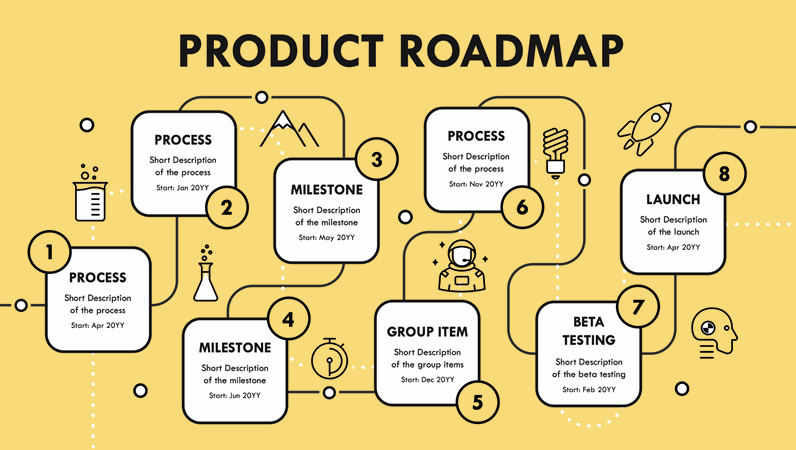
    Product roadmap timeline

    This is the proper breakdown of all the planned and demanded features that you are required to deliver in the result to your client.

    You will develop these features systematically and step-by-step in each sprint of work and simultaneously develop a backlog, i.e. a list of all the features that are to be delivered in the final product.

    3.  Release planning

    Unlike traditional waterfall project management in agile methodology.

    The project is developed by short working cycles known as sprints, and at the end of each period, there is a separate featured release.

    4.  Sprint planning

    Before starting any spring, the project manager needs to conduct a spring planning.

    To determine what will be accomplished in each spring and what tasks are to done y whom and when.

    5.  Daily stand-ups

    You hold these short daily stand-up meetings which do not extend more than 15 minutes.

    These are managed by standing up to keep it brief and short.

    These meetings will be conducted daily to summarize what they have accomplished the day before, and what are their today’s goals.

    After that, you should not extend it to a problem-solving session.

    6.  Sprint review 

    To improve the product and better meet customer needs and satisfaction at the end of each sprint, conduct a meeting with your client.

    Discuss three main questions with your clients 

    • What went well?
    • Secondly, what went wrong?
    • Finally, what could be better?

    This enables your team to understand the clients and requirements better and strengthen the relations between them.

    Conclusion 

    Here I have discussed with what is Agile Project Management and who uses it and how it is beneficial.

    Also, what are the four core values of Agile Project Management that will act as your guild in decision making in your project management?

    I have also talked about the 12 principles of agile methodology and 6 steps that are adopted in this method of project management.

    Also you can read our blog on A Step-By-Step Guide To Learn About Project Management, Top 15 Skills You Need To Master.

    FAQ’s

  • Why Succession Planning Is Important In the 21st Century

    Why Succession Planning Is Important In the 21st Century

    When we discuss succession planning, it is a company model where they identify the quality talents in their work and increment the position from employee to manager to supervisor level and extend the job to the highest level in the company.

    So that company or an organization will develop future leaders to increase their position level and grow their business in minimum time. While those leaders have left the space should reuse the position by the model succession planning level from employee level to a supervisor level.

    In this model is introduced in an organization because those who are concerned about the person of their business/company will retire some days. Also, they want their business to grow efficiently with the help of this model.

    A successor who handles management processes will help motivate their employees, save extra cost and time. While other management firms will charge more for all this process. 

    So there is a management person position named HR (Human Resource) who plays an important role in this process. They decide which employee will increase the position level according to the dedication implemented in work. 

    HR checks the right employee to give a better position level with the skills, capabilities, and experiences in the same place at the right time.

    WHAT’S IN IT 

    Succession Planning Process

    7 Steps to Successful Succession Planning | Robert Half

    We know that every model has a flowchart which works according to some techniques and aspects. Hence, the succession planning model also has a process to successfully work for future basis. It helps older leaders can be replaced by the new leader which is promoted from the employee or any other position to a higher level.

    So here are the five succession planning process which you can also apply in your business model: –

    Identify the candidate position

    • It means let’s take an example that you are running a company of 100 team members. Now you have a vacancy in a team leader position where they have to manage a team of 10 members.
    • Now you have to identify the candidate from the team who can handle the team. Also, have to check their leadership skills. So that their operational activities and strategies can manage a team. 
    • Because if they lead a group properly, they can level up their position with managers and so on. So now the next process is for choosing the people.

    Selection candidate according to a criteria

    • Now you know there will be criteria to select those candidates/members, who complete that rules, like proficient skills, ability and experience in that field. That team member will go for the next round which will be assessed for that position.

    Assess the member & compete with a current team leader position

    • So when the selected people are going for next have to compete with the older leader position level with skills and discuss plans and interest of the company with the member who will assess that position.
    • Now for that assessment, HR management will give training and development processes to identify their potential for particular situations. 
    • If new members compete with the current leader with their skills and potential, then HR management can replace the position with those candidates.

    Provide Succession strategies to Successor who gets the position

    • When the candidate gets a higher position in the company. That member should get all strategies knowledge, training, experience and many more so that he practically implements the strategies with their team. And provides more productivity in their level.

    Develop Members for advance position achievement

    • Because of selected person gets increment their position. Those who are chosen not to have the time to fulfil the potential, learn from the leaders about the knowledge related to your work, skills and many more 
    • Not selected members will again try and achieve all the criteria while competing with current position members to gain more experience and expertise and capability of battling others.

    That why succession planning is very important for crucial to develop every candidate and assess the position on a future basis 

    Benefits of Succession Planning

    4 Benefits of Using an Instant Cash Advance (Plus, Other Fast Financing)
    • Success-proof to your business
    • Identify qualified candidates for future promotion
    • Developing qualified candidates to fill critical positions.
    • Company has an opportunity to share the strategies with higher position candidates to work more productivity for growing a company.

    Needs for Succession Planning

    This model has some needs to fulfil for the company to perform better. Now why this model applies in big organizations? It is because it helps to increase the turnover rates and how they do higher turnovers in minimum time.

    Because of this model, it always increases the pace of work very fast with smart work. It has thousands of strategies which are rotationally apprised in the company when the strategies level decrease its performance.

    Here the employee’s position is also replaced in minimum time, and which is unfair it’s true. Still, they think to increments the companies growth. Those who are replaced by another candidate can grow the company productivity with better pace, which decreased by the older employee.

    Advantages of Succession Planning 

    • Selection of employees are continuously training the work process and develop the ability skills
    • Retention due to knowledge of business experience or practice
    • Any employee can compete in that position and are capable of that position to scale the company

    Disadvantages of Succession Planning 

    Disadvantage Text Stock Illustrations – 218 Disadvantage Text Stock  Illustrations, Vectors & Clipart - Dreamstime
    • Negative effect will impact on those candidates who did not get chances. This is because of some criteria and has good ideas to grow the company level.
    • Rivalries in the company just for the position the hate will spread are easier than positivity.

    7 Examples of Succession Planning

    • Identify the candidate position
    • Check the skills. According to their strength, give them the position work in the company to do the right productivity.
    • Work Design
    • Every member of this company has some criteria to assess in the company. For example skills, talents, leadership, team relationships and many more.
    • Test the competency level for future career plans
    • Take the interview rounds and test the competence with the leaders for next position promotion.
    • Test the performance for handling position
    • Take a one-month practical work in the company and check the performance for development. 
    • Identify career goals of a candidate in the company
    • Check the candidates scope of work that they want to grow their work experience for the long term and are capable of incremental positions.
    • Check the leadership qualities
    • If the candidate is competent and has leadership qualities to handle the situation, then the company provides leadership management where they teach all strategies and skill future roles.
    • Work rotation to get an idea in every field
    • Now those who apply this model have the advantage and disadvantage at the same time.
    • Like if you fight all the leaders, then the company promotes the level of position and have some hopes that you will do more turnovers in this company, but one mistake in your strategies fails. Another candidate gets success in their flowchart; then they will rotate your position with a new leader.

    Conclusion

    So as per explaining all the factors of succession planning, I will give my personal opinion on this model and my knowledge base, the model is very important in the company. 

    Now from the maturing workforce and retiring senior leaders, the model includes the need for knowledge, skills, a judgement of their work productivity and then the top leaders can retire from the post. 

    The second point of model needs is candidates have a connection with team members in their organization and also have to build up their leadership skills for promoting the post. 

    As we know, there are vacancies in higher positions. So Human Resource Management (HRM) has to find out the candidate who can guide the corporate office for future situations and conditions. 

    So here is the conclusion in this model, the senior leader who doesn’t want to lose their position has to develop and train their skill up to date with new strategies so that you will never be replaceable with any of the employees and the organization should not have any doubt in your work productivity.

    Also You can Read our Blog on 6 Ways To Recruit the best candidate for your group

    FAQ’s