Tag: goal setting

  • SMART Goals – How to Make Your Goals Achievable

    SMART Goals – How to Make Your Goals Achievable

    You take a flight but you don’t know where to go, did you get into any destination? You write a letter and post on post office without mentioning the address, did that letter ever sent to anybody? Goal setting is the same as that. Many people set goals but they don’t set clarity of goals. They don’t set the destination of goals. A goal without any plan is just a desire or dream. SMART goals is the tool of setting achievable goals whether it is personal or professional.

    We continuously make an effort to achieve but we can’t. We face a lot of problems while achieving the goals. This is because your technique of goal setting is faulty. Here we are going to discuss the SMART goals which help you to make your goals achievable.

    WHAT’S IN IT

    Introduction to SMART goals

    Different organizations as well as individuals want to make their goals achievable. There is the process of setting the goal in an appropriate way so that we can achieve them. SMART goals is one of the tools or techniques which various organizations use. This technique helps you to attain and track your goals. You can verify at every point if what you are doing will get the desired results. SMART goal technique is also widely accepted by the goal setting theory by Edwin Locke.

    What SMART goals stand for

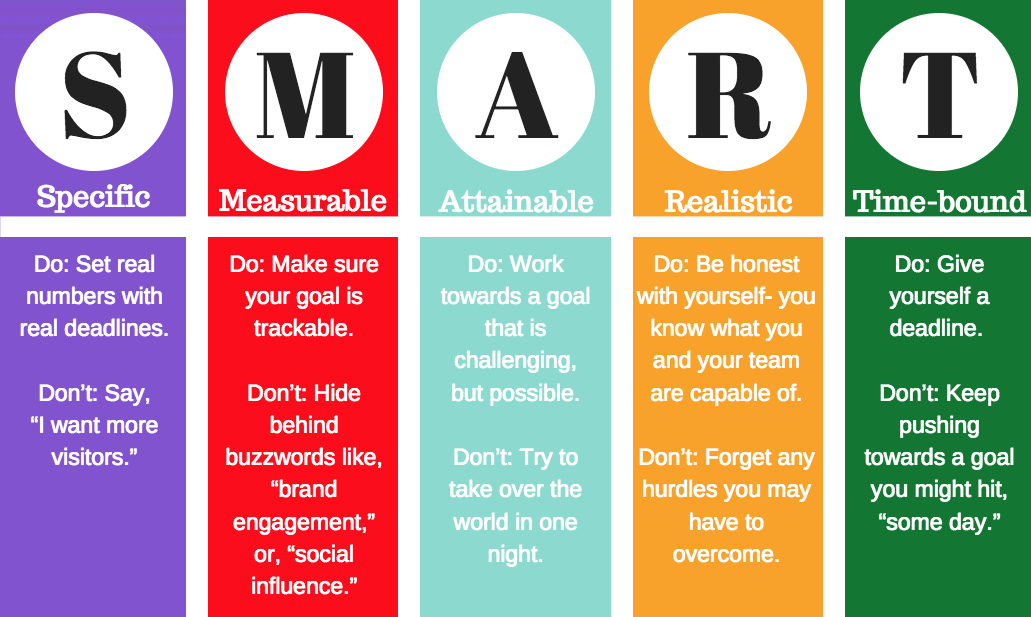
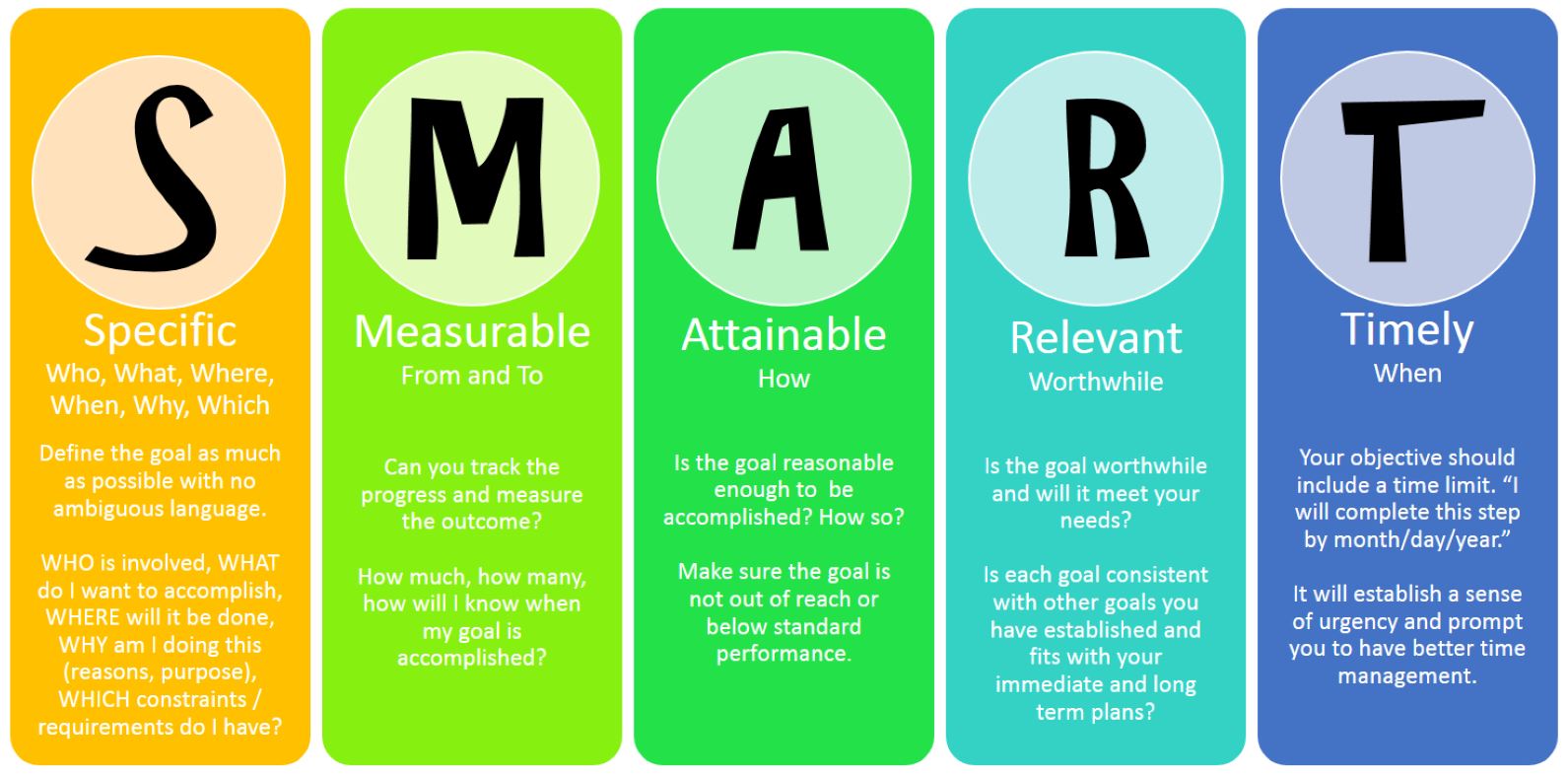
    SMART goals is the analogy which indicates five characteristics of any goal. SMART stands for these things.
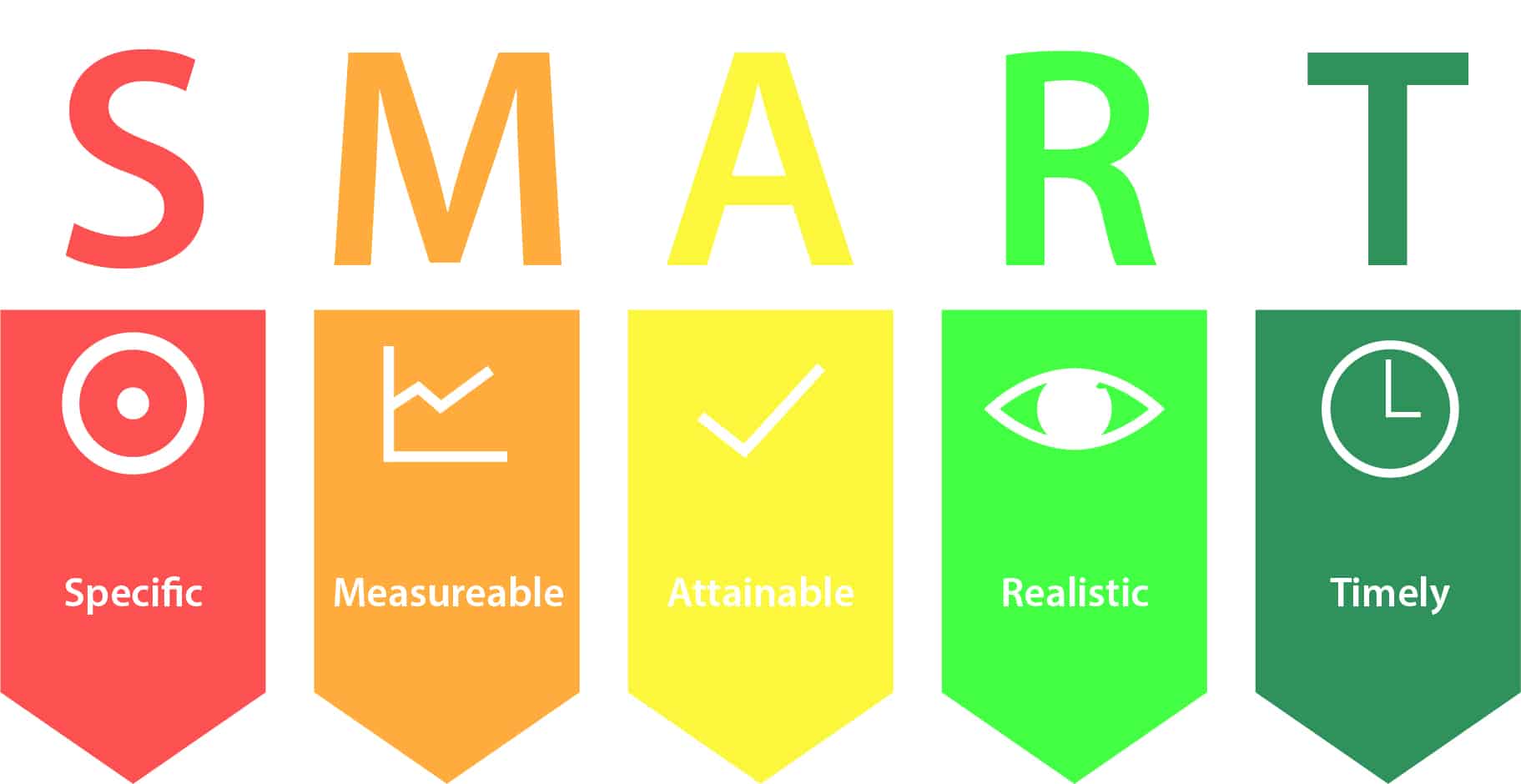
    Image result for smart goals

    S = Specific

    M = Measurable

    A = Achievable

    R = Realistic/ Relevant

    T = Time-bound

    Specific

    THe first character of SMART goal is specific. It says that the goal should be specific. We may have set many goals but are they really specific goals?

    A specific goal is that goal which gives you the clarity of your goals. If you know everything about your goals then that becomes your specific goals.You should ask the question with how, what, where, when etc regarding your goals. If you have all the answers then it becomes your specific goal.

    For example: if you want to become millionaire then to make your goal specific ask yourself yourself these questions:

    What are you going to do to achieve this goal? How much time will it take you to do that? In what age do you want to achieve that goal?

    So, finally you can set goals like “I am going to be a millionaire at the age of 25 with my business”. This is how you can set the goal.

    Measurable

    SMART goals suggest that the goal should be measurable. If you set the goal in which you cannot measure the progress you have made then that goal will never be achieved. You should know how much you have achieved and how much you have remained to achieve. You should break your goals into measurable units so that you can easily complete them.

    For the example of measurable goals, if you set the goal like “I want to lose my weight”. In this goal you cannot measure the progress of losing your weight. But if you set like “ I have to lose 10 kg in 3 months” then the progress can become measurable. Infact, you can break it down such as how much you have to lose in one week to achieve that goal in a specific time.

    Achievable

    The third analogy of SMART goals setting is the achievable goals. Every year many people set new year's resolutions but most of them fail to achieve at the end of the year. It is because they set goals which are very difficult to achieve. Research shows that we will get motivation to do any works only if we have chance to complete them. If you didn’t see any proof of achieve in life then you’ll demotivate to do that work.

    So, before setting any goals check whether that goal is achievable to you for now or not. If not then please do not set that goal because that goal will not give you success rather it can put you in the mental burden. For example, if you set the goal to be a billionaire in one year, then it is technically not possible to do so. If you set this type of goal then your goal become unachievable.

    Relevant/Realistic

    The other important character that SMART goals setting suggests to us is the relevance of your goals.Your goal should be relevant to yourself. Suppose you are very good at drawing but your parents force you to become an engineer and you set the goal to become an engineer. Is that a relevant goal for you? And are you going to achieve it? Obviously it is not a relevant goal for you. Your goal should be something related that makes you motivated to work.

    Another meaning of R is realistic. You set a goal which is completely unrealistic and you dream to achieve it. This is the foolish thing. You can only achieve the realistic and practical goal. So, check before setting the goal that whether your goal is relevant to yourself or whether your goal is realistic or not?

    Time-bound

    Image result for Time-bound

    The other character that the goal should have is time boundness in goal. Every goal should have some deadline to achieve it. Goals which are bounded on time have more possibilities to be successful rather than which are not bound by the time.

    Time adds value to the goal. Suppose you want to lose your weight but you haven’t set any time to achieve that goal. Now, you don’t have the measure of how much you have to lose and in how much time. Ultimately, you are not going to do any of the effort to achieve that particular goal.

    So while setting a goal you must set using the SMART goals setting process and give a certain deadline to any of your goals. Because if you set the time limit then your mind will motivate you to do more work. To complete the task in time you can set the reward, if you complete the task in time.

    These are some the five characters which you should follow while setting the goals. If you set the goals using the SMART goals setting model then the probability of achieving the goal will be increased.

    Tip to make smart goals

    Here are some of the tips for the SMART goals setting.

    Think about Big picture

    Always think about the end goal. Many times when we put any goal we take action for sometime but eventually we don’t continue them. But we should focus on the result, what we are going to achieve at the end of the day. So always think about the result which is big in the process. It will help you to stay focused. Break goals into smaller action plans.

    Once you think about the big picture, you break down your goals into smaller actions. This will help you to know how measurable and attainable your goals are. Also this will provide you momentum to execute your goals in the right direction.

    Write them down

    Goal setting is not wishful thinking. You should write your goals systematically. It will help you to go from one point to another smoothly. If you write the goals then you can have a plan of how to execute the goals IT will help you to take you to your desired result more effectively.

    Track the progress

    Image result for Track the progress

    You need to track the progress on some period of time. You have to review your goals. If your goal is a team goal then you should organize a weekly base meeting to discuss the target. If you have achieved some of the achievement then praise it, reward yourself. But if you have left something then try to improve on that. Basically , give and take feedback from the tips.

    If you are setting a goal for yourself then also track your goal progress. Check how much you have completed, how much you have to complete. Give proper feedback to yourself.

    Conclusion

    SMART goals setting is a method to take one step closer to your goals. The five characters in the SMART goals setting process give you the clarity to work towards your goals. Breaking your goals into smaller actions making them attainable is necessary to achieve the goals. At ast, if you succeed in your goals then don’t forget to celebrate that goal and give reward to yourself. This will motivate them to achieve more goals like these.

    Also you can read our blog on File Management- Managing Electronic Files Organizing & Computer Files


    FAQ’s

  • Locke’s Goal-Setting Theory: Setting Meaningful and Challenging Goals

    Locke’s Goal-Setting Theory: Setting Meaningful and Challenging Goals

    Locke’s goal-setting setting theory is a research-based theory that was introduced by Edwin Locke in mid-1960. Locke created and refined his objective setting theory during the 1960s, distributing his first article regarding the matter, “Toward a Theory of Task Motivation and Incentives” in 1968.

    So, Locke’s goal-setting theory provides the blueprint to make setting meaningful and challenging goals which you can achieve. He has done years of research to demonstrate what types of goals are more achievable and how we should set meaningful goals.

    Locke’s goal-setting theory is useful for personal as well as professional goal-setting processes. So here we are going to learn about Locke’s goal-setting theory.

    WHAT’S IN IT

    Brief Introduction

    Meanwhile, Locke’s goal-setting theory states that the goal setting is directly linked to task

    performance. It means that if we have clarity in goals then we can have enough motivation to

    achieve those goals.

    Likewise, it includes that particular and challenging goal alongside appropriate feedback

    leads to higher and better exhibitions. So, If you are a manager of the company and you want

    to set a goal for your employee for growth of the company then you should clearly mention

    how much time and how much growth you want from them. For eg, 15% growth next year.

    This is specific and also challenging.

    Why Goal Setting Improves Performance

    Image result for Goal Setting

    Also, According to Locke’s goal-setting theory, there are some reasons behind why goal setting improves the performance of the individual as well as organization. So, It has clearly seen that companies and individuals who have some set of meaningful goals are more productive and successful. Meanwhile, Good goal setting helps to improve performance. Some of the reasons why goal nesting improves performance are given here.

    1. Meaningful Goals attract attention and keep us away from distraction

    Meanwhile, Proper goal setting attracts our attention toward our goals and keeps us away from all those distractions which may distract us from the goal. Hence, Goals give us the feeling of responsibility to do work for something we want to get. For example, if you want to achieve A+ in an exam then you may be distracted by other extracurricular activities like playing games, watching movies etc. But if you set the goal then you cannot distract yourself rather your goal attracts you to achieve that.

    2. Goals Energies Us and Push to Work Harder

    So, The goals are associated with any reward. If you get good marks in exams you get a reward. If you do a good performance in your job then also you can get a reward. So with the completion of a goal, there is a feeling of achievement. Meanwhile, Locke’s goal-setting the theory says that if we work harder we can achieve that reward. Also, Goals energize us and push us to work harder so that we can achieve the reward which we want from that goal.

    3. Helps to Discover New Innovative Way for Accomplishment

    So, If we set the goals, I already said that it will motivate and energize us to achieve them. So, during the process of achieving the goals, many obstacles and problems can arise. So, Locke’s goal-setting theory says that, if you have a proper goal setting process then you fight with those obstacles to achieve your goal and to overcome those obstacles you will search for new innovative ways.

    4. Makes aware of your potential

    We all have the potential to achieve something but many of us haven’t discovered yet. Hence, If we set the goal and achieve them then it will give us the confidence to set more challenging goals. So, It will show us the real potential of what we can achieve. If we discover what our real potential is then we can achieve as many goals as we want to achieve, which helps to improve our performance.

    5 principles of Goal Setting

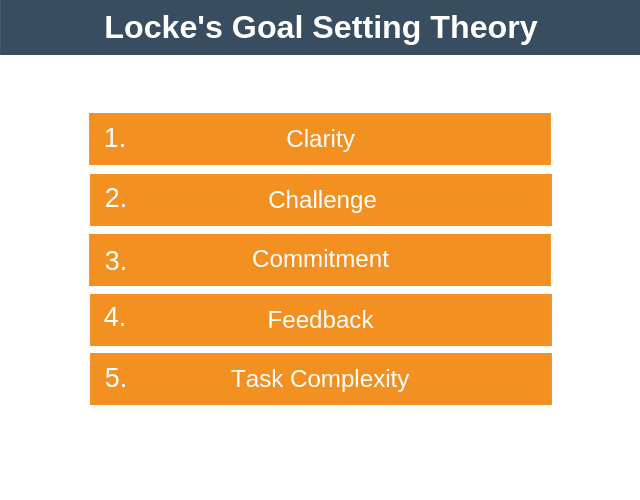
    Hence, In Locke’s theory of goal setting, he has delivered five principles of goal setting. So, He has done research on why goal setting works so well on some people and not so much for others so that he can optimize the goal-setting process for everyone. Hence, According to him, we should use these five principles before setting any goals. Further, I mean to say that good and achievable goals must have these qualities on them. The five principles that he has discovered in his theory are:

    • Clarity in goals
    • Challenging goals
    • Commitment in goals
    • Proper feedback
    • Task complexity
    Image result for 1. Clarity in goals:

    1. Clarity in goals:

    Loke’s theory of goal setting suggests that to make our goal achievable we should make them clear. So, Many people set the goal to lose weight. But this kind of goal will never be achieved because we cannot measure the progress of goals. So, The goal should be clear and specific. If you want to make a goal regarding weight loss then set the goal like “ I will lose 30KG in 1 year”.

    Hence, In this type of goal, you can see the clear path of what you have to do to achieve that goal. Here are some tips to make your goal clear.

    1. So, Use SMART mnemonic to set the goals. SMART stand for:

    ● Specific: Goal should clearly tell you what, why and how you ctually want to achieve.

    ● Measurable: Hence, You must be able to measure your goals. How much they have been achieved and how much is left to be achieved.

    ● Achievable: Some set the goals which need too much effort to work on them. So, Those not achievable goals. Those goals only made you suffer. So avoid those goals rather you should set the goals whose you can clearly see the results.

    ● Relevant: So, Goals should be relevant. If you are setting goals for any organization then you should also be aware of how your goals are valuable for the organization.

    ● Time-Bound: Hence, Your goal should have a specific deadline for the completion of the goal. For eg, six months, one year, two years etc.

    2. Make a proper plan on how you are going to achieve them.

    3. Ensure you will measure your goals in a particular period of time.

    2. Challenging Goals

    Locke’s goal-setting theory states that more the challenging theory the chances of achieving them is also high. Compared to mediocre goals, challenging goals are more motivating. So, Here challenging goals doesn’t mean not achievable goals. So, We already discussed that according to SMART technique we should always set achievable goals. Challenging goals are those goals which give you more motivation and dedication to achieve them not those which completely wipe you down.

    How to set challenging goals?

    ● Ask genuinely yourself what your goal is too much easier or too simple to achieve?If yes then make sure you should set little more challenging goals but don’t make it enough challenging.

    ● If the goal is a group goal then set up a competition type of thing among the team members and also set any reward. This motivates every team member to push their limit further and do more challenges.

    ● Think about the potential obstacles and problems of having the capacity to wipe you out from your journey and plan how you are going to push through these problems.

    3. Commitment to goals

    To motivate yourself and to achieve goals you must be committed to your goals. Make sure you will make those goals in which you are committed to achieving those goals.

    If you are setting goals for the team then you and every member of your team should agree on that goal if not then you have to make them agree and commit.

    For eg. committed goals, if you make a team to achieve some goal and you put all the work pressure on your team then it will not be the committed goal but if you and your team member equally work then it is a committed goal. That’s what Locke’s goal-setting theory said about a commitment to goals.

    How to be committed to goals?

    ● Keep yourself in the path by visualizing what your goal means to you if you achieve it.

    ● Make sure goals are sensible and realistic so that your team members agree with the goal.

    4 Proper Feedback

    Image result for Proper Feedback

    Locke’s theory of goal setting states that if you provide good feedback to your goal then it will increase the motivation to achieve the goal. If you are working in a team then in a certain period of time you should give feedback which can help to gauge your progress. The feedback should be regular and both the negative and positive feedback are welcomed.

    If there is any negative feedback then try to improve on that. How to give/ receive feedback properly?

    ● If you are working in a team then organise the meeting on a weekly basis and discuss the goal and receive and give feedback

    ● Develop confidence to ask others for their feedback. Ask like, “How am I doing this?”

    ● Self-generated feedback mechanism must be designed. There are different apps and software to do so. For eg, Strides.

    5 Task complicity

    Task complicity is also one of the greater factors of goal setting. If the goal is too complex then it will be difficult to achieve, Highly complicated tasks demotivate and wipe you out from the journey of achieving meaningful goals. So it is necessary to make tasks simple and non complex, according to Lock’s goal-setting theory.

    Tips on task complicity

    ● Make sure you enjoy your goals. If you are getting stress from your goal then reconsider about it

    ● If you set any complex task then provide it more time than others task

    Involvement of Employee in Goal setting: What theory said

    According to Locke’s theory of goal setting, the involvement of employees has mixed results. It

    has both positive and negative impacts.

    ❏ The Negative Side: If an employee is involved in goal setting then employees try to set

    less challenging goals which eventually affect the performance of the organization

    ❏ The positive side: If employees are involved in goal setting, then it is easier for

    management to get goals accepted as employees are participating in the process of

    goal setting.

    Locke finds out that Locke’s goals setting theory is culturally bound. This means it doesn’t

    work in every country and culture in the world. It was developed and adapted in the country

    like the USA and Canada where people are independent and seek challenging goals to grow.

    It may not work in those countries where people are interdependent and they try to skip challenging goals and look for shortcuts.

    Conclusion

    Locke’s goals setting theory believes that if you set challenging goals and also provide

    proper feedback then the motivation to complete your goals will be increased. For that, he

    suggests we should make our goals clear using the SMART rule. SMART goals help to avoid

    those mistakes which can become an obstacle in your goal setting. Further theory suggests

    the goals must have five principles which we have already discussed before.

    Also you can read our blog on File Management- Managing Electronic Files Organizing & Computer Files
    FAQ’s

  • Eight Common Goal-Setting Mistakes

    Eight Common Goal-Setting Mistakes

    Our goals give us a clear idea of where we want to be in the future. A good goal-setting helps us to improve in our ability and potential to get what we are capable of. Many people set their goals but they barely achieve them. Most of the people quit.

    The reason they can’t pursue their goals is they are not setting their goal appropriately. They make many goal-setting mistakes. If you set the goal in the wrong way you cannot achieve it.

    In fact, it becomes a burden for you. That’s why we should avoid making goal setting mistakes. Here I am going to share with you some of the mistakes that people make while setting the goal. If you want to make your goal achievable then you have to avoid these mistakes.

    WHAT’S IN IT

    1. Not having a long term vision

    Image result for Not having a long term vision

    The first goal-setting mistake which people do is not having a long term vision of yours. It is important to have a vision with you before setting goals. A vision is something that you want in the future. For example, you want to be a millionaire in future then this is your vision.

    Having a vision gives you a clear idea about what to set a goal for. Most people never think that what they want ultimately in the future. They often think about the present. They focus on the goal for one or two years. For eg. they are in college then they set a goal only to pass the college with good grades. But they don’t think about why they have to pass college.

    After passing college, will this college graduation help their vision? So, before you set the goal to decide your vision. Get a clear idea about your future, what you want to be. Maybe you want to become a businessman or doctor or engineer or whatever but decide. Then, you set a goal which helps you to achieve your ultimate future. If you set the goal in this way then it has more probability to get success.

    2. Set Unrealistic Goals

    Another goal setting mistake that people do is that they set an unrealistic goal. You should have your goal realistic. Obviously, we can have a vision which seems to be unrealistic for now and we already discussed how important it is to have a vision.

    To make a goal realistic you can do an exercise. You can rank your goal in between 1 to 10. You can rank according to how much you motivated, dedicated to achieving that goal. For eg; your goal is to earn one million dollars a year; if you think this goal is in the rank of more than 7 then this is your realistic goal which you can achieve but if you give it less than 7 then you are in doubt that you maybe cannot achieve this goal so this is not your realistic goal.

    If we set the goal realistic and we make it achieve then our brain releases endorphins which give us pleasure as well as motivates us to achieve further goals. Although we can have a realistic vision, we should also have realistic milestones.

    3. Don’t know the reason for achieving that goal

    Image result for Don’t know the reason for achieving that goal

    Another reason why people often fail to achieve their goal is that they don’t have an actual big reason to achieve them. For eg: if you want to graduate from college and that’s your goal but you don’t know why you want to graduate.

    Having a strong reason to achieve a goal is very important. In the progress of achieving the goal, you may find lots of obstacles. Those obstacles may pull you back and ultimately you cannot achieve that goal. This is the problem by which most people quit in the middle.

    If you are running toward the goal without any reason then it is like going toward a dark void. But if you have a good reason to achieve that goal then that reason can give you motivation, strength and capability to fight against those obstacles. So this is another goal setting mistake you should avoid to achieve your goal.

    4. Not have a plan

    Another goal setting mistake that people do is that they don’t plan how to work on your goal. Planning is important. Planning gives you the idea of how to execute your work and also gives your ideas on how to deal with problems occurring during your work toward the goal. How to make a plan? you can do various things like making a to-do list. Make a to-do list and find out what to do on a particular day, week and year.

    Manage your morning to make a to-do list because that time your brain will be more active… Another thing you can do is you can also make a could-do list. In this list, you write all the things that you can do to achieve that goal. For eg: if you want to lose your weight then you can make a list where you write all those things that you could do like you could dieting; you could join the gym etc. From your could-do list, you can choose the most important things that you can do using the 80/20 principle and you can apply to your to-do list. This is how you make a plan and avoid another goal setting mistake.

    5. Don’t take action

    Image result for Don’t take action

    Remember setting a goal is easy but taking action on them is the most difficult part. Not taking an action is another big goal setting mistake that people do. Most people take New Year’s resolutions but they rarely achieve at the end of the year. It is because the goal the setting is a way but continuously work on them is hard,

    So, it is necessary to take action on our personal and professional goals. We should have daily rituals regarding our goals and we have to follow them regularly. Also, we should evaluate our progress on a daily basis. weekly, monthly, quarterly and yearly basis.

    If we have achieved a comprehensive goal then we have to reward ourselves but if we are not progressing anything then we should punish ourselves and we should make sure we will achieve more in next time.

    6. Clashing with your personality and morals

    Our ethics and identity should always be better when we are setting our goals. Another goal setting mistake that people do is they don’t care about their morals and aesthetics.

    If we set the goals which are violating our morals then those goals are never gonna make us happy. If you give a value to something then you should also set your goals which value that thing also. For eg., If you value honesty then you should not set your goals which give importance to dishonesty. If you set those goals then first of all those goals are never going to be achieved and also if those somehow got achieved that goals never gonna give you that

    much happiness in your life. So it will be better not to make this goal-setting mistake.

    7. Set multiple goals at the same time

    Image result for Set multiple goals at the same time

    If you run toward the two butterflies then you cannot even catch one, similarly, if you run

    toward the multiple goals at the same time you cannot achieve any of them. But many

    people make the same goal-setting mistake. They set multiple goals at the same time and

    they end up getting nothing.

    We should focus on some goal at a time. We have limited willpower and if we spend this

    willpower irrationally then it is just the loss of willpower. So, first of all, we have to set one

    primary goal which is most important for your vision then after we achieve them.

    8. Share Goals with others before they are achieved

    You may be thinking that how can be sharing goals with others before achieving be the

    mistake on goal setting. But it is truly a goal-setting mistake you should not make while

    setting a goal.

    It is found in the research that if you tell your goals to others then your brain feels like it has

    already accomplished that goal. Our brain releases dopamine hormone which gives us the

    feeling of happiness and accomplishment which ultimately stops us from working on our

    goals and we can never achieve them.

    Hence, you should also care about this goal-setting mistake while you are working on your

    goal.

    Conclusion

    The goal-setting process is not a very tough process though working on goals is very

    important and quite difficult also. During the goal-setting process and achieving, many

    people make some goal setting mistakes which we should not do. If you don’t repeat the goal

    setting mistake process then you can also achieve your goals.

    Finally, if you find some of the other goal-setting mistakes which we should not do then

    please mention them in the comment section. It will be helpful for all those people who want

    to achieve their desired goal.

    Also you can read our blog on The Flow Psychology Model – Balancing Challenge and Skills

    FAQ’s

  • How good is your goal setting?

    How good is your goal setting?

    If you want to be successful in your life or if you want to achieve something then you should have a goal. So, A good goal setting gives you the path, motivation, and enthusiasm to achieve what you have desired. But how to know that your goal setting is good?

    Good goal setting is a process, not the imaginary wishful thing. Hence, The process needs some sort of plan. So good goal setting is a plan. So, You should have a good plan to make your goal achievable.

    Many people set their personal goals or professional goals but they don’t know whether your personal goal setting or professional goal setting is good or not. Here we are going to discuss how good is your goal setting.

    WHAT’S IN IT

    The character of good goal setting

    Hence, A goal without a plan is just a dream or a wish. If you want to achieve something then it must be your goal not wish or desire. But goals need a plan which is called the goal-setting process.

    Many people set goals but they are not pursuing them. Why? Because the good goal setting has some sort of character to follow. Here are some characters which your goals should have followed. So, These characters indicate how good is your goal-setting…

    1. Make sure your goal is specific:

    Image result for Make sure your goal is specific

    You should have specific goals. A goal is said to be specific if it can give the answer of how, what, when a type of question of your goals. For example, if you want to lose your weight then your specific goal should give the answer of

    • How much you want to lose
    • At what time you want to lose
    • Also, What will be the process to lose

    If your goals can give the answer to these questions then it will be your specific goal. If you set the goal just to lose weight then it becomes your desire but if you set like “I want to lose my 10kg in 6 weeks” then it becomes your specific goal. So check whether you have set specific goals or not.

    2. Have you set smaller size goals?

    In your goal setting make sure you have a smaller size of goals. If you have set the big goal then you have to break it down. For eg., if you have set to lose 30 kg weight in 3 months then break it down to 10 kg in a month. If you set the goals like this then you can easily measure the progress you have made in your goal which ultimately gives you the motivation to work harder in your goal.

    Another benefit of setting your goal smaller in size is you can feel the feeling of achievement while you complete the task. It will release endorphins in your brain which give you more willpower to complete further tasks. So check out in your goal setting whether you have made your goal smaller in size or not.

    3. Can you achieve those goals or not?

    Goals should be small but also achievable. Have you set achievable goals or not? An achievable goal is that goal which doesn’t make you suffer while you are working on them.

    Especially, those goals which are about your interest or passions achievable goals. Also, some sort of goals requires different kinds of skills to achieve. If you want to achieve those goals without the skill you need those goals are not your achievable goals. It is better to have some knowledge and skill related to achieving that goal and then set that goal.

    So it is necessary to be an achievable goal for good goal setting.

    4. Is your goal setting realistic?

    Image result for 4. Is your goal setting realistic?

    Good goal setting is not imaginary wishful thinking. Your goals are the practical and relevant thing. Hence, the goal should be relevant to you. We often set goals which are not perfect for us. If you set the goals for others such as your parents, friends, your boss etc. then it isn’t your relevant goal.

    You have to set the goal in which you are interested. Set those goals which give you happiness to achieve. If you are setting goals under the pressure of others or if you are setting those goals which are impossible to achieve by your effort, and hard work then those goals only give you suffering and burden.

    So if you want to have a good goal-setting then check whether it is realistic or not. If it is not realistic then better to not work on that goal.

    5. Have you set some specific time to complete your goal?

    Time gives us urgency and motivation to complete the task. So it is necessary to have a deadline in your every goal setting. The goals which have not specified the lime limit have less possibility to be successful. It is because we take for granted those tasks or goals. We didn’t priorities those goals which have not any specific time bound For example, you have two assignments to complete. One has two days to complete but another has no time limit. Then you definitely work on the first one which has a time limit. This same scenario is also applied to the goals.

    So a time limit helps to make a good goal setting. If you have not given time to your goal to complete then give a certain time. But while giving the time you should also consider the hardness of goals. If your goal is quite hard to achieve then give some more time but it is easier than give relatively less time. If you give less time to the hard goal then it will give you tension and anxiety.

    Giving a time limit to the goals is the signal of good goal setting. These are some of the characteristics of good goal setting. You should check out your goal setting and if you have not set your goal according to then you should review your goal setting.

    Tips for good goal setting

    Here are some of the tips you can apply to make good goal setting which will be more effective and achievable.

    ➢ Before making a blueprint of your goal, consider why you are going to set the goals.

    Connect your personal value with your personal goals or desire you want to achieve. If the value of yours is connected with your goals then it will help to motivate in the tough time that you will face during the process of achieving your goals.

    ➢ Use SMART goals technique to set your goals.

    Image result for ➢ Use SMART goals technique to set your goals.

    Remember your goals should be specific, measurable, attainable, relevant and timely bound. Also, while forming a goal think about the positive impact of that goal in your life. If you have faced some problem and learned something in your previous goal then apply the knowledge if you can in the current goal setting.

    ➢ You need the motivation to achieve any goal.

    To motivate yourself, think about the end result. The end result means what you are going to achieve. Also, you sometimes may feel broken in the process of achieving your goal. It may be because you set too big goals. Try to break down goals into the pieces so that you can easily achieve them. This gives you further motivation

    ➢ Your goal should have a certain purpose.

     If you feel a lack of purpose in your goals then redesign your goal. Ensure the purpose and impact of your goal. If you ever feel demotivated then you can also take support from your friend and family.

    ➢ If you have achieved something in your goal then you must not hesitate to celebrate the result you have achieved.

    Acknowledge the effort you have given to that particular goal. Think about the process, whether it was easy or hard.

    If it was easy then give some more hard task next time but if it was too hard to achieve then give some less hard goal next time.

    ➢ Get knowledge from the goal you have achieved and use that knowledge for future goal setting.

    ➢ Manage your morning, make a to-do list about what action you have to take on that particular day to make your goal successful.

    Conclusion

    In the end, to achieve something in your life goals are important. We should have some goals but it should have some characteristics which we have discussed above.

    Remember about the SMART setting which gives you an idea of how to set your goals and next time when you set the goals don’t forget to clarify how good goal setting you have.

    Also you can read our blog on How to Start a Day -Manage Morning When You’re Not a “Morning Person”

    FAQ’s

  • Personal Goal Setting: How to Set a Goal

    Personal Goal Setting: How to Set a Goal

    “If you want to be happy, set a goal that commands your thoughts, liberates your energy and inspires your hopes.” —Andrew Carnegie Many people want to achieve something in their life. But only a few can achieve what they want. Also, Everyone dreams of something and it is ok to dream for something you want. But it is not that much easy to achieve. For instance, many people never achieve that and the personal goal setting is important to achieve something. People work hard their entire life but at last, they don’t seem to get anywhere and they feel adrift in the world. It is because they don’t actually have their goals to achieve them.

    So, The personal goal setting process is a technical process. We should know how to set a goal so that we can get what we want in our life. Also, Here we are going to talk about the process of goal setting and discuss some of the ideas about goal setting suggested by professional and successful people themselves.

    WHAT’S IN IT

    1. Difference between goals and Vision

    Image result for 1. Difference between goals and Vision

    So, People often get confused about their goals and visions. They think about their vision and their goals and misunderstand the concept of personal goal setting. But, Vision is something like dreams.

    It is an imaginative form. If we wish for something then it is vision. But the goal is something different and Hence, The goal is a more concrete form. So, We can see progress and achievement in goals but we can’t on vision. For example: if you think you want to earn $1 the millions of dollar then it becomes your vision because you haven’t specified how you’re gonna make it. But, if you think you want to make $50000 this year from your business or whatever you do then it will become your goal.

    So, What I meant to say is that the goal is specific and concrete that you can see the progress of achievement but the vision is not specific and we can’t evaluate the process of achieving the vision. Hence, We should have our vision but we should also know the difference between vision and goals.

    So, Most of the time, people think of their vision as their goals and end up achieving nothing great.

    2.Why we need personal goal setting

    Image result for personal goal setting

    Personal goals setting is the way to think about plans and ideas needed to make your imaginary future vision into reality. Also, Many successful businessmen, actors, artists, athletes and other successful people make their goals. So, The main reason for personal goal setting is to get the direction where you want to go in future.Hence, If we look into the interviews and read about famous and successful people, we can find that what they have achieved is all because of their personal goal setting. So, we need a personal goal setting because of these benefits.

    1. Goals make us focus on our dreams.

    2. They give ideas about the actions we need to take for the future.

    3. Goals help us to improve in new skills and learn new things.

    4. They give momentum and energy to get our work done.

    5. Goals make our mind stable and give the proper path and direction to the brain.

    3. How to set a goal

    Goal setting gives a long term vision and short term motivation to achieve something. So, It is important to set a goal which helps you to get what you want.Also, In the personal goal setting, the main thing you need is a technique to set a goal.

    So, Here I am going to share some of the ideas which help you in your personal goal setting. These points are also suggested by most of the successful people in the world.

    1.Unlock potential:

    Let’s start with an example. suppose you put a pigeon in the case and pack it in the box, take it long away and release it. What do you think a pigeon does? Obviously, it flies over the sky for some time and it manages to find its nest anyhow. This is the potential of that pigeon.

    Similarly, we humans have way more potential than pigeons for our goal seeking. But often we can’t find out our potential. Hence, We think that we don’t have the potential to achieve something and often we neglect to select a particular goal. We are not aware of our success in achieving potential. so before you make any goal you should know about the potential in us, which is obviously very high. So, That means we can achieve anything, just we need a proper goal. So, never underestimate setting a goal.

    2. Take charge:

    Image result for Take charge

    Emotions play a vital role in our personal goal setting. Especially, negative emotions are never going to make our goals achievable. People often blame others for what they haven’t achieved, which is not something you should do. In Fact, you should take a 100% charge of anything so that you can set a personal goal for yourself to improve yourself.

    We can think from two perspectives. If we blame others for everything then we actually never find out our potential to grow but if we stop justify our negative emotions we can focus on ourselves and make goals more feasible.

    So, the main idea of this point is negative emotions can affect your good goal-setting so we should avoid them. In fact, we have to avoid all these negative emotions so we can clearly set our goals.

    3. True Goals:

    If you set the goals, you have to achieve them. The main reason for setting goals is to achieve them. But many times we can’t get what actually our true goal is. Many people don’t know what they actually want but set goals in which they are not really interested. This happened with us also. for eg. maybe you have a passion for creative writing but you don’t know your passion and set a goal to be an engineer. This type of goal cannot be achieved. So you should make true goals.

    BLUE SKY THINKING Technique

    The best technique to find a true goal is BLUE SKY THINKING technique. In this technique, you set your goals looking to the sky, not in the land. I mean to say that you set your goals limitlessly. In this technique you make a note of all the goals you want to achieve in your life and think that you have all the abilities, money, support to achieve your goal then you can choose what will be the best goal for you.

    For this, you have to ask some questions to yourself and give a genuine answer to those questions. This exercise helps you to find your true goals:

    you should have a clear answer to these questions:

    • Write down your three most important goals in life right now.
    • What are your three most pressing problems or worries right now?
    • If you won a million dollars in cash, tax-free, tomorrow, what changes in your life would you make immediately?
    • What do you really love to do? What gives you the greatest feelings of value, importance and satisfaction?
    • If you could wave a magic wand over your life and have anything you wanted, what would you wish for?
    • What would you do, how would you spend your time, if you only had six months left to live?
    • What would you really want to do with your life, especially if you had no limitations?

    If you have answers to these questions then I hope you will get your true goal. You should focus on your true goal and beside true goal you can also work for your side goals. But remember the true goal is important for your happy and peaceful life.

    4. Planning for your goals:

    Image result for Planning for your goals:

    Planning is important for personal goal setting as well as to achieve them. If you got your clear goals then the next step is to make a plan to achieve them. It’s ok to not have a clear plan but you should always have a plan for how you’re gonna make your goal achievable. So the next question is how to make a plan?

    There is a proverb that if you want to eat an elephant then the best way is one bite at a time. The same thing applies here also. If you want to achieve some big goals then you have to make a plan by separating your goal into the year, months, weeks and days and you have to complete it at that specific time.

    ● First, understand your big goal and estimate how many years it will take to complete.

    ● secondly, you separate that goal into the littler and littler makes a speciality of which you need to hit to reach your lifetime objective.

    ● Finally, you have your plan and now you can work into your personal goal setting to achieve them.

    So manage your every morning to make a plan for that day, what you are going to do to achieve your goal.

    5. Measure Progress:

    I already mentioned above that goal is measurable. You have to measure your progress on your goal frequently. If we complete our goal in time then our brain releases endorphins which give us happiness and also it motivates us to improve our skills also. So It is necessary to measure the progress of achievement of your goal.

    To measure the progress, examine whether you are doing good or not and give a score. Also, you can give a proper deadline for your goal. This helps to activate the subconscious brain and help to achieve your goals subconsciously.

    6. Focus on one goal at one time and don’t wait for anything to start:

    Most people focus on multiple goals at once and want to achieve them at once. But this idea is not worthy. Yes, you can make multiple personal goal settings but you have to give the most preference to one important goal only.

    The other thing that people often do is that they wait for something for their personal goal setting. For eg; Many people wait for new years and take a goal that day often those goals were never continued by them.

    What I want to say is that we should not wait for anything to take a goal. If you want to achieve something big then start from now, take a goal and start working

    4. SMART personal goal setting

    Image result for SMART personal goal setting

    SMART goal setting is one of the ways to make your goal more powerful. It has various meaning but it usually stands for

    • S – Specific (or Significant).
    • M – Measurable (or Meaningful).
    • A – Attainable (or Action-Oriented).
    • R – Relevant (or Rewarding).
    • T – Time-bound (or Trackable).

    Using this mnemonic, our goal becomes more concrete and specific. For example instead of putting the goal as “I want to visit the world” you can put your goal using a SMART technique as “I will finish my world tour on 22 March 2030.” Check out goal-setting theory to learn more about the goal-setting process.

    5. Achievement of Goal

    Personal goal setting is one thing but achieves your goal is another. So, you manage to achieve your goal then take a time and enjoy the moment of your achievement and If the goal is very significant then don’t hesitate to give yourself a deserving reward. It will help you to set further goals and it also helps to increase confidence in you.

    ● Evaluate the process of achievement. if you have achieved them easily then set your next goal harder

    ● If you have achieved that goal very hard then you should have your next personal goal setting quite easy.

    ● During the process, if you learned new skills which help to change other goals then do so.

    Conclusion

    Personal goal setting means motivating yourself to turn your future dreams into reality. Every

    successful person has their own goal setting techniques. Here we have discussed

    some of the professional ways of your personal goal setting. Remember that you should

    have specific, measurable, achievable, relevant and time-bound goals.

    Also you can read our blog on How to Start a Day -Manage Morning When You’re Not a “Morning Person”

    FAQ’s