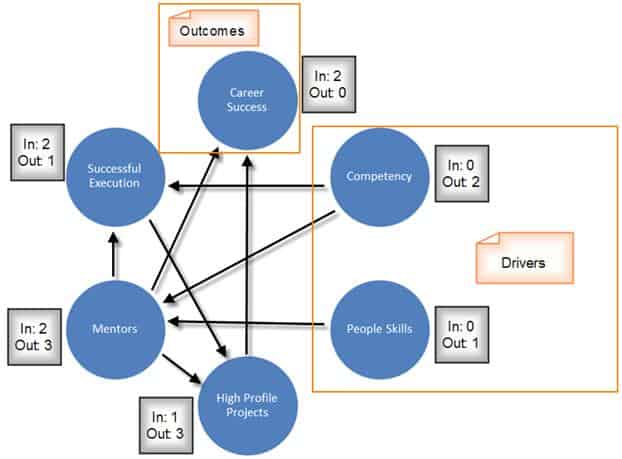
We face a lot of issues and problems in daily life, which are related to each other. So interrelationship diagram helps us to solve those problems. Basically, interrelationship diagrams are a tool to identify the root cause of any problem.
Also, This is a diagram, which shows how different kinds of problems are related to each other. It also helps to solve problems in a creative way and it also shows the causes and effects of all issues.
WHAT’S IN IT
What is an interrelationship diagram?
This is also known as 7 new QC tools or 7 new management tools. Interrelationship diagrams help us to think in multiple ways rather than linearly.
Hence, An interrelationship diagram is a tool to identify the root cause of any problem. It is a very useful tool for individuals and businesses. Using this technique, you can easily understand how multiple issues are related to the problem and influence each other.
An Interrelationship Diagrams presents the issues in boxes and all boxes are connected to each other by arrows. Arrows are considered as a cause and effect relationship between problems. The cause with the highest number of outgoing arrows will be known as the root cause.
How to create an interrelationship diagram?
Use the following method to make an Interrelationship diagram
1 Identify the problem
In an interrelationship diagram first, you need to identify your problem and add this to the top of the page as a heading.
2 identify issues
After identifying problems you need to identify issues of your problem by brainstorm. Add these issues inboxes.
3 identify cause and effect relationship
Now you need to connect these issues by arrows. In this stage, you need to decide which is a cause and what are the effects. Means you need to compare every issue to each other and identify its effect and do an arrow pointing from cause to effect to show the relationship.
4 identify intensity
In this stage, you need to identify intensity. Means, observe every issue and count every outgoing arrow of every issue and count every outgoing arrow of every issue. Most outgoing arrow issues are known as your root cause. From this technique, you can identify the root cause of your problem.
5 Take actions against high intensity
Now you know your high-intensity problem and you reach your root cause. So, finally, you need to take action against all these high-intensity problems.
Interrelationship diagram example
Followings are the issues that are affected by a ‘POOR PRODUCT QUALITY’
From the help of the above steps, we create this interrelationship diagram.
From the above diagram first, we understand our main problem which is poor product quality.
Now we find out our issues related to our problem and identify our issues, now we need to arrange them into boxes or circles.
After arranging the issues we need to compare every issue to each other and we need to find out every issue’s cause and effect relationship.
You need to point arrows from cause to effect, means while comparing every issue you need to arrow them, means which issue is effect to other issues.
After pointing all arrows, now we count every issue’s arrows, mean’s incoming and outgoing arrows.
Now, here we are finding out an outdated plant and machinery issue has most outgoing arrows and interrelationship diagram’s rule is, ‘most outgoing arrows issue is your root cause.’
So, from the above diagram, we find out our root cause of the problem. It’s also known as a key driver of a problem.
Now, we need to take action against that issue and we need to solve the issue as much as possible.
Interrelationship diagram for business
Every business faces a lot of problems in their earlier stage, and it is very hard to solve all problems, so here is a tool with available interrelationship diagrams, which can help you to find out the root cause of your problem.
Interrelationship diagram is part of 7 management tools. Basically, it is a problem-solving tool. If you want to know the root cause of any business problem, then use this tool you will find out your answer.
It also shows you the cause and effect relationship of problem issues. It also helps to understand how different kinds of problems are connected to each other.
You can also use this technique in your personal life to find out the main reason for your problem, but mostly this technique is used in business. This is very cheap and time-saving techniques to find out the main reason behind your problem.
This technique does not give you a solution but it gives you direction. You need to take action on your root cause and implement your best decision on that.
Conclusion
If you want to solve your daily life problem or your business problems then an interrelationship diagram is the best tool, which can help you to identify your root cause. It is a very easy technique for any person to use. You just need to do some practice of this technique. Try this technique and implement it in your life, you will learn something new.
Interrelationship diagram is a part of 7 new management tools. Basically it is a problem-solving tool and it helps you to identify the root cause of your business.
What are the 7 new management tools?
following are the 7 new management tools: 1. Interrelationship diagram 2. Affinity diagram 3. Tree diagram 4. Matrix diagram 5. Matrix data analysis 6. Arrow diagram 7. Process decision program chart
When to use an interrelationship diagram?
If you need to find out the root cause of any problem, then this is the best tool to apply. This tool helps you to understand the relationship between cause and effect.
Is an interrelationship diagram useful for business?
yes, it is very useful for any business. It helps you to identify the root cause of your problem and it is also useful in daily life.
Why an interrelationship diagram?
it is a very cheap technique, it is very simple and useful, it’s also a time-saving concept.
What is the purpose of an interrelationship diagram?
The main purpose of interrelationship diagrams is to show the relationship between causes and effects, and it’s also helpful to us to find out the root cause of a problem.
Before knowing how the business process can be improved let’s understand what exactly is a Business process, and time management. So, Why there is a need to improve business processes?
Business process definition
So let’s understand by splitting the two words business and process. Usually, a business is an organization where a group of people works for achieving a common goal and manage time and hence process states the flow or sequence of work which has some start and endpoint and series of activities in between where each activity creates or change something or add up some value
Any value before the process is input and the result after adding up the value is output.
So, in a nutshell, we can say that a sequence of activities is designed to create something of value or can say time management.
Types of Business process
There are 3 types of business process, in general
1. Operational
2. Supporting
3. Management
Operational Business Process
Meanwhile, It is a business process that includes the core activities of a business. For example, in the Bakery shop, the operational business process is making cakes and this work is allocated as per time management to different people according to their skills that are preparing cake sponge, preparing the icing for the cake, etc.
Supporting Business Process
So, Here, the business process includes the work which supports the core activity like recruiting the best chef, technical assistance, etc.
Management business process
Consequently, The process includes managerial work like managing the budget, Time management, managing the employees, etc.
WHAT’S IN IT
Business process Example
So, The business process is a sequence of logical steps that need to be performed for achieving the goal of the business.
For hiring, a business needs to perform these steps
First, they give advertisement in the print media or job portals about the vacancy,
After receiving sufficient applications the HR calls the selected candidates to come for an interview or pre-placement examination,
Also, The exam or interview is conducted, a candidate needs to clear it.
Hence, The most suitable candidates are selected based on their performance,
After this, the candidates are asked for documentation and verification,
A joining letter is given to the selected candidates.
Required training is given to the new employee.
So, this is the procedure of hiring new employees in the business and wherever the business needs to hire new employees they go through this process only as this is standardized and efficient in time management.
Business process improvement
Business process improvement is a managerial activity where organizations use different methods for analyzing their process to find out the gap between actual and standard, and fill that gap by improving the process, ensuring proper time management.
So, After knowing what the business process and its types are, let’s move forward and know what the need of improving it is.
Meanwhile, As the business process is the activity that an organization does in sequence to achieve its goal and there is always a scope for improvement. Hence, attaining more efficiency which ultimately leads to attaining more productivity or profitability.
One business doesn’t need to be improved or redesign its business process in case of low performance, it can be done in normal situations also to achieve high performance.
ADVANTAGES OF IMPROVING BUSINESS PROCESS
Less time
By improving the business process and time management the time of production or manufacturing will decrease as the process becomes efficient much earlier.
Increase in quality of output
So, As the product or service becomes standardized the quality of output enhances under time management. Hence, no confusion exists between the employees regarding their work or role.
In Efficiency
Also, This will lead to an increase in efficiency as the process becomes standardized. For example, during the process of manufacturing goods, the laborers know their work how to optimally utilize the resources which lead to less waste material.
Increase profitability and lower cost
Improving the business process ultimately leads to an increase in profitability as due to optimum utilization of resources the resources are well utilized and at a lower cost.
How to improve the Business process at work
Determining Objectives and framework
Objectives are the desired results of the improvement process which the management and organization attempt to achieve. Hence, this will provide the required focus, direction, and motivation for the improvement process.
Identify Customers and determine their needs
Need to understand customers, their profile, their steps in acquiring, Using, and acting on disposing of a product as per Time management. However, hence the purpose is to improve the business process that provides more value to the customer.
Study the current process
In short, the existing processes will provide an important base. The purpose is to know the “ what” and “why” of the aimed process. However, some companies go through improving processes with a clean perspective without emphasizing past processes.
Formulate improvement process plan
The information gained through the earlier steps is translated into an ideal improvement process. So, Customer-focused improvement concepts are identified and formulated. Thus, in this critical step options of processes are considered and the best is considered.
Implement the new improvement plan
It is easier to formulate new processes than to implement them. Implementation of the improved process and application of other knowledge gained from the previous steps is key to achieve dramatic improvements. Hence, It is the joint responsibility of the planner and management to operationalize the new process.
Methods for improving Business process
Here there are some methods for improving this i.e
Six Sigma
Total Quality Management
Kaizen
Benchmarking
SIX SIGMA
To begin with, six sigma means continue with the desired quality in processes and end products. Hence, It means taking systematic and holistic approaches toward improving efficiency and lowering the cost and Time management.
It gives almost perfect goods and services to strive to meet and improve organizational goals on quality, cost, scheduling, manpower, new products, and so on. This works on the path of improving standards continuously. six sigma said that 99.99968% of the products produced are error-free while ensuring Time management.
SIX Sigma Efforts target three main areas
Improving customer satisfaction
reducing cycle time
reducing defects
Six Sigma Methodology
1) DMAIC- DMAIC is an acronym for five different steps used in six sigma directed towards the improvement of an existing product, process, or service. In short, the 5 steps are defined, measure, analyze, improve and control
2) DMADV- it’s again an acronym for the steps followed in implementing six sigma. It is a strategy for making new products, services, and products. Hence the five steps are Define the product, Measuring it, Analyzing it after analyzing Designing and lastly Verifying.
TOTAL QUALITY MANAGEMENT (TQM)
It is a system where people focus on a continuous increase in customer satisfaction at a continuous lower cost.
TQM is a system approach strategy and an inner part of a higher level of strategy. Thus, it works horizontally across all functional departments, involves every employee, top to bottom and include supply chain and the customer chain, Time management, which extends backwards and forward
TQM emphasis learning and being adaptive to continuous change.
Principle Guiding TQM
1.A sustained management commitment to quality
2.Focusing on the customer
3.Preventing rather than detecting defects
4.Universal quality responsibility
5.Quality measurement
6.Continuous improvement and learning
7.Root cause corrective action
8.Employee involvement and empowerment
9.The synergy of teams
10.Thinking statistically
11.Inventory reduction
12.Value improvement
13.Supplier teaming
14.Training
KAIZEN
The root of the method is from japan which focuses on small but continuous improvement of a process. Here the organization is more into believing that the change and improvement should be continuous.
BENCHMARKING
In short, it is an approach where the industry sets its target and measures productivity based on best industry practices. Hence, It helps businesses in improving performance by learning from others.
Thus, Here company practices against their competitors
Process of benchmarking
Assess the need for benchmarking
Clearly understand the current process
Identify the best framework
Comparison of the process from others
Prepare report and implement the steps found necessary in filling the performance gap
Evaluation
A software than can be used to improve business process
The software that an organization can use for improving business processes is HELFO. It is an amazing tool for the improvement process. It has a good interface and can operate easily. Here diagram can easily work just by a click drag and drop button. And this document easily generates in a well professional form.
Although the software is free and doesn’t charge any cost for documentation and process modelling, you just need to have an account on the platform.
Hence, It provides a visual interface of all the steps of the process that we discussed in the methodology
How to choose which method to improve your business process efficiency
It wholly depends on the type of people you have as only people are the one who is the part of your business process and also the environment surrounded your business.
Hence, choosing the right method is very important as it involves lots of time, energy, and expertise.
Conclusion
Analyzing the current situation then understanding the target customer, outline the plan then implementing it, and lastly filing the performance gap is not a one day work that requires lots of hardware.
In short, the decision ultimately affects business profitability, Time management, productivity, and efficiency.
A business procedure is a lot of steps or assignments that you and your group use over and again to make an item or administration, arrive at a particular objective, or offer some benefit to a client or provider. At the point when procedures function admirably, they can altogether improve effectiveness, profitability, and consumer loyalty. In any case, forms that don’t work can cause disappointment, delays, and monetary misfortune.
To improve a business procedure, follow these means.
Guide forms.
Update the procedure.
Get assets.
Survey the procedure.
Remember that you’ll have to improve most procedures sooner or later. Hence, new objectives, new innovation, and changes in the business condition would all be able to make built up forms become wasteful or obsolete.
How business process management can work to improve business performance?
Business Process Management can prompt expanded efficiency. With rising rivalry and additionally requesting endurance conditions, organizations must work at their best. thus, BPM can help increment efficiency and empower organizations to give clients more
How technology can improve business processes?
Technology permits businesses to accelerate production speed. The employer can analyze how people are working under them, whether they are doing their work efficiently or not. Task and time management tools allow us to do so.
What are the process improvement skills?
Process improvement skills refer to the capability that has a systematic approach in identifying, analyzing and finding out the performance gap which is a requirement to improve for the purpose of standardization or quality enhancement
How does ERP improve the business process?
ERP( Enterprise resource planning) software is for the purpose of improvement of the business process in the following area – Human capital management, Inventory Management, Planning, and Scheduling.Simplified Reporting, Integrated Customer Relationship Management
Data and Information Management (DIM) refers to the set of people, processes, and technologies supporting information assets. Also, It comprises policies, procedures, and best practices to ensure that data information is understandable, trusted, visible, accessible, and interoperable. Hence It aims to promote interdisciplinary data-driven information management research, especially targeting large-scale datasets in scientific/academic, government, and business domains.
So, Driven by the need for qualitative and reliable data and information to bring their reporting and analytics initiatives to the next level, or pushed by regulatory and compliance rules (like BCBS239, AnaCredit or Basel III for banks and Solvency II for insurance companies), we are noticing an increasing interest for companies to properly manage their data information assets.
WHAT’S IN IT
About data and information management
Meanwhile, Data information carries with it the ability to make the organization smarter and more effective. Most organizations pay close attention to the data asset. So, Usually, Data is very essential to make well-known decisions that guide and measure the achievement of the organizational strategy. Also, The way an organization uses and manages the data is just as important as the mechanisms work to bring it into the environment.
The appropriate data of the right quality permits the organization to determine which processes have the greatest impact on the business.
Most of the data information in organizations ensure that their data assets are accessible to the individuals who need it, usually are of competent quality and timeliness, and are protected against any form of misuse and abuse.
Successfully giving data and information assets does not happen by itself; it requires dynamic data management by applying specific domains, policies, and competencies throughout the life of the data. Similar to systems, data goes through a cycle. As you can see The diagram below presents the key phases of the data life cycle.
Efficient data management through all of the data information cycle phases is the foundation for reliable information. Data may typically have a longer life than the project that creates it. Though the funding period officially defines the lifespan of most projects, the resultant data may be available for many years afterward.
If an organization manages and stores the data properly, the data is available for use for the future, increasing the investment made to generate it by increasing clarity and usefulness. Hence the time invested in planning and implementing effective data management pays results far above its investment costs.
Value of data
Data without any context has no value; data information that consumers never use is worthless, also. The value of data is in the knowledge and uses. Hence, Extracting information and presenting it in an appropriate format may be summarized as data analysis and reporting. However, data analysis and reporting circumscribe several overlapping disciplines, among them statistical analysis, data mining, predictive analysis, artificial intelligence, and business intelligence. The data information and Information Management has an appreciation for these domains and may use the same tools and incorporate some of these domains. The common ground among all of these domains and IDM is making the best use of the data.
Knowledge Required
This does not come easy and brings new challenges for businesses when it comes to managing their data and information. Dealing with data information should be knowledgeable in at least one of the following environments or disciplines:
Big data
Big data describes the high growth and availability of data, both structured and unstructured. Its characteristics are volume, velocity, and variety. It might be difficult to manage with traditional tools, it might move too fast, or it might exceed current enterprise processing capacity. Big data information and applications contributed to the growth of NoSQL databases.
Operational data
Operational environments provide central transactional capabilities (i.e., processing applications, claims, payments, etc.) that usually work with a DBMS. For structured data, Relational DBMS, or RDBMS, are used mostly.
Data exchange
Organizations use data information exchanges and data exchange standards to share information with internal or external parties. Side by side standardizing exchange formats and metadata minimizes impacts to both the sending and receiving systems and reduces cost and delivery time. A related field is master data information and management (MDM). An example is a vendor list. The U.S. Treasury requires specific information for identifying contractors before the federal government reimburses them. Most federal agencies use this centrally collected list. Exchange, transform, and load tools typically support these types of data trade activities. ETL tools manipulate data and move it from one database environment to another.
Data warehouses
The integration of same and disparate data from across organizational, functional, and system boundaries can produce new data assets. The organizations can use the latest data to ensure consistent analysis and reporting, to increase the information needed for decision making. Data information may be structured, unstructured, or both. Business intelligence has become a recognized discipline. Hence, It takes advantage of data warehouses to produce business performance management and reporting.
Data mining and knowledge discovery
Mining applications explore the patterns within data to find new insight and predictive models. An organization should use specialized software that applies high statistics, neural net processing, graphical visualization, and other high analytical techniques against targeted extracts of data. Hence, In addition, tools should evaluate continuously streaming data within operational sources.
Database management
Knowledge in this discipline requires specific training related to a specific DBMS and being certified. A certified database management professional (CDMP) is responsible for the installation, configuration, and maintenance of a DBMS (e.g., storage requirements, backup, and recovery), as well as database design, implementation, monitoring, performance, and security of the data in the DBMS (Software that controls the organization, creation, maintenance, retrieval, storage, and security of data in a database. Applications make requests to the DBMS, but they do not manipulate the data directly.)
Data architecture
A data architect is responsible for the complete data requirements of an organization, its data architecture and data information models, and the design of the databases and data integration solutions that support the organization. Usually, The data structure must meet all the business requirements and regulations. A specialized area in data architecture is the role of the data steward. The data steward is usually responsible for a specific area of data such as one or more master data.
Core Principles
An efficient data management program begins with identifying core principles and collaborative activities that form the foundation for providing efficient, effective, and sustainable data. You can see The organization should interlace the following core principles throughout all of the data management activities:
Firstly, the data collected is apt, timely, relevant, and cost-effective.
Secondly, data efforts are cost-efficient and they minimize redundancy and respondent burden.
Thirdly, activities related to the collection and use of data are consistent with applicable confidentiality, privacy, and other laws, regulations, and relevant authorities.
Fourthly, data activities look for the highest quality of data and data collection methodologies and use.
Data activities are coordinated within the organization, maximizing the standardization of data and sharing across every medium.
Partnerships and collaboration with all stakeholders are cultivated to support common goals and objectives around data activities.
Data activities adhere to appropriate guidance issued by the organization, its advisory bodies, and other relevant authorities.
Also, we use data to inform, monitor, and improve policies and programs.
Conclusion
In summary, Information and Information Management (DIM) alludes to the arrangement of individuals, procedures, and advancements supporting the creation, assortment, stockpiling, misuse, and removal of data resources. Hence, It includes strategies, systems, and best practices to guarantee that information data is reasonable, genuine, obvious, open, and interoperable.
Data Security is the foremost vital process without it our files don’t seem to be secure.
Hence, Data Security is the method of protecting files in a similar database and by adopting the set of applications and control that identify the importance of databases.
WHAT’S IN IT
The Importance of Cyber Security
Cyber security or Data Security is most required because the government, military, corporate, and medical organizations collect, process, and store unprecedented amounts of knowledge on computers and other devices.
So, A big portion of that data will be sensitive data, whether that beholding, financial data, personal information. Hence the volume and class of cyber attacks are growing, companies and organizations, especially those who are tasked with security purpose information regarding national security, health, or financial records, have to take steps to shield their sensitive business and personal information on Data Security.
There are basically 3 elements in Data Security
1-Confidentiality
2-Integrity
3-Availability
Confidentiality
It ensures that the data is being used by the authorized individual.
Integrity
Ensures that information is reliable similarly as accurate Data Security.
Availability
Ensures that data is simultaneously available and accessible to satisfy business needs.
Data Security Technologies
Data Auditing
A data audit refers to the auditing of information to assess its quality or utility for a selected purpose. Auditing data, unlike auditing finances, side by side involves observing at key metrics, except for quantity, to form conclusions and Data Security about the properties of an information set.
Data Real-Time Alert
Also, It takes companies several months to urge a breach.
Data Risk Assessment
So, Risk assessments summarize important findings, expose data vulnerabilities, provide a thorough explanation of each vulnerability, Data Security, and include prioritized remediation recommendations.
Data Minimization
It may well be the principle that states that data collected and processed should not be held or further used unless this can be one of the reasons that were clearly stated ahead to support data privacy and Data Security.
Ways to develop Security Culture In Teams
Install the concept that security belongs to everyone.
Many organizations have the opinion that the protection department is in command of Data Security.
Sustainable security culture requires that everyone within the organization is bushed. Everybody must desire a security person. Hence, this is a security culture for everyone. Security belongs to everyone, from the chief staff to the lobby ambassadors. As everyone owns a small amount of the company’s security solution and data security culture.
Data Security risks
Risks associated with lack of visibility
Companies often have terabytes of knowledge, and therefore the risks of information breach rise when companies don’t know where critical and controlled data is being held across their infrastructures on desktops, servers, and mobile devices or within the cloud. Hence that’s a large risk because it makes a finding of privilege abuse or unauthorized users getting sensitive data almost impossible until it causes hard to damage.
Risks associated with human actions
Companies have generally trusted their internal users and focused on defending against those accessing the network from the surface, which mindset continues to prevail because the Netwrix research shows, most companies continue considering hacker attacks to be the foremost dangerous threat, while the evidence shows that it’s insiders who present the overwhelming majority of security incidents.
Ways that Cyber Security best practices that every employee must know
Protect their data
It’s important to not leak our company’s sensitive information. for instance, if you give out a picture online that shows a whiteboard or visual display unit within the background, you’ll accidentally reveal information someone outside the company shouldn’t see. Hence by the identical token, make sure to respect the belongings of other companies.
Whether or not it’s accidental, sharing, or using the IP or business secrets of other companies could get both you and your company into a problem. Your company can help protect its employees, customers, and data by creating and distributing business policies that cover topics sort of thanks to destroying data that are no longer needed and therefore the thanks to reporting suspicious emails or ransomware. Hence avoid pop-ups, unknown emails, and links your company can help by employing email authentication technology that blocks these suspicious emails. Hence you’ll usually be notified that the e-mail has been sent to a quarantine folder, where you’ll check to figure out if it’s legitimate or not. use caution.
Use strong password protection and authentication.
If you’re working remotely, you will be ready to help protect data and ensure Data Security by employing a virtual private network, if your company has one. Hence a VPN is crucial when doing work outside of the office or on a business trip ensuring Data Security. Hence Public Wi-Fi networks are often risky and make your data prone to being intercepted.
Enable firewall protection at work and reception
Having a firewall for the company network and your home network may well be a primary line of defense in helping protect data against cyber attacks. Firewalls prevent unauthorized users from entering your websites, mail services, and other sources of information that can be accessed online.
Invest in security systems
All of the devices you utilize at work and reception should have the protection of strong security software. Hence your company needs to provide data security within the install security software updates and keep a replica of your files
Given IT security best practices means keeping your security software, web browsers, and operating systems updated with the foremost recent protections. Antivirus and anti-malware protection are frequently revised to specialize in and reply to new cyber threats. If your company gives out instructions for security updates, install them immediately. This also applies to non-public devices you utilize at work. Installing updates promptly helps defend against the foremost recent cyber threats. Hence Cyberthreats often aim at your data. That’s why it’s the best thing to secure and replica files just in case of an information breach or a malware attack. Hence your company will probably have rules about how and where to repeat data. Important files are often stored offline, on an external hard, drive, or within the cloud.
Talk to your IT department
The IT department is your friend. It’s an honest idea to work with IT if something with a variety of software updates hits a snag. Don’t let an easy problem become more complex by attempting to “fix” it. If you’re unsure, IT can help. It’s also smart to report security warnings from your internet security software thereto. They may not remember all threats that occur. Usually, It’s also important to stay involved when traveling. Let your IT department know before you go, especially if you’re visiting by using public Wi-Fi. Have an honest trip but don’t forget your VPN which can compromise Data Security.
Remember to create sure it’s, well, IT. Be careful with tech support scams. you’ll receive a phishing email from someone claiming to be from IT. Hence the goal is that it may trick us into installing malware on your computer or provide sensitive data. What to do? Don’t provide any information. Instead, contact your IT department right away.
Employ third-party controls
Companies and their very own employees might monitor third parties, like consultants or other employees, who have temporary access to the organization’s network. It’s important to limit third-party access to certain areas and remember to deactivate access once they finish the duty.
Embrace education and training
Smart companies take the time to teach their employees. Hence Your responsibility includes knowing your company’s cyber security policies and what’s expected of you.
Conclusion
IT department is your friend and solely prepared for you so that business-critical runs smoothly while ensuring everything runs as expected. So reach out to them whenever you need any technical support. Usually, it’s not DIY stuff to ensure safety when you’re working with such business-critical data and information.
There are multiple options and tactics to implement and ensure data security, once can be using VPN or sd-wan instead of regular wired over the internet or using different devices for personal and professional use.
Is Data Security important?
In today’s world, it is turning into a major concern for almost every company, seeing the increased rates of bad actors and information still gets compromise.
What are the Data Security levels?
Public: Public information because the name implies, is public, and doesn’t require any additional controls when used. Internal: Internal information is company-wide and may be protected with limited controls. Internal information includes the worker handbook, various policies, and company memos. Confidential: the tip is team-wide and its use should be contained within the business. This information may include pricing, marketing materials, or contact information. If disclosed, counsel could negatively affect your business and ultimately your brand. Restricted: Restricted information is very sensitive and its use should be limited on a need-to-know basis.
Who is Data Security Analytics?
Data Security analytics is an application to cybersecurity that uses data collection, data aggregation, and analysis tools for threat detection and security monitoring. a company that deploys security analytics tools can analyze security events to detect potential threats before they will negatively affect the company’s infrastructure and bottom line.
Having a great organization, satisfied clients is a dream of every employer when they start but what makes an organization great and a client satisfied, It’s the employees, the team members who make it happen, who make the dream come true through their hard work, skills, abilities. They are the ones who enrich the customer experience by their service which leads to excellent customer reviews.
WHAT’S IN IT
Why Employee retention is important
If customers are the king of the market then employees are the real assets of the organization and no organization can afford this loss of losing one of their asset he/she can be replaced physically by someone but his/her skill sets, attitude, which he/she possessed can not be exactly replaced by the person. Thus it is important to provide your employees with a great organizational culture, creating a healthy working environment for them.
As rightly said by Angela Ahrendts (senior vice president of Apple)
“Everyone talks about building relationships with customers. I think you should build one with your employees first.”
It is important to retain your good team members, But how to do that?
Top Ways to Retain Your Great Employees
Use These Tips for Employee Retention
A successful employee retention strategy cannot be made in isolation. You have to become a team member, you need to understand each nerve of your employee. No two employees are exactly alike, of course, each has different needs, wants, desires, goals but each employee wants to feel appreciated by their employer.
You should consider the employee-employer relationship in an organization, and look out for ways to keep your workers feel happy about their work as well as the place where they work.
Use These Tips to Retain Your Great Employees
1) Induction and Orientation
For every new hire on the very first starting day, there should be an introduction to make him aware of the organization, other team members, staff, organization culture. This will make him feel connected, a part of the family.
2) Mentorship
Every new hire needs some guidance and mentoring, through mentoring the new employee can learn from the experiences of their mentors and can also give their fresh insight on any topic of concern. This will lead to the overall development of the employee as well as the organization.
3) Understand employees psychograph
It is extremely important to understand your employees’ nerves, what they are going through, is there any problem which they are facing in the organization, any issue related to work or any stress, by understanding this we can create a better working experience for them.
4) Understand their Career Goals
Every employee wants challenging work that can improve their skill sets and can grow professionally. Look into this whether their career objectives are getting fulfilled or not, whether they are getting enough opportunities or not, if not then work upon this.
5) Training and Development
Spend on your employees, spending on your employees is never an expense it’s next to investment. This lets them grow and develop professionally which will increase their productivity, and when they will grow they will feel happy and satisfied for eg. pay for continuing education training, pay fees for attending conferences or industry events each year.
6) Communication
There should be a proper flow of communication in an organization. Where employees can openly discuss and share their opinion and ideas regarding any topic of concern.
7) Two-way Feedback
There should be a proper two-way feedback mechanism where the employee as well as the employer can communicate and can give their valuable feedback like the employer can give feedback to their employees regarding their work or ideas likewise employees should also have the opportunity to give feedback on the working environment of the company or organization.
8) Invite employees for new ideas
Employees should feel celebrated, they are the ones who are working very hard day and night. Therefore we should welcome any new ideas or any insight coming from them.
9) Appreciate
Each employee wants to get appreciated for their work, Appreciate them for that, for their hard work, Words like you have done a great job, words like this make them feel good, or you can also give them some monetary rewards like bonuses or gifts as well.
10) Provide equal platform
Each employee should be given equal opportunities and there should be no discrimination between the employees, equal and fair distribution of work should be there.
11) Perks
perks make your organization different from others, for example- organizing lunch for employees or free snacks or coffee every day. These small acts leave a great impact on employees and this lets them feel more connected and engaged with the organization.
12) Wellness offerings
Every organization must introduce employee wellness programs, this program is an important step in improving the health and productivity of employees, by introducing employee wellness programs there would be low health care costs and as well as the employees will feel happy and the environment will also turn into a positive one.
13) Recognition and reward
Employees must get recognition for their work. Every person wants to feel appreciated and get recognized for their work. Show them that they matter. For example- a gift card or a sincere mail or a day off also works great.
14) Work-life balance
There should be a balance between the employee’s personal life and professional life. Overburdening them with the work is just not the key, asking them to work for long hours after office time will also not only increase their stress level but will also decrease their productivity.
15) Respect
Every person deserves respect, then these employees are the biggest asset of your organization. They are working day and night for you therefore you should Create a healthy and respectful environment for each employee in the organization.
Final Thoughts on Retention
Companies should revisit their retention strategies every year.
Employees must get a fair Salary at least according to the market standard.
There should be a great organizational culture
The balance between life and work.
Strong employee-employer relation
Employees should get some perks and benefits.
Clues that employees want to leave
Things can be communicated by behavior or body language also it’s not necessary that it would be only communicated by words. Thus it is found that employees who are likely to leave the organization show or have certain changes in their behavior or body language or attitude.
Things that you can notice
Less active, Do not participate actively in various activities.
The decline in productivity of the employee
Reluctant to participate in various activities
Show less interest in working
Less interaction with the management
Reserved and quiet
Less social interaction with the staff
Do not share feedback
More Complain and arguments
Weak Commitments
Offer fewer ideas or suggestions
Must do for any Organization
Employees feedback is essential, when he/she is your employee, working in your organization you asked them for the valuable feedback you communicate with them on various issues related to the organization whether it is related to the organization culture or work stress or whether work-life balance.
But ask yourself a question, do you ask these questions or communicate with the employees when they leave your organisation? Do you ever ask them for their feedback regarding various organisations for example why they are leaving, why they do not want to continue with you, or whether they have faced any problem in the organisation, how was their experience throughout the time which he/she spent in the organisation. Have you ever asked these questions to them, if NO then you should ask?
Exit Interviews
Whenever an employee leaves your organization you should conduct an exit interview. But before that you should ask the employee and tell him about the purpose of doing this and also should inform you that this information will be kept confidential.
Questions that can be asked to him/her
why they are leaving, why they do not want to continue
What problems they have faced in the organization
How was their experience with them
The feedback received by you from your exiting employee is beneficial for your organization, based on this feedback you can make necessary changes if required any, you will get to know more about your organization or we can say more about the employees that what problems they are facing if any, why the employees are leaving or why they are not satisfied. Based on this you can create a better culture in your organization.
As rightly said by Angela Ahrendts (senior vice president of Apple)
“Everyone talks about building relationships with customers. I think you should build one with your team first.”
Conclusion
Thus feedback received in Exit interviews are very valuable and possess a lot of information regarding your organisation working, culture and many more things.”
As rightly said by Angela Ahrendts (senior vice president of Apple)
“Everyone talks about building relationships with customers. I think you should build one with your team first.”
By listening to his/her queries and needs, try fulfilling them and make them feel listened.
Why to retain a good team member?
To ensure a business-critical run as expected and maintain a workflow within company and team and ensuring organizational cultural values remain intact.
What do you think when you think of the “right leader” or the “right person for your team”? You can imagine a person, no matter what problem he encounters, will not lose control of his character. You can also become a person like this by Helping your people developing Emotional intelligence. Or, you are thinking of someone who has confidence in employees, listens to their team, is easy to talk to, and always makes wise and prudent decisions as a leader to help people.
And similarly who are the real good listeners. No matter what situation they are in, they always seem to know what to say and how to say it so that we will not be offended or frustrated. They are caring and considerate to help people. Although they may not find a solution to the problem, they usually leave with greater hope and optimism to help people.
We may also know some people who are proficient in emotional management. Hence they will not get angry under stressful situations. Instead, they can examine problems and calmly find solutions to help people need. Hence they are excellent decision-makers, and they know when to trust their instincts. However, regardless of their strengths, they are usually willing to treat themselves honestly. Although, they accept criticism well and know when to use it to improve performance
These are the characteristics of people with high emotional intelligence.
WHAT’S IN IT
Do you also want to be like this?
Well, let me tell you it is not rocket science and you can also become a person like this. You need to be more Self- aware, motivated, and more socially aware. Hence you have to control your emotions and manage them in the right way so that you can lead people more effectively.
Well, nowadays emotional intelligence is very important for your professional success. Companies take separate psychometric tests to check your emotional intelligence level. No organization wants its employees to be low on EQ (Emotional Quotient). They want an optimistic, team player, and emotionally stable employee.
We talk a lot about Emotional Intelligence but what is it exactly?
Emotional intelligence or EI is your ability to understand and process your feelings and humans. People with high emotional intelligence know how they feel, what their feelings mean, and how these feelings affect others.
A person high on EQ knows his emotional state and negative emotions (frustration, sadness, or other more subtle things) very well, and can recognize and deal with them. These people are particularly sensitive to the feelings of others.
So how can these skills be improved or managed??
Before going in depth-first let’s understand the characteristics of Emotional Intelligence, how it works, and what skills you need to have to call yourself an emotionally stable person.
Characteristics of Emotional Intelligence and how it can be improved
According to an American psychologist Daniel Goleman, who helped to popularize emotional intelligence, there are five key elements to it:
While helping your people you need to introduce these concepts and their solutions to them. Encourage them to follow the skill set in increasing their emotional intelligence level.
Given below are five key characteristics of Emotional Intelligence
1. Self-Awareness
A person’s high emotional intelligence makes them confident. When people make important decisions in life, they can understand their feelings and control their emotions. Hence they will not control their emotional turbulence and are more likely to pay attention to their strengths and weaknesses.
So, what measures can you take to increase your self-confidence?
·Keep a diary -Using a magazine can increase confidence. Side by side taking a few minutes each day to write down your thoughts can increase your confidence.
Slow down– If you experience anger or other strong feelings, please slow down the inspection process. Remember, no matter what the situation is, you can always choose how to respond.
2. Self-regulation
Emotional intelligence can help people control their emotions and impulses without making them aggressive and jealous. It prepares one to think before reacting to the situation. Hence Self-regulation makes people considerate, adaptable to change, honest, and attentive.
So, how do you improve your ability to regulate?
Know your values
do you know where you will not compromise? Do you know what values are most important to you? Take the time to check your “ethics”. Hence if you know what is most important to you, you may not have to think twice when faced with ethical or moral decisions-you will make the right choice.
Take responsibility
If you blame others, stop when things go wrong. Commit to accept your mistakes and bear the consequences, regardless of the consequences. Hence you may sleep better at night and quickly earn the respect of others.
Practice keeping calm
next time you encounter difficulties, please pay attention to your behavior. Can you relieve stress by calling others? Perform deep breathing exercises to calm yourself. Try to write down any negative content you want to say, then tear them up and throw them away. It’s best to express these feelings on paper (don’t show them to anyone!) and speak out to your team. You can also challenge your answer to make sure it is appropriate!
3. Motivation
People who deal with high levels of emotional intelligence are motivated. They are happy to be able to deliver high-quality products immediately for long-term success. Also, they faced positive challenges and proved to be more productive and agile in the execution of their tasks.
How can you improve motivation?
Know where you are
Determine the motivation for leadership. Through our assessment of leadership motivation, you can see your motivation in your leadership role. If you need to improve your leadership skills, you will be taken to resources that can help you.
Hope and do the right thing
Motivated managers are usually optimistic, no matter what problems they face. Adopting this way of thinking maybe a practice, but it is worth it.
If you face challenges or failures, try to at least understand this situation. When we learn an important lesson, it may be a small thing, such as a new contact, or something that has a long-term impact. But when you look for it, there is almost always something positive.
4. Empathy
Another important part of emotional intelligence is compassion, which enables people to know the emotional aspects of others around them without being decisive or conservative. They can handle interpersonal relationships well by understanding the attitudes of others, even non-obvious feelings.
How can you improve empathy?
Put yourself on other people’s shoes
it’s easy to stand in your position. Ultimately, it’s up to you! But it takes time to look at the situation from the perspective of others. In the article about the conceptual post, you will find a useful way to do this.
Pay attention to body language when
Listening to others, you can cross your arms, move your legs back and forth or orbit your lip. This body language tells others how you feel in a certain situation, and the message you convey is not positive! Learning body language can be a real asset in a leadership role because you can better determine how someone feels. Hence this allows you to answer appropriately.
Respond to emotions
Ask your assistant to be late-do it again. As long as he agrees, you can hear his voice disappointing. Therefore, please reply to his feelings. Tell him that you appreciate his willingness to work overtime, and you will be disappointed when you are late. Hence if possible, find a way to reduce trouble late at night in the future (for example, release it on Monday morning).
5. Social skills
People have acquired considerable social and communication skills through a high degree of emotional intelligence. They do not grow up alone but will inspire others to grow, thus reflecting a strong team-building ability. Usually, he also focused on the art of crisis resolution with a broad vision and a proactive spirit.
How do you develop social skills?
Know how to resolve conflicts
Managers need to know how to resolve conflicts between team members, customers, or suppliers. If you want to succeed, then it is necessary to learn conflict resolution techniques.
Improve your communication skills
How is your communication level? Our communication quiz will help you answer this question and provide useful feedback on how to improve yourself.
Learn to praise others
As a leader, only by winning employees can you praise them, which can increase the loyalty of the team. Learning to praise others is good art, but it is worth it.
Well, these are the methods or some of the solutions by which a person can improve emotional intelligence, and as a teammate or leader, one should motivate the people around you to use these methods in their skill-building to help people.
But it’s not going to be very easy. When you have to help other people to be more confident, socially aware, and motivated
So, what else can you do?
Help people discover their deep and very personal vision for their future,
Help them discover how their current work may require some work to make the future a reality. These are the first two stages of Richard Boyztis deliberately changing the theory, and we have been testing with leaders for years.
Ways to change complex skills
People can initiate and support changes in complex skills related to emotional intelligence in the following ways:
First, find the dream. When looking after employees, you first need to help figure out the important things in life to help people. Hence only in this way can you proceed with the work that is important to that person. Then help your employees develop a clear and compelling vision for the future, including building strong and positive relationships with family, friends, and colleagues to help people.
Next, find out the actual situation: What is the current state of this person’s emotional intelligence? Just as a person has a powerful dream to draw strength, he is also strong enough to withstand pressure to find out the truth. If you are training him now, you have confidence that he will listen to you. However, this may not be enough to help people need. You want to find a way to get feedback from others through a 360-degree feedback tool (such as ESCI (emotional and social skills list)) or a self-study process for executives (as described in this book). Become an echo leader), where you can directly talk about your EI and other skills with trusted friends.
Once you have dreams and reality, it’s time for interval analysis and learning plans. Please note that I did not say “performance management plan” or “development plan”. The difference in the learning plan is that it is a direct path from a personal point of view, and it requires gradual learning to reach the destination-to truly develop skills to help people.
Conclusion
Developing emotional intelligence can make a difference between success and failure in life and work. Moreover, if you are solely responsible for the contributions of people to the team and the organization, then you will try to help people who are challenged, incompetent, and dangerous. That’s your business.
The right pay structure helps in boosting the morale of the employees as well as develops loyalty towards the organization. Side by side, it helps in retaining talented employees by improving their skill expertise.
Providing them compensation in the form of the right pay structure can help in the productivity of the organization.
Before understanding what kind of stipend structure is suitable for the employees. We need to understand why does the right stipend structure matter?
Pay evaluations can be founded on showcase costs or real pay rates, or a blend of the two strategies. For instance, you could utilize market information to build up the strategy to go for a compensation evaluation and utilize genuine pay rates to decide the midpoint in the range.
To build up to pay grades dependent on real compensations. Make bunches dependent on levels in the authoritative chain of command. Hence, for instance, directors and VPs would be two separate compensation grades. For instance, various jobs with comparable hierarchical worth, necessities, and pay rates can be remembered for a similar gathering.
The base and limit of a range can be determined from the midpoint or comparative with a lower and higher evaluation to shape a consistent movement.
Secondly, the organizations need to take into consideration certain factors such as employee engagement and satisfaction to boost the morale of the employees indeed the defined goals and objectives can help the employees in providing a clear understanding of their work area.
Factors considered while creating the right pay structure
Some of the factors which are taken into consideration while forming an equitable reward structure are as follows:
Experience
Occupation adverts ordinarily indicate how long of experience they need for the post and offer a relating pay. Usually, Indeed, even inside a compensation band, your offer will rely upon your experience level.
Skills
Although, Your compensation is straightforwardly corresponding to how much ability you bring to the activity. But, when in doubt, places that require talented workers or individuals with explicit capabilities will be paid more, while the broader positions, like organization, will draw in lesser compensation.
Education
Your degree of instruction and its quality (for example the foundation you are from) likewise affects your pay. The executives move on from the IIMs, for example, will order a superior cost in the activity advertised than MBAs from different establishments.
Geography
Although, the area you are posted in has a great deal of effect on the amount you are paid. But, pay rates for a similar position will change across various towns and urban communities since they consider contrasts in the typical cost for basic items.
Inflation
Although, organizations must offer pay rates on a standard with industry norms. But, with the rise in inflation, the buying intensity of pay rates is on a consistent decay. To pull in new workers, organizations must guarantee that pay rates are balanced for expansion with the goal that buying power increments or if nothing else continues as before.
Different Types of Pay Structure
To begin with, there are wide varieties of pay structure followed across different organizations depending upon the criteria set by the management authorities.
Individual Pay Rates
It is generally considered to be one of the most recognized stipend structures across various organizations.
But, It involves a fixed salary based on the employee’s roles and responsibilities in the organization. The salary is paid usually in a weekly and monthly duration.
The benefit of this process is that it gives the organization an initial idea of the distribution of salaries in an efficient way meanwhile creating employee value in the organization.
But this type of stipend structure is not volatile due to the payment of a fixed salary as there is no static growth in the reward structure. The only growth in their career is through promotions or transfers which takes a lot of time due to which employees get demotivated. Thus, It is most feasible for small organizations.
The individual pay rate should not be confused with individual pay ranges as both are different forms of stipend structure where the latter focuses on a predefined scale rather than a fixed pay. Thus, this type of pay structure is most common in government firms.
Narrow-Graded and Broad-Graded Pay Structure
Although, in a narrow graded recompense structure, the grade range is usually made up of large grade ranges with various jobs distributed into the particular grade range respectively. Hence, this type of stipend structure is usually followed in the public sectors
Grade
1st step
2nd step
3rd step
4th step
5th step
12
80000
82000
84000
86000
88000
11
75000
76000
77400
78000
79400
10
60000
61300
62000
63900
64600
9
55000
56300
57600
58300
59300
8
50000
51200
52700
53400
54800
7
45000
46200
47500
48000
49600
6
40000
41600
42400
43300
44400
5
35000
36400
37200
38900
39800
4
30000
31200
32300
33200
34700
3
25000
26500
27200
28300
29400
2
20000
21600
22300
23500
24900
1
15000
16500
17200
18400
19500
In a broad graded pay structure, the grade range is usually on the lower side as compared to the narrow-graded stipend structure. Hence the salary bandwidth is lower and hence, keeps the employee motivated as the pay scale jumps are quite high.
Grade
Bottom
Mid
Top
5
55000
57400
59200
4
50000
52100
54300
3
45000
46800
48300
2
40000
42500
44100
1
35000
37500
39200
Pay Spine
In short, the pay spine follows a company-wide pay structure which is widely used to bring simplicity in the organization. However, the pay spine is said to cover all the grade pay salaries from a lower managerial position to a senior managerial position. Hence the recompense structure is said to be equitable as it usually covers the fixed salary as well as the incremental income.
The pay progression is said to be not that huge in ranges but ceases to provide clarity to its employees building compatibility and trust towards the organization.
Job Families
To begin with, the job family reward structure provides some kind of harmony between the large number of compensation frameworks provided by the organization. So, it usually groups all the homogenous roles and separates the individual roles based on the information and supremacy. Job families are usually created for multiple departments specifically to combine all the facts about knowledge and experience.
This type of pay structure usually works well due to the cost control factor. Furthermore, management can easily work upon and examine the salary structure on an interval basis and can rectify it for the same. Thus, The structure is versatile and is very much recommended for progressive recompense structure.
What is the right pay structure for your organization?
It is one of the extreme situations a company faces while selecting which type of pay structure should be followed in the organization. Selecting the right reward structure can motivate the employees to work hard on their roles whereas a wrong recompense structure can demotivate the employee and ultimately low productivity in the organization.
Few of the things to consider while selecting the right recompense structure are:
So, If you are a developing organization, and there is no decent evaluation pay structure, the activity of building a new reward structure can help to resolve the problem of achieving the advancement of the organization. It assists set with increasing a framework for pay so you can settle on recruiting choices rapidly. It guarantees that you will manufacture your developing association on a framework that is reasonable and agreeable. Furthermore, perhaps above all, while setting up an evaluation structure, your association will be compelled to settle on hard decisions about how you need to organize pay. Hence, A right pay structure paves the path to remove the blocks from the deconstructive roads.
If there is any unique objective that needs to stand out from the competitor’s areas such as technology, medical, sales, and other ground reality work can follow the hybrid pay structure i.e. compilation of different types of reward structure to create a new structure suitable for the respective organization.
To begin with, setting up job-based ranges is a decent stage for having some reasonable rules for pay. At that point, you can start to explain how representatives go into and travel through and between ranges.
Conclusion
Finally whichever structure you choose, recall that the most significant action is to communicate with the employees. So, tell them what you choose about how to adjust your compensation to your hierarchical objectives. Further, it’s insufficient to simply pay the individuals, you’ll need to convey your method of reasoning for pay practices to help connect with and spur your top representatives. Hence, towards the day’s end, the pay is about individuals and results, and we need to get both rights in our associations.
How to create the right pay structure for your startups?
As startups initially said to have low capital and dynamic structure due to which they tend to provide low fixed compensation structure to its employees. Hence, with the period of evolution, startups can build a standard structure such as individual pay rates depending upon the policy of each organization.
Why is the right pay structure necessary for an organization?
In short, creating the right structure motivates the employees in their workforce and determination to dedicatedly work for the organization. Thus, it also helps in maintaining a standard procedure of disbursement of payment in the organization.
Is the pay structure similar to every organization?
In short, no the structure is not similar to every organization. Thus, every organization has different missions and visions on which the company works throughout their business cycle.
Will the same pay structure sustain throughout the organization?
In short, no, as with the changes in the inflation rate in the market, the organization should make themselves adapt to these changes promptly so as to sustain the business. Thus, for government organizations, fixed pay is generally for a period of time whereas in startups the pay structure is dynamic seeing the dynamic nature of the organization.
Is there any pay increase annually?
Although, Choices about remuneration increments depend on monetary conditions, economic situations, hierarchical needs, and staff part execution, all of which may change in a given year. But, Swarthmore’s training has normally been to offer staff individuals a yearly increment toward the beginning of the financial year; notwithstanding, these increments have never been ensured. Thus, staff individuals who have been in their situations for a brief timeframe may not be qualified for expansion toward the beginning of the financial year.
If you ever think about how to attract and retain the best team ever, you possibly can, and especially if big salaries and huge bonuses are just not an option for you, then you should know how Motivating Employees Without Bonuses.
As you know that getting and keeping the right people on board is vital to your success, especially in today’s time of low employee engagement and high turnover. But even more significant than that is getting the right people in the company which makes going to work more fun and something you can look forward to.
Recent studies of employees show that creating a positive impact is the most essential estimate of employee success. Then, Followed by in this order: doing work you love, excellent work/life balance, and of course the pay.
First, let us know that why Motivating Employees Without Bonuses is essential?
The way you will make your employee feel, the same way he will make feel to the customer. Remember that an effort that is appreciated gets repeated. If your employees are motivated, then your customers are motivated.
WHAT’S IN IT
Tips for motivating employees without bonuses
1. Celebrate every small success.
You should celebrate the small success and milestones of your employees with a standing ovation. Keep the workplace vibrant, whenever something good happens to give high fives, pat the backs of team members, laugh loudly, make clapping’s, etc. celebration makes a change in physiology which changes psychology because action changes perception. Being vibrant attracts motivation.
2. Create a well-defined growth path
If an employee observes in a company that he is going to have good growth here, he will stay there and work. Show employees a well-defined career growth path. For example- If he is today’s manager then tomorrow he can be a general manager and can go further ahead.
3. Potluck
You should do something that makes your employees feel; office environment the same as the family environment. To do this, organize a weekly potluck activity. In this activity, on a day, every employee should bring extra food from his home, and all team members will sit together and enjoy the food like a family. Remember, a family that eats together always stay together.
4. Free food for extra time workers
If an employee arrives office before working hours, then you should arrange breakfast for him.
If an employee works for late hours after working hours, you should arrange dinner for him. By doing this, employees will not feel a problem for staying more than working hours. These supporting conveniences help.
5. Encourage good health
We can have many small ideas for this, which does not require much money, but the benefit is much more significant. Conduct activities like Zumba dance, Power yoga, Aerobics, GYM, laughter, yoga, etc.
You can give gym subscriptions to the whole team at the same place so that they all can go there together and feel motivated.
6. Employee to Employee engagement
Make a Gratitude board, keep a sticky notepad and pen near it. Whenever any employee will do something for another employee, then another employee will write a thankyou note for him. It will be visible to the whole office, and everyone will praise that person. And the helping culture will be repeated because the work which is appreciated gets repeated.
Make a routine of giving gifts, awards, certificates, etc. every week to an employee of the week. Employees will get eager and excited to get that recognition. Although business running is logical, people are emotional, that’s why you should handle people emotionally so that they can run business logically. You can have the same model for employee of the month or year.
8. Employee stock option
If your company is not big enough and you want to hire the best people, then consider this option for the offering. For this, you have to be a private limited company. Before offering SME IPO ( small and medium enterprises initial public offering ), you can launch Esop ( Employee stock option ). These are kind of little equity or revenue sharing. If an employee sees the growth of the company is directly proportional to his growth, then he will be ready to join work at even lower wages.
9. Flexibility
These are the things for which very human crave more of; we crave more control over our schedule because in life things happen both special events that you just don’t want to miss and people get sick—plus putting the emphasis more on results rather than who is at their desk at what time gives people more control over their day and makes them feel trusted, which is very important.
Now, of course, there are jobs where you do need to be at your office desk at a specific time, but in those cases, you might want to consider having people cross-trained or consider having a few part-timers instead of one full-timer.
10.Time off
What’s one thing all people want more of? Of course, it’s more time. Give your employees regular paid holidays and flair days. Flair days are spent time off that you can take to do something inspiring and fun. Like go to the museum or head to the water park or learn any new skill.
11.The best tech
This one is going to cost you some money. You have to fasten your team and make sure they have the best-updated software and other machines. Now, of course, you don’t have to update every time something latest comes out. But the best tech not only helps the team be more productive but also builds company pride because you know this nothing is more demoralizing than trying to get something done and being hindered by the pinwheel of tech.
12.Challenge them to grow
You need to anticipate a lot from your people and challenge them to gain new skills because if they are not going to see a growth path ahead, they are not going to stay. It helps in motivating employees without bonuses.
13.Acknowledgment and appreciation
This is one of the most important things you can do to attract and retain talent, and it’s one of the most underrated. You have to make it a part of your company culture to celebrate, appreciate, and publicly acknowledge people for their hard work. For example, when someone in a company hits a milestone, hits some major on a project, or when a team gets something gigantic done; you should pour on sincere and specific recognition for each person.
14.Engage your employees within the process
If you are not able to find out what will motivate your team, then don’t feel afraid to ask them. You can ask them what kind of rewards and incentives they want through surveys, brainstorming sessions, or a suggestion box.
Once you have got the employee feedback, you can create goals for them to achieve.
15. Know them personally
Your business is your second family. That’s why you should recognize employees’ personal level, such as knowing about their families, hobbies, favorite food, etc. Identify if any problem is stopping them from working more. For example, if an employee has a dog at home and because of it, he can’t stay long in the office then allow him to bring the dog in the office.
CONCLUSION
Motivation is essential for employees because they are humans and humans run on emotions. To boost feelings, motivation is necessary. The best-proven ways to motivate your employees without money are discussed above, and you have to choose which one of them will work for your team because factors of motivation vary from person to person.
To truly motivate your team and other people, you have to inspire their internal interest. And that’s something that money cannot buy.
FAQ’s
Which factors affect employee motivation?
Recognition, Development, autonomy, environment, and work-life balance.
How employee motivation affects performance?
It is practically observed that intrinsic motivation increases the satisfaction and performance of an employee in a company.
How employee motivation affects organizational behaviour?
Generally, if employees are motivated, then they focus on bringing positive returns which increases organizational performance.
How to measure employee motivation?
you have to observe factors like willingness to take new projects, no. of absences, social behaviour, carelessness, etc.
Who is responsible for employee motivation?
Although motivation is internal as a leader, it is your responsibility to create an environment in which people can motivate themselves.
What is employee motivation definition?
In short, employee motivation can be defined as the process of driving internal enthusiasm and commitment inside an employee.
Why employee motivation wanes?
There can be many reasons for this such as he is not doing the right job made for him; there is a negative impact of office politics on him; they don’t feel appreciated; the employer, do not trust him; etc.
Being an employer, you need to find new and different ways to reward your team. For making a sound reward system at your workplace; you have to do some strategic and creative thinking. However, many companies do not do such things which make their employees uncomfortable.
You will see an excellent rewarding system in every big company in the world.
Many companies avoid this because they think this is time-consuming and costly for the company. Such companies do not see the more significant benefits of rewarding their team.
But being an employer, you not only have to reward your team but also give them appreciation and recognition.
There are many good reasons why companies and employers should reward their team and employees. This includes better office culture, better engagement, and productivity of the group. Here are the best ways to reward your team, which shows that you care for them.
WHAT’S IN IT
12 WAYS TO REWARD YOUR TEAM
Handwritten Appreciation
When a boss gives a handwritten recognition to his employee, it can go a long way. In this method, there is no high cost of money and time. Writing a handwritten note for the appreciation of his performance, for wishing him his birthday, or for any festival makes him feel that you acknowledge the person and shows care for him. It shows that you have time for them also. This action speaks Louder Than words.
Give parties
When you celebrate for project completion of any festival throwing an office party is always a good idea as a reward. Office parties are good because it allows employees to feel more connected and comfortable. It might cost more than a handwritten note, but your team will thank you for it.
Money
Everyone works for money and loves it. However, it does not create a long motivation effect. But there are exceptions when you change the purpose of giving it. Getting money is in the form of a bonus when you work extra hard is more appealing than just getting handed money. This works for many people as they feel, they deserved it. This works best at the time of festivals when people have extra expenses.
Holidays
Giving an off for a few days to an employee who is giving better results is suitable for both him and his team members. Give extra holidays during festivals so that he can spend time with his family or can go back to his hometown for the celebration. Giving these holidays without cutting them from their annual leaves will be a heartwarming gesture.
Magazine subscription
Reward your team with magazine subscriptions. Magazines should be the ones who talk about productivity, health, personality improvement, financial knowledge, etc. Such magazines will help your team members grow on a personal level, and resultingly it will be beneficial for the company at the end. Give them options for such magazines and let them choose. This will make you a good boss who cares about the improvement of his employees.
Book the tickets
The whole team can go for a movie or a cricket match. From concerts to sports many events are happening all around the year. Going to such activities as a team will be fun.
While working, everyone works as a team, so while enjoying the whole squad should make fun.
Go for a trip
You can go on an adventurous trip with your team. You can go for a picnic or an exhibition visit. Rewarding your team with such visits will be a good idea. And make sure to make such trips regularly in a year or two.
Meeting Location
Do not always keep meetings at the same office; it feels boring. You can have a meeting out somewhere nice. For example, many people have their meetings at coffee shops. There you can give a treat to your team as well as perform the session. Moving to a new place for meetings is always a productive and rewarding activity.
Everyone gets more creative while working at a new place with the same people. Hence you can have a great brainstorming session. Many leaders use this as a productivity hack.
Sometimes you can also invite their families to make them happy and celebrate.
Give flexible working locations
Earlier companies used to give the second Saturday holiday to make employees happy. Then it became common. Now many companies offer flexible dress codes, and startups do not care much about them.
Now in today’s world, although work from home is typical due to COVID-19 pandemic after that, also companies should give the option to work from home. Working from your place provides more flexibility to employees, and hence productivity increases.
Show Personal touch
Always being in professional mode adds boringness in the office. So, mixing a personal touch is good. It will be fun and make your team feel connected. Small actions such as giving them high fives, patting on back, praising them in front of everyone, etc. make a big difference.
You can give rewards like becoming a boss for a day, going for lunch with the boss.
Whenever you get public recognition for any project, always praise the efforts of your team by calling out their names. Remember, Nothing sounds sweeter than listening to your name.
Provide free training
Most new generation employees consider development opportunities and career growth as an essential part of the job. As a leader, you need to provide them with practical and competitive knowledge. You can teach them the skills by yourself or by hiring a professional.
Remember, the new workforce coming into the industry is hungry for knowledge. They know learning is priceless. Hence this could be the best priceless reward you can offer.
Healthy food and gym subscription
Busy and hard-working people usually do not pay much attention to their health and fitness. You can offer your team a gym subscription nearby office so that they can collectively go and support each other.
You can also offer a high nutrition diet from office canteen. It will improve their health so that they don’t get ill and they respect you.
CHALLENGES WHILE REWARDING YOUR TEAM
Although rewarding your team may generate great teamwork and great results. But, it can also destroy groups and fail projects.
You should reward the behavior you want to see. Paying the team just for the sake of doing it, irrespective of observing your team’s behavior may destroy the team’s seriousness.
You should reward the team for working as a team. It takes a team to work as a team. There are many people in the group those have different areas of expertise, skills, training, etc. It is hard to bond together with people of various kinds.
Do not only reward a single person of the team. It will cause jealousness among other team members for that person as well as for you. Just like in the sports team, a single-player cant makes the team win, same in business a single person cant help in doing the whole thing.
When a team includes persons from different backgrounds and cultures, then you have to take extra care. For example- a few members of your team are vegetarian, and you throw a non-veg party, it may not be received very well. If you do something according to a culture that has no meaning for people of other cultures, then you are not rewarding that group.
Conclusion
In short, you should always remain smart while rewarding your team. After reading the above tips, you would have realized that these rewarding activities may sometime cost you money, but in the end, it improves your team in every aspect. You should never consider this task as a regular chore. But you should do it by your heart because it’s your team that makes you a leader. Without a team, you cant be a leader. Treat them as a family who helps you in running your business.
Each of the rewards told above will convey your recognition and appreciation for the hard work and dedication of your team.
Generally, Strategic compensation is a human resource management technique used by companies to bring growth in employee performance.
This process helps in the orientation of employees’ behaviour and performance to the company’s objectives and goals..
The main goals are to:
Attract employees,
Retain employees,
Motivate employees,
And to maximize the return on investment.
The head of Strategic compensation is the person of top management as it hugely impacts the cost of the company.
WHAT’S IN IT
WHAT IS COMPENSATION?
Compensation refers to all cash and non-cash payments given to an employee in exchange for the work they had done.
Earlier compensation only meant paychecks, but in today’s world, it means much more.
Employees now want not only reasonable wages but also other benefits and policies which help them financially, such as retirement and healthcare plans.
Employers have to address these demands to hire and retain the best employees.
All companies use specific compensation strategies to manage their employees.
TYPES OF COMPENSATION
There are two types of compensation: Financial compensation and nonfinancial compensation
1. Financial compensation
It is also called monetary compensation. This type of payment contains Money as its value. There can be two types of financial compensation:
Direct Compensation
These include the Money paid to the employees in the form of salaries, wages, bonuses, and commissions. Wages and salaries are fixed, whereas bonuses and commissions are variable. Wages are usually paid in hours to unskilled or semi-skilled labor.
Salary is paid to skilled and educated employees.
Wages can be paid to part-time workers and contract workers. Salary is paid to people who are joined to the company for a long time.
These conditions are not universally true.
Commission-based compensation is typical in a sales job where it is paid out according to the percentage of target met. Commissions are also based on timings and gross profits, where higher and earlier you sell a product, the more you get.
Bonuses are also variable, but they can be paid to anyone either to a salesperson or a salaried person. These are usually paid based on business’ performance or an individual’s performance.
Indirect Compensation
These are not direct payments but have monetary values. This includes health insurance, stock options, retirement plans, etc. These things have a monetary value.
2.Nonfinancial compensation
It is also known as non-monetary compensation. It includes paid holidays, free training, awards, flexible work hours, and many other perks such as free commuting by the company’s car.
STEPS TO CREATE STRATEGIC COMPENSATION
It is crucial to have a compensation strategy because employee costs are the significant expense of any business. While making your strategy, you need to consider the following things:
1. Ask from your employee
It is essential to get their input and find out what benefits them most. Every type of employee has different demands, depending on their age, gender, culture, etc. Next, after getting inputs to align them with the compensation, you can offer. This will make all your employees happy.
2. Give better than your competitor
As mentioned earlier, you need to give the best compensation to retain best-talented employees. To remain competitive in your industry and your location, do proper research what your competitor offers to his employees. Although you cannot beat the competition in every aspect, this research will help you to get more creative in the strategies you make for compensation.
3. Do the Budget
This budget allocation will decide how much to pay in salaries and how much in other bonuses and rewards. You need to take a realistic view of your company’s operational and human resource budget. Calculate the amount you can spend on one employee.
Next, include all the factors, including taxes, benefits, paychecks, bonuses, and compensation. Include performance-based compensation. For example, for a budget of $10000 for payment, if 90% is salary earning and 10% is benefits, you need to find how that 10% is spent – one case might be – 7% on healthcare benefits, 2% on retirement savings and 1% on tuition.
4 Give rewards
While making a budget, keep in mind how compensation can help in increasing employee performance and motivate them to grow while being in your company. For example, you can offer a better retirement plan for employees who spend a long time with the company. If they are joined with you with a particular number of months, you might offer stock options as bonuses. You might offer them extra holidays for completing targets before the deadline.
5. Categorize by pay Grades
Firstly, Paygrade is a method of categorizing different types of jobs into groups that have the same salaries and worth. Establish compensation which determines pay grade based on job positions and responsibilities. Having this framework allows the company to determine the number of wages available based on job level. This gives employees the idea of what he can expect for a given role.
6. Remain legal
Strategic compliance gives the idea for an organization to pay. However, the way you offer compensation and implement them should meet the legal requirements of the country or region.
Check requirements for overtime, minimum wage, child labour, and equal pay according to gender. The company should seek legal counselling before finalizing and implementing strategic compliances.
7. Be open about Total compensation
When you talk with employees about total compensation, make sure they get every information they need. Provide accurate information without any hidden intent. This is the biggest problem today, which causes discomfort between employees. There is a large gap between what employees expect and what he gets in reality.
Make sure that while talking about compensation to employees, use it an opportunity to acknowledge everything that is included in the package. This will also build trust and healthy relation between employees and the company.
WHY IS STRATEGIC COMPENSATION IMPORTANT?
Strategic compensation is significant as the right compensation strategy helps to build a reasonable and competitive advantage for the company. The wrong implementation of strategic compensation may destroy the company and will not utilize the full potential of employees.
1.Talent Retirement
One of the most challenging hurdles for the company is retention. When a large number of skilled professionals who get old they, retires. They have played an important role in building the company, with them their expertise and talent also retirement.
2.slowdown and pandemic impact
Due to recent slowdowns of the world economy and worldwide lockdown due to COVID-19, companies have to make cut-outs. After all, everyone needs highly skilled people at a reasonably low cost.
3.Industry competition
This is because there is a shortage of quality labour in the market. More employees are needed, as the business grows. But it is not possible to get experienced and talented people that easily.
CONCLUSION
In short, whatever a company gives to an employee in return for his work comes under-compensation. Companies have to decide these compensations based on multiple factors strategically.
Many companies offer the best compensation packages to get talent, but in doing so sometimes, they really can’t afford it. In such situations, strategic compensation becomes essential. Companies should be transparent to the employees and realistic in giving rewards.
Hence, such a realistic approach will give you the best and loyal employees. And it will provide higher Job satisfaction rates from your company.