Category: Productivity

  • What is the Psychological Capital? – Detailed Guide

    What is the Psychological Capital? – Detailed Guide

    Do you want to know what psychological capital is?

    Understanding psychological capital, we have to first know about CAPITAL. In economics, we can say capital consists of assets that can enhance one’s power to perform economically advantageous work.  

    We, as human beings, always heard something like human capital. 

    This human capital is widespread in today’s day to day life; it means the skills, knowledge, and abilities of the humans or employee are the actual capital of humans. 

    But at the same time, we never heard about psychological capital. This is one of the essential capitals that needs to take care of an employee’s performance and well-being.

    So, let’s read a detailed article on how Psychological capital works?

    WHAT’S IN IT?

    What is the Psychological Capital?

    Psychological Capital is not difficult to understand, but it is something like train our brain in such a way that with the help of some resources, we develop and improve our brains for better performance in a job or real life, and also get success in all the way. 

    It is the thing which we can learn, developed or trained easily with the help of experts.

    4 resources of Psychological Capital-

    In psychological capital, we have to also take care of four essential resources, which are-

    Self-Efficacy-

    This looks like a very fancy term as such, but it simply means Confidence. Confidence or self-efficacy is a significant factor in difficult times. 

    Problems in research that those peoples who have high self-efficacy are excellent in facing  Problems. 

    Those people always motivated for whatever the task was given to them; they try to do it with lots of confidence and focus.

     If somehow, they face any failures, they dare to bounce back.

    self efficacy is a positive psychological capital.

    How to develop self-efficacy-

    Here we have some techniques to develop Self- efficacy as a part of positive psychology capital-

    Always focus and visualise your past success-

     It is a technique which you can do in your free time. Just sit in a quiet place and think about your 

    past success. After doing this, you feel lots of positivity inside you.

    Copy other people- 

    It is the method to try to copy successful peoples who are doing great in their particular area. Try to think about how they act in a problematic scenario, how they feel. These question helps you to increase your self-efficacy.

    Hope-

    It is also one of the core resources which shows motivation for doing things. 

    In researches, it is also seen that those having high hopes try to put lots of hard work and effort into the work. 

    And after putting these things, if the work is not done as planned, they tried different alternatives. But they wouldn’t stop.

    How to Develop Hope- psychological capital

    Here we have some techniques to develop hope as a part of positive psychology capital-

    Goal setting- 

    It is a fundamental aspect of every part of life; when you put a target, you always try to chase it and get the target complete.

    During this, you always have hope inside your mind, which tells you that you can do it, which is ultimately our primary purpose in positive psychology.

    Motivation- 

    It is also essential because hope and motivation both go hand in hand.

    motivation is a necessary psychological capital

     If you see whatever the hurdles you have, if you have a 1% of hope, then automatic motivation comes and vice versa.

    Optimism-

    It is a widespread word for all, which means expectation’s for positive outcomes. Optimistic people are very clever and always try to find out different ways of completing the given task.

    How to Develop Optimism-psychological capital

    Developing optimism is all about changing our focus from negativity to positivity. It can be done by accepting the past, accepting the present moment, and looking for opportunities.

    Resilience-

    This is our last resource, which is like a sea. It means always bounce back spirit.

    I give the example of the sea because if you closely see the sea, you know whatever the challenges come at sea like high tides, flood, pollution, etc.

    It never stops; it always moves freely. This example shows how a resilient person works in their life, always bounce back spirit irrespective of challenges.

    How to Develop Resilience-

    Here a great Senior Editor Diane Coutu, always tell us that resilience is a combination of three things which are-

    Face Reality- 

    In this, Diane always tells accepts the reality, whatever the situation you have. If you neglect the case with think positive, it takes a longer time to change the situation. 

    And also, your time and energy might be loose.

    Search for Meaning- 

    In this, he suggested trying to find what is your meaning for life. It should be more valuable and motivating, which helps you to move forward.

    Improvise-

     It is an ability that helps us in tough times where we don’t have enough resources for a fight,

    But there is hope and dedication that comes automatically, which tells us whatever we have in our hands to try to use it and bounce back.

    Benefits of Psychological Capital.

    As we know that this topic comes from organizational studies, so here I took examples related to the company perspective. 

    We know that in the company, both employee & employer both should have excellent psychological capital.

    As we also know that the employee performance directly indicates company performance. 

    For this, it is always suggested that employee psychological capital be high. 

    They work with high motivation, hard work, and bounce back spirit, which ultimately helps to company’s growth. 

    For the company positive surroundings and culture, the employer is directly responsible. 

    Due to this factor, it is essential that employers also focus on psychological capital for company wellbeing.

    Positive Psychological Capital-

    We all know that when we heard the term psychology, we always think about the mind or mental illness. 

    But today, we come to know a different perspective of that, which is positive psychological capital. 

    This type of psychology is coming into existence at the very end of the 20th century.

     Positive psychology is a state of mind where we define a person as upbeat, optimistic, or not by observing the above characteristics: Self-Efficacy, Hope, Optimism, Resilience.

    hope is one of a psychological capital


    Positive psychological capital is very famous amongst lots of great psychologists. 

    With this curiosity, a well-known psychologist Martin Seligman, a former head of the American Psychological Association, chose positive psychology as the theme of his presidency term and did lots of research and theoretical development in this field.

    Due to his hard work and long vision, there were Two new branches of positive psychology are being implemented into the industrial-organizational world, which are-

    Positive organisational scholarship- originated by Kim Cameron. In this, their primary concern is to facilities positive characteristics to the organisation during a crisis.

    Positive organisational behaviour (POB) – research by Luthans focuses on positive- psychological states on employee attitudes, behaviours, and performance.

    Why Should Organizations Invest in People?

    The idea of Psychological Capital was initially designed for organisations. 

    A psychologist Pioneer Fred Luthans always tells us that organisations should focus on psychological things rather than educational entities. 

    He always argued that every company could buy buildings, types of machinery, the workforce, etc. 

    The only thing that creates a competitive advantage, or we would say as make a Difference, is human psychology, a trained brain, or a proper mindset.

    Luthans has also proposed two types of knowledge which are explicit and tactic.

     Although, explicit knowledge consists of skill set, abilities, and the things learned from school or colleges as a part of education. 

    Also, tactic knowledge, which he always focuses on and tells everyone to be the focus, comes with socialisation and the company’s surroundings.

    With this idea, Luthans always suggests companies invest in human capital management rather than hiring a skilled temporary workforce.

    Conclusion

    So, here we come to the end of this article. Although, I firmly believe that I provided lots of information related to psychological capital.

    But, I want to tell you that the concept of psychological capital helps us develop our well-being, life satisfaction, and motivation.

    And also, we know that what are the elements is there for this, like hope, efficacy, resilience, and optimism are there. If we try to start developing any one of us in our life, 

    Then it automatically changed our life with the proper mindset and made our environment much positive.

    Also, you can read our blog on The Flow Psychology Model – Balancing Challenge and Skills
    FAQ’s

  • What Is Personal Branding? -Present an Impactful and Authentic Image

    What Is Personal Branding? -Present an Impactful and Authentic Image

    In today’s era, everyone has heard the term branding. The business creating their branding is a common scenario we have seen.

    Branding is equally essential to sales and marketing as it gives a more robust image with effective and sustainable results.

    Everyone does branding to make their business different from the competitors in the market by creating demand and value.

    It is a way of influencing others by creating branding through emotions and perception.

    I want to ask you if you ever have thought of branding your own. Is it possible to imprint a personal image?

    Then for all the above doubt, I want to say that for the branding of the business there is a new trend that is about Personal Branding. Many of you have come across this type of branding, and also, some of you know what is personal branding.

    WHAT’S IN IT

    What is Personal Branding?

    It is a process of changing the plan of branding business to personal. It’s an ongoing process in which you have to develop, manage, and maintain the brand name and image by marketing yourself to the outer world.

    It’s a story that people say about you when you are not in the room. Eventually, in it, the others play an active role by taking action about you.

    It’s about focusing on your image as expertise in your field; you are the solution to every problem in your area. It is not about highlighting what you create or develop. It’s about you, you and only you.

    It plays a vital role in connecting the customers and clients, along with your administrative services.

    It helps make you different from the other to lead you to stand out from the crowd. You can make a story of your own by describing your personality, experiences, and skills. 

    Personal branding is not different from the business but in simple words. It is a type of branding in which you promote yourself instead of marketing service, name, or product.

    personal branding

    In this digital era, someone might be able to search for you on many search engine platforms in every step of life if you have a brand name about your own.

    There are many social platforms like Facebook, LinkedIn, etc., where you create your branding as it will create opportunities for you.

    It is a key for successful people who reach the top in their fields, like Richard Branson, Oprah Winfrey, and many others.

    It is vital for those who want to impact the community, like those who wish to identify themselves as motivational speakers, political leaders, or social workers.

    Why is Personal Branding Important?

    The important thing is it is essential because it helps in influencing the people as a strong brand.

    It makes you remember society even after your absence as it will make you memorable.

    This branding is easy for owners and traders of small businesses. And it will be more difficult as we move to the high-level company. 

    Because there is little difference between owners and their business. While in more prominent companies, there are big teams who are working to achieve the goals.

    Even there are many people whose own branding is more popular than their organisation or their products. For example, ELON MUSK is well known worldwide as a leading entrepreneur more than his company PayPal, SpaceX, and TESLA.

    image of Elon Musk, a personal branding expert.

    It also helps in making your image credibility. Suppose your function as a chief guest after building your brand; many people already have searched about you online.

    According to the new survey, it is found that many employers have started their screening process through the candidate’s social media profile before interviewing them. From this, you can understand its importance even in the selection process, which plays a vital role.

    Even for business owners, it is essential. Suppose you post some content in your social media profile; it helps shape your perception and reputation.

    A business owner should create its brand as it will help in gaining more new customers along with maintaining the older customers.

    How to Grow Your Brand?

    Following the things to know to grow yourself as a brand

    Discovering yourself by thinking deeply

    I suggest you start this process by knowing yourself first; if you only don’t know about your own, this will help you make your brand.

    So just sit back and start thinking about what you like, your goals and vision and which thing you are master. Think about the skills and talent that will make you unique from the crowd.

    Then note it down in any format you want, identify what you are now.

    It will help differentiate between them, and by noticing this gap, you start working on it to fill it up.

    You can also know your perspective from others, as many of you will be unable to identify your authentic self because many of you will undervalue yourself.

    By taking feedback from others about what they think of you, what is your importance for them, and you might be surprised about their perspective.

    Also, one can start working on their visibility, like how many know you in your organization or community. Is your presence visible to other people? Are you findable enough in your niche? 

    If you get the answer, you can also start working on your visibility because the visible things will be there.

     Be consistent about your niche.

    After deciding your capabilities, strength, and the area, you lack start working on the plan whose result you want to show to the world. The program includes ideas, behaviour, values, and what you want to deliver to your particular target audience.

    You should be consistent on your path so that the audience has clarity about you and your things; otherwise, it will confuse them.

    You should also be consistent in your social platforms. If a new person comes and visits your profile, he/she might get an idea about you within 30 seconds of who you are, what you serve, or what is your purpose, or what is your niche.

    Suppose your profile doesn’t look like this, then you should start working on it right now and start posting content that makes sense, just like professional swimmers who swim towards their end goal by remaining in their lane only instead of going zig-zag.

    So it is also essential to develop your branding online by making it appealing and sensible, which can influence others.

    Now let me explain to you my branding example about Gary Vaynerchuk. He set a perfect example for consistency towards his audience.

    image of gary vaynerchuk,  a personal branding expert

    This gentleman always talks about hustling and hardworking until you reach the goal. By creating free content at the same time on multiple platforms.

    He selected this as a niche, and he keeps on serving the audience the content without any expectation in return from them.

    This quality is missing nowadays in many leaders. That makes him an influencer and motivator leader.

    I want to say that whatever is your niche, just stick to it and be consistent to avoid confusion among your audience.

    Be authentic

    In this present world, the audience is more intelligent than we think, so we should always create our image genuine and be honest in outreaching them.

    You should never try to fake yourself in terms of branding; you should be authentic.

    Also, along with being genuine, it helps to make your path of personal branding easier regularly, and again, it attracts and gains the organic traffic of the audience.

    Many people try to manipulate their voices and make fake personas that are not real.

    If you understand the method of personal branding correctly, you will never do this. Instead, it helps to be authentic, leading them in their success path ahead much more manageable.

    An individual will desire for life to keep going in their strength area and doing the things that make them satisfied by feeling happiness.

    If not, this authenticity can also help you hide your weakness as you will create a genuine image and assist in correcting the deficiency.

    Conclusion

    Your branding gives you many advantages in your career. It provides a platform to showcase your talent, skills, and mindset. Also, it helps in building trust with your present and future clients.

    Being consistent and authentic is the key to having successful branding about your own.

    Also, read our blog on 15 Proven Low cost branding Ideas For Your Business

    FAQ’s

  • Importance of Emotional Intelligence in the Leadership

    Importance of Emotional Intelligence in the Leadership

    The concept of emotional intelligence is rooted in the work of Charles Darwin. Modern emotional intelligence was initially researched and explored by graduate student Wayne pains in 1985. Doctoral thesis is a study of emotion continuing this exploration and coining the phrase emotional intelligence or EI was salivating mayor in 1990.

     Since 1990 EI has been developed adapted and embraced by the business world and educational leaders. By the research of Daniel Goleman and others in its simplest form, emotional inteligence can be defined as being aware of and managing one’s own emotional reaction to situations.

    It also means to purposely understanding those feeling and reactions in order to react more effectively in any given situation. Furthermore, EI includes recognizing different types of emotions and others distinguishing the difference between one’s emotions and those of others.

    Using that information to guide one’s actions and thinking, understanding the emotional aspects of human interaction can help reduce misunderstanding in the workplace and help build more cohesive teams.

    WHAT’S IN IT

    Why is emotional intelligence important

    Although, Harvard Business Review, along with psychologist and Science journalist Daniel Goleman has discovered that the most influential leaders are alike. But, in one crucial way, they all have a high degree of EI Goleman asserts that there are four main dimensions of emotional intelligence-

    • Self-awareness
    • Self-management
    • Social awareness
    • Relationship management

    Self-Awareness

    It is the means of having a deep understanding of one’s emotions as well as one’s strength weakness needs and drives Goldman content that self-awareness is the basis of institution good decision making and one’s moral compass .

    image of a mirror depicting self awareness

    Self-management

    Although, It refers to effectively handling your distressing emotions. So, Leaders cannot effectively manage emotions in anyone else without handling their own emotions first.

    So, EI leaders can use the knowledge they have obtained about themselves to increase their self-control, trustworthiness, conscientiousness, motivation, and adaptability.

    Social awareness

    It is also referred to as sympathy is knowing and understanding how others are feeling by reading verbal and nonverbal.

    But being able to communicate with them effectively. So, According to Pino’s twig and Olson the Social awareness dimension of EI state that a heightened state of awareness.

    And a leader’s communication ability is vital to understanding both the situation and the follower’s level of comprehension.

    Relationship management

    Although, Relationship management or the art of handling relationship centres around a leader being able to put that tired of self-awareness, self-management and empathy together in this final EI ability.

    So, Goldman contends that managing relationships skillfully boils down to moving people in the right direction. Hence, Through handling other people’s emotions effectively the art of persuasion conflict management and collaboration.

    What does the research say about emotional intelligence?

    Although, According to Goleman poets’ research, a person’s emotional intelligence is twice as important as IQ. Hence, Goldman studies emotional intelligence in the workplace.

    Although, Leaders in the top 10% of an organisation are extremely EI and show no discernible difference between them and their emotional intelligence skills and capabilities.

    emotional intelligence

    So, Goldman refers to this as being a complete person as people develop their skills and improve in their areas of need; they create a higher overall EI, which then, in turn, makes them a more effective leader. 

    A place for EI in the workplace

    Although, Emotional intelligence is an essential part of professional development. These skills have been strongly associated with both dynamic leadership and satisfying personal life experiences. In fact, many researchers have recognised EI as a significant predictor of success in the workplace.

    So, understanding emotional intelligence concerning building the most successful partnership with co-workers and clients may take many forms.

    Likewise, the benefits of actively engaging and a better understanding of it can lead to a more effective personal management system, more adaptable teams, better listening skills, development of leadership intellect and a decrease in interpersonal conflicts.

     Engaging emotional intelligence training and development can help individuals building solid professional relationships and leadership skills. This can help faster an individual’s leadership potential by understanding the complex relationship between emotions and action. Leaders can better understand their own emotional reactions as well as a better employee more successfully.

    How I use emotional intelligence in the workplace

    Although as an emotionally intelligent leader, I feel it is vital to understand and incorporate the four leading emotional intelligence competencies in the workplace to be an effective leader.

    But, through strategically building and using emotional intelligence, a leader can enhance their sense of self and Oneness within the organization. As an emotionally intelligent leader, I will have the drive to achieve results, the ability to take the initiative, the skills to cooperatively collaborate.

    The strength to lead teams through challenging times and the motivation to energised and inspire my peers consistently by successful utilising its competencies. So, I will be better prepared as a leader for handling the emotion values, and goals of the people I lead.

    It will generate healthy and effective communication flow throughout the organisation; furthermore as an organisation’s climate is the result of attitude, decision-making abilities, communication efforts and emotions of the leader.

    I will ensure that my leadership style, along with my strong sense of EI, will create a workplace the encourages and supports a happy and caring environment where people can thrive and develop both personally and professionally and more productive at generating a more significant positive impact on the organization’s vision and goals.

    Conclusion

    We should respect our intellectual as well as sentimental values. But, we can not merge those values with our work profile. A leader must be aware of his IQ and EQ. It is the duty of a leader to stay calm even in a panic situation and finally take unbiased decisions.

    Hence, Emotional intelligence means a person who has a great sense of communication and management skills. They have the ability to make proper plans and also execute them.

    Also, read our blog on Helping your people developing Emotional intelligence

    FAQ’s

  • Plan B – A Guide to Develop a Good Contingency Plan

    Plan B – A Guide to Develop a Good Contingency Plan

    Many people believe that having a plan B can distract you from plan A. But, when anything unexpected becomes, plan B which is professionally known as ‘Contingency plan’, can save your business. You must have experienced that when you make a plan, not all the things hit the exact accepted results, and if our goal is connected, then there will be a chance that we drop the project. In such a case, plan B becomes useful.

    WHAT’S IN IT

    Should we develop a Contingency plan?

    Plan B is professionally known as the Contingency plan. Contingency means uncertainty; as we all know that, we will take plan B in use only when something uncertain will happen with plan A. That’s why we call the plan a contingency plan.

    If you are the person who believes that “having a plan B can distract you from plan A”, Then you have a little bit of misunderstanding. You think that plan B is altogether another plan. 

    If you think that plan 1 is what we want to do, and plan B is an entire second plan, we will execute if plan A doesn’t work. Then the quote written above is maybe actual.

    image of board with plan B on it

    We are not developing a contingency plan so that we can execute it when A completely fails. We have to develop plan B to lower the chances of plan A failing. If anyone or two or three tasks of project A fail, how can we continue program A using its alternatives? 

    That means we are not changing the destination; we are just changing the path. And however, changing the direction is the bright choice instead of returning home back.

    Develop plan A without thinking about a contingency plan

    As mentioned above, our result is one. So, we should design a project. Alike, you don’t have plan B. Don’t even think of plan B; just focus on plan A. When you start planning for plan A just treat it as if you have to make only one PLAN.

    After making the plan(plan A), most people think developing a contingency (plan 2) is just a waste of time; they see it as an extra luxury. The desire of the plan A everyone is excited to execute the plan they have made; therefore, no one thinks that our list can go wrong somewhere. But, if you develop plan B in certain conditions, it can save your project A.

    If you are not developing plan B, it means you are opening yourself to unnecessary problems.

    Developing a good Contingency plan

    Previously we have discussed that plan A should be made like there is no plan B. But, now we are going to make a plan B. As we have discussed, we have to specify the alternative paths if the plan A’a a small part of the project did not work. 

    In most cases, plan B is for doing something if anything negative happens to the plan, but it also has conditions on the positive side in the case of business. For example, what should we do if extra funding is offered to us? 

    Simply, plan B is the answer to questions like “What if…”. Plan B should be made by tacking a broad spectrum in mind. Plan B is part of risk management somewhere. It should contain disaster recovery as well as economic disaster and other things.

    Key points to develop a contingency plan

    Identify and prioritise your resources.

    This should always be the first step when you want to develop plan B. we must analyse what resources we have and how they will be used. Most of the time, if the primary goal fails, the reason is financial crises or any other resource crisis. Plan your contingency plan as it covers the flow that may occur in program A.

    Make a list of critical risks.

    You would have an idea about which type of risk is there in your plan A. According to that, make alternative paths. Make sure of the number of bets you should cover in this list. Identifying the crisis happening in the future is a tricky thing. So, do good research on your particular project. And find the most number of risks. 

    Find more than one solution.

    Try to find more than one solution because you don’t know whenever you have to apply this plan what of the resources will be available to you. 

    image of planning done on a board

    Try to make it full proof.

    Yes, there will always be a certain void. But try to make that void as small as you can. If your plan A will go a little wrong, then if you have made plan B precisely, you will not panic in that condition and overcome whatever flow there is.

    It should contain the solutions to fix the flows of all types like lack of human resources, technical risks, political issues, etc. 

    You may think that why political issues? It comes into the picture when you are working with government guidelines, and the policies and rules suddenly change.

    Discuss plan B with your team

    After the plan becomes ready, you must provide a copy of that plan to your team members and discuss it with them. Tell them the whole program and tell them also to be ready if plan A gets failed we have to follow this plan. Again do a meeting and try to fix out the issues and improve the project.  

    Review and improve the plan

    When you initially made the complete plan, it doesn’t mean now you have an age that will help you no matter whatever the condition is. As your business grows, you will find out the voids in your plan. You will get a new experience, so try to improve the project eventually after a particular period.

    CONCLUSION:

    Whether it is plan A, B, C or whatever, one thing that will always be the same is we can not predict the future. So, no plan would be perfect. But, if you have worked hard in developing contingency plans, your mind will start functioning like that. But, eventually, you will improve your skill of making contingency plans. Because of this, your decision-making skills will also be improved. 

    Some people see plan B as a waste of time, or it is just an extra luxury. Intelligent leaders know that there can be a flow in plan A. so if we develop plan B, it can save our business. Most of the time, leaders don’t focus on plan B; they are inviting unnecessary problems to you by doing this.

    Also, you can read our blog on How to get more done in less time: 10 simple productivity hacks

    FAQ’s

  • Ultimate Guide to 4MAT Learning Cycle Model

    Ultimate Guide to 4MAT Learning Cycle Model

    In this blog, you will learn about the 4MAT learning cycle and Delivering instruction that everyone can understand easily.

    WHAT’S IN IT

    Introduction to 4MAT Learning Cycle Model

    Ultimate Guide to 4MAT Learning Cycle Model

    The 4MAT gaining knowledge of the cycle was invented by Bernice McCarthy in 1980. 4MAT model gives teachers and trainers a systematic way to train all learners to think and learn well.

    It also offers a method for creating an environment for continuous learning and development. It is embracing and flexible.

    Inclusive as it takes into account the many different ways that people learn. These guide outlines are flexible enough that the facilitator can choose their way to facilitate the learning event.

    It is a structure for developing a dynamic and greater worried fashion of coaching through as it should be counted on the studying procedure that every learner is going through.

    While traditional instruction may focus totally on facts and knowledge. The teacher’s roles will completely change as they move through the 4MAT Learning Cycle.

    They are more effective in the first two quadrants of learning as the goal is to engage students But the learner takes over within the last two quadrants, where they need to apply learning in real-life situations or contexts. 

    Background

    It is based on four major theories which are as follows:- 

    1. Kurt Lewin’s experiential Learning Model where experience is connected to new learning to validate and test abstract concepts.
    2. David Kolb’s experiential learning and his style research.
    3. John Dewey’s emphasis on learner experience and concept integration through action.
    4. Robert Kegan’s movement from subject to object, from connecting experience to analyzing experience, as the key to cognitive growth. 

    All these models have founded on the premise that learning is a continuous process of growth and change that is grounded in inexperience. 

    4mat is about the interplay in how people perceive and how they process what they perceive. There are two ways of perceiving and the overlay of these two dimensions is the foundation of the 4MAT learning cycle.

    1. Experiencing:- Here you sense things, being alive to what’s happening, emotionally captured by the moment, feeling the learning through the experience.
    2. Conceptualizing:- Translating experiencing conceptual forms into language, Ideas, systems, and an abstract approach to learning, trying to figure out what’s happening and naming it. 

    We process by reflecting on these experiences, acting on what we learn from them. 

    4MAT Learning styles

    David Kolb in 1984 found that the four combinations of perceiving and processing determine the four different learning styles.

    Type One Learners:- Imaginative learner

    In a new learning situation, Type One learners will rely on their intuition and gut when deciding on the relevance of new. They will take time to think things through before acting.

    They start with what they see, then they generalize and Prefer to take in information from a “feeling” perspective and make sense of it.

    •  Their main focus question is “why?”.
    •  Model themselves on people they expect.
    •  Learn through communication with different people.
    •  Strengths are innovating and imaging.
    •  Become involved in learning by listening and sharing ideas.

    Type Two Learners:- Analytical learner

    Type Two learners will rely on external data and knowledge when deciding on the relevance of information.

    They start with an idea, then they reflect on it, watching it, and take different shapes. They will make sense of new information by reflecting and thinking things through before trying out new approaches.

    In a new learning situation

    • Their favourite question is “what?”.
    • More interested in ideas and concepts than people.
    • Enjoy debating the issues.
    • They engage intellectually with ideas.
    • And They will re-examine facts if the situation surprises them.
    • They need to know what the expert thinks.

    Type Three Learners:- Pragmatists learner

    They start with an idea and then experiment and test it to see if it is working or not. Prefer to take in information from a “thinking” perspective and make sense of it by doing. 

    • They need to know how things work.
    • Their foremost question: “How? ”
    • Seek usability and like to test theories.
    • Enjoy solving problems.
    • They need to know how things they learn can help in ”real life”
    • They need hands-on experience

    Type Four Learners:- Activists

    Type Four learners will rely on intuition and their sense of what will work. They start with whatever they see, hear, touch, feel. Then they plunge in and try it out in action.

    They will try different approaches to determine the usefulness of the information being learned.

    • Their main focus question is “what if?”
    • Learn to trial and blunders out and self-discovery
    • Excel in a scenario calling for flexibility. 
    • The strength is to take action and carry out plans.
    • Adaptable to change and like to take risks.
    • Often reach perfect conclusions in the absence of logical justification.

    Right and Left Mode

    • Learning involves interaction between the right and left hemispheres of the brain. The ability to hold two major brain functions in balance in all teaching.
    • The balance of the Right Mode Operates out of being, comprehends Imaging and intuiting, seeks patterns, creates metaphors, is simultaneous. Strives to synthesize, consolidate information synthesizing. 
    • Two important books give prestigious credence to the notion of right- and left-mode functioning.
    • Daniel Kahneman describes these complementary functions as “fast and slow thinking”, and Chip and Dan Heath metaphorize the description as “an emotional elephant with a deliberate, analytic rider atop”. Balance strategies that require students to use both of their brain functions. 
    • Overlay of Both Right and Left Functions The 4MAT design alternates the synthesizing right mode and the analyzing left mode throughout the 4MAT Quadrants to assure balance and interaction. 

    4MAT Learning Cycle Model

    Ultimate Guide to 4MAT Learning Cycle Model

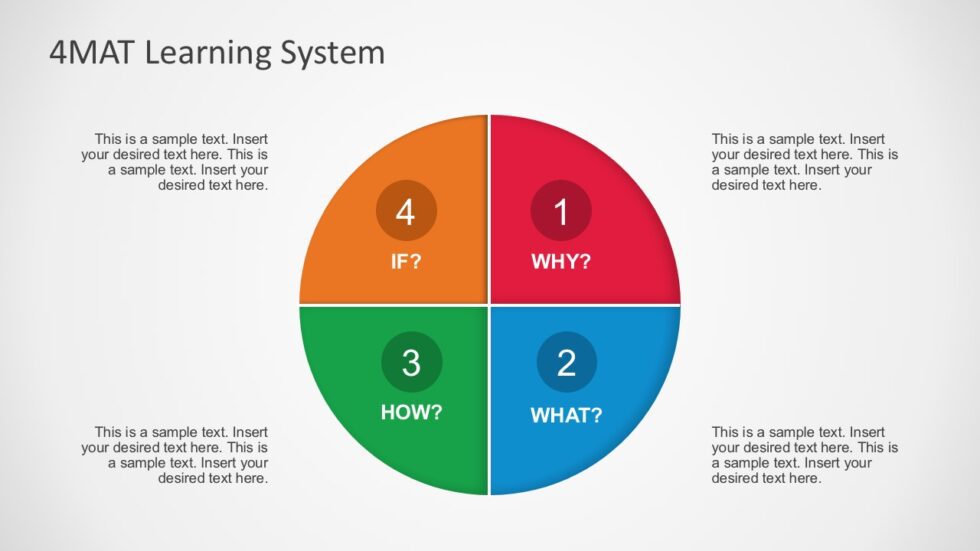
    Quadrant 1:- Why?

    In this quadrant, something happens and your attention is gained. In this, you ask the question “Why? ” Why ought I take note of this? Why is it important? Meaningful? 

    In quadrant one, the first phase of the learning cycle, the goal is to connect. During this quadrant, your complete focus as a facilitator is on winning the attention of your learners and engaging their interest in the subject. 

    In this quadrant, you are seeking to help them understand the real value of what you’re saying, and get the learners to think about how you’re saying fits in with and enhances his or her existing experience.

    Learners concerning their non-public thoughts and ideals to the idea being taught.

    1. Connect (Right mode)

    In this mode establish the relationship between your group and the content connecting to their lives, not telling them how it connects but having something happen in the group that will bring them to create the connection.   

    2. Attend (left mode)

    In this mode have your group analyze what just happened, have them attend to their own experience, and the perception of their fellow group members.

    Quadrant 2:- What?

    In quadrant two, you seek out expert thinking. In this, you ask the question, “What? ” What ought to I understand approximately? And What do the specialists have to say? What statistics exist?

    You build learner’s knowledge and encourage them to find out facts. In doing this you help learners make you watch, reflect, and think about this new information. 

    This all helps to build a good base of the subject. The goal of learning is to inform, to present facts in a systematic and organized form. 

    1. Image (Right mode)

    Encourage the group to picture the concept as they understand it, have experienced it before you take them to the experts.

    2. Inform (Left mode)

    Now they may be equipped for receiving and inspecting professional knowledge. Inform them about expert theories and knowledge.

    Quadrant 3:- How?

    In quadrant three you move into action. You practice. You explore the question, “How?” How is it useful? And How will I apply it? How does it work?

    During this quadrant, you train the realistic talents that come from the concept and inspire newcomers to check their knowledge of the material.  

    This way learners confirm and refine their understanding, and apply and generalize the information they’ve learned. The goal is to help learners to test theories and ideas and apply them to the practical world.

    1. Practice (Left mode)

    Stay first with the left mode. In this group practice, learning as the expert has found it.

    2. Extend (Right mode)

    This is the stage where innovation begins. Group understands sufficient, have sufficient abilities to start gambling with the content, the abilities, the materials, the ideas, the parts, the details, the data, and the big picture, to make something of this learning for themselves, to be interpretive.  

    Quadrant 4:- If

    In the last quadrant four, you encourage learners to extend creatively their use of the skills you’ve taught. This gives practice in new skills and helps them reinforce.  

    During this quadrant, you assess the results of your action and adjust. In this, you ask the question, “If? ” If I do this then what will be the new results generated?

    If I am to achieve success in making use of this, what variations will I make for my real-international environment? 

    1. Refine (Left mode)

    In this also stay first with the left mode again. The group has proposed an extension of the learning into their lives.  

     2. Perform (Right mode)

    At last, have your students perform, Here the content takes a new shape, as it is formed through the group. Look for originality, relevance, new questions, and connections to larger ideas, immediately useful skills.

    4MAT Facilitator Style’s

    Type-1 Facilitators

    • Encourage their students to be authentic.
    • Belief reflection is the main method for raising self-awareness.
    • See knowledge as the basis for achieving good potential.
    • They are aware of social issues that affect human development.
    • Involve their students in discussions and group projects.

    Type-2 Facilitators

    • Try to help their students be knowledgeable.
    • See knowledge as the basis for achieving the target.
    • Are interested in transmitting the best knowledge.
    • Are up to date on the expert knowledge in their content areas.
    • Involve their students in lectures, note-taking, and readings.

    Type-3 Facilitators

    • Believe their students should approach problems scientifically.
    • See knowledge to enable learners to make their unique way in the world.
    • Excel in the technical aspects of their field.
    • Are interested in helping their students achieve high skills competence.
    • Involve their students in problem-solving, and hands-on activities.

    Type-4 Facilitators

    • Help their students with their dreams.
    • They Involve their students in many out of school activities.
    • They see community needs as learning opportunities.
    • Are inquisitive about allowing beginners to search for possibilities. 
    • See knowledge as important to bringing out change. 

    Conclusion

    The 4MAT learning cycle describes the learning activity itself.

    The cycle is creating the connecting experience, encouraging discussion and sharing of perceptions requiring imaging of the concept, informing with the best and most current knowledge, structuring the practice with different options, and providing multiple strategies for extending learning into student lives.

    If teachers understand the cycle perfectly, they can take it. It helps both teachers and students to teach and to learn in a structured form and it provides an easy and effective way of teaching and learning.

    Also you can read our blog on Top 50 Personal Morale Booster

    FAQ‘s

  • Encouraging Team Creativity- Helping Your People to Think Creatively

    Encouraging Team Creativity- Helping Your People to Think Creatively

    Creativity is about creating innovation and finding great solutions to problems. And business is also the same definition. So, both are very essential factors for each other. 

    We live in a competitive world that changes faster. To survive and become successful in this world you need to do something innovative or different. Creativity is one ability that can complete this need.

    Encouraging Team Creativity

    Coming up with a creative solution that solves the biggest problem in society is the basis of startups and businesses. The reason behind all successful market leader companies is the innovative product or service. 

    An innovative leader can open new opportunities for companies. But an innovative team can turn opportunities into success.

    But the question is How encouraging team creativity? 

    WHAT’S IN IT?

    How to Encourage Team Creativity?

    How to Encourage Team Creativity

    1) Hire Potential Staff

    Hiring employees for your companies is a very important part. Because employees are those who run or handle the company. 

    So, be careful while hiring staff. Hire someone on his potential not only just on their skills.

    2) Create a Clear Vision of Your Company

    A clear vision gives your team direction. But, their all thinking and energy goes in one direction. That helps your team to think differently or something creative. 

    If you involve all your team members in changing the goals and strategies of your company then they feel like they are an important part of the company. And they started giving suggestions or

    ideas for new goals and also enjoy the success of your company.

    That affects the overall growth of your company.

    3) Give Training Your Team

    Creativity is about thinking innovatively and creating it. So, it requires learning something new for it. And today’s world of competition needs to keep updated with new learning yourself. 

    Team Training

    So, give training of new things regularly to your team. New learning opens their mind. New learning also boosts their confidence. 

    And both an open mind and confidence to do something inspires the team to think creatively. Learning also gives direction to create that idea into reality.

    “Train people well enough so anyone can hire them on 3x salary, give love enough so they don’t want to leave you also for 10x salary.”- Richard Branson

    4) Listen to Your Staff

    Listening is the most important skill for any leader. If you listen to your employees, they start feeling important and free. Only if your employees or teammates feel free with you, then only they interact with you and give new ideas and suggestions to you. 

    Positive interaction makes your relations better than boss-employee relations. Always end the meeting with open questions to your team-mates and listen to them carefully.

     If you can’t listen to them then they assume you are arrogant. And they started avoiding you and the goals of your company. 

    But, if you listen carefully then their perspective becomes very positive towards you. That’s why all the team can connect with one goal easily and also gives new innovative ideas, suggestions. And if all members of a company work as a team then the efficiency of work and company grow fast. 

    That is the best way to increase the creativity of your whole team.

    5) Act on Their Ideas

    It is very important to listen to employees’  ideas. But most important is to act on their ideas.

    If you just listen to their ideas and don’t react to them then employees start feeling you are arrogant. And after that, they don’t give any new ideas or suggestions to you. 

    If an idea is not good then tell them corrections but when the idea is good then take action on it. Your action encourages them to think about more innovative ideas.

    6) Regularly Do Brainstorming

    Brainstorming

    Brainstorming is a popular way to solve problems innovatively and generate new creative ideas. It is a process where all group members come together and discuss one topic.

    Because of the participation of all members, you get many perspectives about that idea. You get many problems and solutions about that one idea.  

    Brainstorming also encourages your employees to think creatively and share their ideas freely with others. So, do brainstorming regularly in your company.

    Remember a few things while doing brainstorming-

    1. Participation in discussion is a must.
    2. Set a time limit.
    3. Record everything.
    4. Give everyone a chance to share their ideas

    7) Create a Positive Environment

    It is very important to have a positive environment in your office. Make your office where employees do work freely. 

    Interior is a very important factor for any office. The fact is that you and your team spend more time in the office than at home. Good office interior affects the thinking of employees. 

    Positive Environment

    They feel fresh or depressed depending on how right your office interior is. And a fresh mood can generate more ideas. A fresh atmosphere encourages us to think creatively. 

    For creating a positive environment You can paint spiritual paintings on the walls of offices, put some indoor plants in the office, that small changes affect a lot.

    8) Give Freedom

    Different people have different styles of doing work. Some employees work better with music, some are with pen and pencil. 

     Everyone just loves the freedom, if you put conditions on working style employees they do not work at their full efficiency. But if you give them the freedom to their working style. It increases their efficiency and productivity.

    Giving freedom also connects your employees to you. They started doing work with interest and interest generates love towards work. So, employees always try to give their best at work. It is very important to the success of any company.

    Because of freedom, they started feeling better or relaxed at work. So, they can generate more and more ideas.

    9) Allows to Take Breaks

    Continuing work reduces the efficiency of work. It also gives stress. We get tired faster by doing continuous work. 

    Our brain is not a machine. It needs some breaks for rest and recharge. The scheduled break helps to store all information in our brain. And also increases the productivity of your employees.

    A rested brain can think better innovative than a tired brain. So, it is very important to give short breaks to employees during office time.  

    It depends on you or your employee’s contract to give a paid break or non-paid break.

    10) Tell Them Don’t Be Afraid to Fail

    Creativity is all about taking a high risk. So, there is always a chance to fail. Some ideas are brilliant but not profitable for business but sometimes an average idea becomes profitable to your company. 

    If you shouted at employees for their mistakes. Then they are always afraid to share their new ideas. It reduces their creativity. 

    So, don’t be angry when an employee makes a mistake. Give them advice on how they can improve their mistakes and grow. 

    When all fear goes away from your employees then they become fearless. And they feel free to share new creative and innovative ideas.  

    It is very important for encouraging team creativity.

     11) Give Best Awards

    Give Best Awards

    When any employee does some extraordinary work or gives some great idea or suggestion. Then must appreciate our award him ‘in front of all team members.

    Remember, when a leader gives appreciation in front of others then the employee feels very proud of himself. Then he started work not only with more productivity but also connected the company emotionally. Once he connects with all his emotions then he thinks a lot about companies success so he can give a lot of creative and innovative ideas.

    It is very important to connect all members of a company with one purpose.

    Rather than searching for people who do not work properly, search for people who do better encourage them, appreciate them. After seeing this, for appreciation, lazy people also started doing their job efficiently.

    “On which activity you give the award, employee do these activities repeatedly.”

     – Dr Vivek Bindra

    12) Make an Emotional Bond with Your Employees

    Humans are emotional. They easily connected with emotion.

    Remember “Salary is never the highest motivation of retention” 

    “You don’t need only hand and legs, you need head and heart.”- Dr Vivek Bindra

    So, connecting heartly with your employees is very important. If you and your employees are connected emotionally then you get all the pain points of your employees.

    Then you can help them to get out of that pain. Once you do this, then your employees connect emotionally with you.  

    Once they connect with you stronger than they never leave you and always think about your success.

    Work with your employees as a friend or leader, not as a boss. If you work as a friend, then freely give you new innovative and different ideas.

    13) Diversify Work in Your Team

    If one team does one work continuously then they start feeling bored. So, automatically reduces the efficiency and productivity of their work.

    Diverse your team may encourage them to learn different skills. So, the team never feels stressed. This method also inspires them to use their creativity in their work.

    Conclusion

    Employees are the heart of any company. Also, employees come first. So, their skills, their development, their abilities are very important to the overall growth of your company.

    And creativity is an ability that is a must for success. So, make an emotional bond with your employees and always help them to think creatively. That helps your company to achieve more and more goals.

    Also you can read our blog on :- 3 Ways to Deal With Change

    FAQ’s

  • How to Handle a Stressful Job and Relax your Mind?

    How to Handle a Stressful Job and Relax your Mind?

    Stress is the body’s reaction to any change that needs an adjustment or response. The body reacts with these changes with physical, mental, and emotional responses. If you are currently working, you might know what it feels like to be stressed on the job. one question that comes to our mind that is How to handle a Stressful job? A must-do project will arrive without warning.

    Stress is a feeling that can be emotional or physical tension. It can come from any time or thought that makes you feel frustrated, angry, or nervous. Stress is our body’s reaction to a challenge or order.

    In simple bursts, stress can be positive, such as when it helps you avoid danger or meet a deadline

    Stress is a normal part of an individual’s life. While it may seem like there is  nothing going our way we can do about stress at work, there are steps you can take to relieve the pressure and regain control over the Stress. It can be anywhere either at the home or at the workplace i.e at  the office or job

    WHAT’S IN IT?

    Why is it important to handle Stress?

    If we are living with high levels of stress, we are putting our entire happiness at risk. Stress spoil not only our emotional health but also our physical health.

    It narrow’s individual ability to think clearly, function effectively, and enjoy life. It may look like there’s nothing you can do about stress.

    Effective stress management helps us to break the hold stress that has on our  life. As a result, we can be much happy, healthy healthier, and even more productive.

     The ultimate goal is to lead a balanced life, without stress with time for work, relationships, calmness, and to have fun—and the elasticity to hold up under pressure and meet challenges head-on.

    Therefore we need to be free from stress to lead a happy life. One thing comes up to mind is How to handle stress?

    handle-stress-at-job

    Some of the sources of stress at the job:

    1. Firstly, due to Low salary or the stipend
    2. More workload
    3. Less chance of growth
    4. In Addition, it can also occur due to a lack of support
    5. Working with long Hours
    6. Change in the shift(duties)
    7. Hard or tight Deadline

    What are the ways to deal with a Stressful job

    Be Comfortable :

    Dealing with the stress at the workplace or job is physical discomfort, often related to where we perform most of our daily tasks or work. Having Deep and controlled breathing is the best way to calm down and find the most comfortable place for our thoughts.

    Breathing techniques are also effective in the long term. Once we feel the stress is rising again, we can always come back to the state of mind of full relaxation or comfort zone and dealing with the stress.

    Turn to colleagues/co-workers for support:

    Having a strong support system at work can help in Refreshing us from the negative effects of job stress. Just remember to listen to them and offer support/help when they are in need as well.

    Instead of drawing attention to our smartphone, try to be in engaging with your  colleagues, friends or co-workers

    Cool Down as Quickly as Possible:

    Whenever we feel we are frustrated or angry, It is a  heated feeling in our body that can cause us to react.

    Instead of immediately reacting Breathe in through the mouth as if you are sipping through a straw, and then breathe out normally through the nose which helps in dealing with a Stressful job.

    Take time to Refresh :

    To avoid the negative effects of stress and mental, we need time to Recharge  and return to our pre-stress level of functioning. Therefore this recovery process requires switching off from work by having periods or intervals of time

    When we are neither involving in work-related activities nor thinking about work. That’s why it is an important part that we disconnect from time to time, in a way that fits your needs and wish.

    Although When we are not able to take time off, get a quick boost by turning off your smartphone and focusing your attention on non-work activities for a while.

    Make Habit of Doing Exercise Regularly:

    excercise-for-stress

    Regular exercise is one of the best ways to manage or practice a stressful job. While Daily exercise helps us not only to handle a stressful job, but it can also help to boost our memory, creativity, Thinking, making ideas, intelligence quotient. (IQ) and helps us in productivity.

    When we are focused on work, It is easy to neglect our physical health. But when we are supporting our health with good nutrition and exercise, we are much stronger and more Strong to Cope with stress.

    We should remember that any additional movement will help us to manage stress and live a healthier life.

    Also Read: 5 BEST Meditation For Stress Relief: Take a Stress Relief Break

    Prioritize and organize work :

    Making priority can be a major source of workplace stress, especially when we feel like we constantly fire fighting to learn how to focus on what is important, not just the urgent ones.

    If we are working on a project that seems huge, break it into smaller steps. This helps us to allows accomplishing one thing at a time, instead of trying to take everything on at once.

    These can be done by creating a balanced schedule, Planning regular breaks, Prioritize tasks and break the project or work into Smaller ones When job and workplace stress become huge, Therefore, These are simple, practical steps you can take to regain control over to deal with a stressful job.

    Talk to your supervisor or mentor :

    Start by having an open conversation with the supervisor. The purpose of this is not to lay out a list of complaints, instead of to come up with an effective plan for managing the stress that you have been identified, As a result, you can perform at your best on the job.

    While some parts of the plan may be designed to help you improve your skills in areas such as time management, project discussion etc. Talk or speak to them regarding the particular factors that make their jobs stressful. Sharing information with employees can also reduce uncertainty about employee jobs and their futures.

    Reviewing Negative thoughts:

    Long stress and worry can lead people to develop a mental filter in which they automatically involve in the situations through a negative view or ideas. 

    To overcome negative thoughts, treat them as a theory instead of facts and consider other possibilities. Regularly practising this skill can help people at work to reduce negative emotions in response to cope up with a stressful job.

    Being Focus on Problem-solving:

    stress-at-job

    Stress can also be caused due to problem-solving. It is an active problem  strategy that involves teaching people to take various specific steps when approaching a roadblock or challenge.

    These steps include defining the problem, brainstorming potential solutions, Defining the problem, understanding and analyzing the problem, selecting the best solution and other alternatives. These steps can  help to cope with a stressful job.

    Think Positively:

    Our attitude plays an important role in the level of stress, It Doesn’t matter what kind of work we do. We can choose to select the tasks, responsibilities and people with a negative attitude, or can choose to our work and relationships with a positive mindset.

    Although the amount of work or task is the same, the effect on our health and well-being is great. Whenever we catch ourselves slipping into a negative thought of the mind,  start making an effort to challenge our creativity and to think positively rather than Challenging our negative thoughts with logical, fact-based thinking, to boost our self-confidence As it Results in a deal with a stressful job.

    Track your Stress: 

    We may not know what is the reason which is making a cause for stress, exactly how our body responds to stress, or how we cope with stress.  We might consider tracking at the same time every day, or you might want to do it in stressful situations. 

    To track our stress Keep a paper for a week to identify which situations create the most stress and how we respond to them. Recording our thoughts, feelings and information about the environment, including the people and situations being involved, the physical setting and how we have reacted.

    Going For a Vacation:

    how-to-handle-stress

    As long as the worker or the employee doing his job at a point he/she can feel stress. Due to some reasons can be worked based, personal, financial and many more. To Reduce stress one way is to have away from the job and going on a vacation or Holiday which helps is dealing with a Stressful job.

    Having Family and good friends are strong enough for the social support network can help in reducing stress. Positive vacations have a high effect on energy and stress.

    It is studied that about 94% had as much or more energy after coming back after a good trip or vacation. On the other side on low-stress trips, 55% of people returned to work with even higher levels of energy than before the trip. Hence going on vacation helps a lot in dealing with a stressful job.

    Some other ways to Handle a stressful job are:

    • Developing healthy responses. 
    • Establishing the Boundaries
    • Getting some support
    • Finding ways to stay cool and calm
    • Identify the causes of stress
    • Managing a time

    And many more.

    Conclusion:

    It is Conclude that stress can be considered as a fact of nature and the force from the outside which disturbs the individual. When it is on the job it becomes costly for employees or co-workers reflecting in lower productivity, reduced motivation and job skills.

    However, emotional intelligence plays an important role to create the abilities in an individual to better control the stress in the workplace.

    Reduce stressful situations for employees helps in keeping them in a healthy state of mind, both physically and mentally, Employees who learn how to peacefully deal with stress, will increase their personal and workplace performance while maintaining a healthy balance in life.

    Also Read: 10 Ways To Make A Bad Day Better

    Frequently Asked Question’s

  • The Inverted-U Theory – Balance Performance & Pressure

    The Inverted-U Theory – Balance Performance & Pressure


    Pressure sometimes acts as a catalyst in the process, increasing one’s performance level. Let us suppose that you work as a Sales Representative for an organisation and have been doing pretty well for yourself.

    Unfortunately, in a particular quarter, it seems like the organisation will miss its quarterly target, and your manager asks you if you could bring in more sales this time.

    Given the situation and slight pressure from your boss, you decide to take on this opportunity with open arms.  What happens next is that you not only meet your target but overachieve it.

    image of a person in pressure of work


    One can see that there is a slight relation between pressure and performance. In the same scenario, imagine if the boss would have said, “Either you meet your target or lose your job”. This kind of extreme pressure will do more harm than good as you would be spending more time worrying about losing your job instead of making strategies to meet your target.

    We will learn about the  “Inverted-U theory” – also known as the “Yerkes-Dodson Law” to understand this relation in-depth.

    WHAT’S IN IT?

    What is the Yerkes-Dodson Law


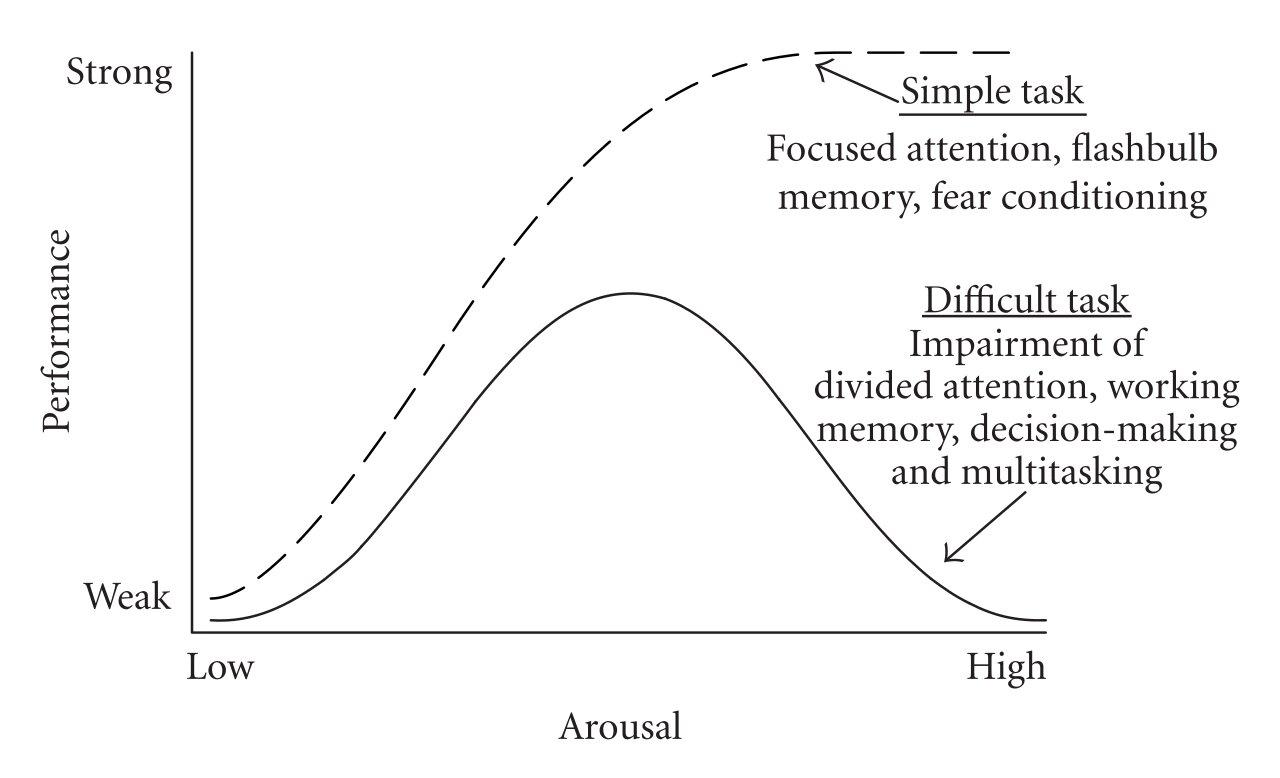
    The Yerkes–Dodson law is an empirical relationship between pressure and performance, originally developed by psychologists Robert M. Yerkes and John Dillingham Dodson in 1908. “The law dictates that performance increases with physiological or mental arousal, but only up to a point when levels of arousal become too high, performance decreases. “
    -Source: Wikipedia.

    image of dillingham dodson
    image of robert yerkes

    Understanding the Inverted-U theory Curve

    On the left hand, we see that Low-Pressure results in mediocrity in terms of the performance level. The lack of pressure does not push people to give their 100%, let alone “going the extra miles” to finish the task.

    The middle portion indicates that the people are performing at their peak levels. Here the pressure is at the optimum level pushing people to their limits positively and not making them struggle.

    On the right hand, we that under high-pressure work to perform and start to suffer from high stress, anxiety, and unhappiness. People here get overwhelmed by the demands, which are next to unrealistic requirements.

    Here we can conclude that to have high-level performance; there is an optimum level of pressure that needs to be applied. Four such factors help us determine the amount of stress necessary to have a good understanding.

    Factors that influence the Inverted-U theory

    Like we discussed earlier that some factors influence the optimum level of pressure. We have to keep in mind that everybody is not the same, and working for one might not work for the other. These factors consider this point and help you to find the right amount of pressure. 

    Skill Level: 

    Whenever someone takes a new task in their hand, there is a high intrinsic motivation for the study. Eventually, with a passage of time, when the person increases his/her skill to a level to find the study easy, we witness a drop in performance level.

    In such a situation arises the need to exert pressure from outside to keep the performance level up.

    Personality: 

    Different types of personalities respond positively to different levels of pressure. As per a study, an extrovert person would perform better under high pressure. Whereas an introvert person will perform better under low pressure, one needs to keep in mind that the person might already be under some sort of tension or stress due to some of the happenings in his/her private life. This is one crucial point as it can help in not putting up the person under high pressure.

    Task Difficulty:  

    A task of easy difficulty will require less effort and attention than a charge of hard difficulty. Let’s take the example of a Chef. It won’t be a problem if the Chef has to cook for ten people instead of 5 or 7.

    Imagine if the same Chef says, let’s participate in a competition where he has to give a presentation between 100’s of people about various dishes and how he cooks. This might be a task of more incredible difficulty and would require more effort and preparation from his side. 

    Trait Anxiety: 

    Self-Confidence plays a significant role here. A person with high Self-Confidence is likely to perform better under a high-pressure situation than a person with low Self-Confidence. It’s because a confident person always believes in himself and his abilities. He takes on new opportunities with a positive attitude.

    Whereas a non-confident person always lives under self-doubt, questioning his abilities. Before facing the task, he is more about winning or losing instead of preparing for it or looking at it as a learning opportunity.

    Difference between Pressure and Stress

    We often hear these statements that “I work under high pressure” or “I have a stressful job”. Generally, these two statements are the same; for them, pressure = stress. To everyone’s shock, I will say that no pressure does not equal emphasis. As per  Hendrie Weisinger:

    • Stress refers to too many demands and not enough resources – time, money, energy – to meet them.
    • The pressure is a situation in which you perceive that something at stake is dependent on the outcome of your performance.
    image of hendrie weisinger

    Generally, stress is always viewed to be a negative term as compared to pressure. Stress is looked at as a situation where one is not much in control of the problem. For Example:

    late meetings, long commute, too many deadlines. Now, these are the situations that are not possible to control.

    On the other hand, a problem under high pressure is one you own. For Example, You have to meet a given sales target to meet. Now it’s upon you; if you put in the extra effort and are willing to go that extra mile, you’ll accomplish the target.

    Conclusion

    So after this article, I believe readers will now not see pressure always in a negative light like other people. Moreover, you can teach them how pressure can help to enhance performance. This is very useful for people who are having managerial roles as this can help them get maximum output from the team without burdening them.

    Remember, the optimum level of pressure is the key here, which depends on the four factors we discussed. It’s also essential to notice that the individual might be already in some sort of stress because of his/her private life. Confusing pressure with the focus can cost us a lot, especially in terms of productivity.  So, it’s necessary to know when to utilise what.

    Also, you can read our blog on 5 BEST Meditation For Stress Relief: Take a Stress Relief Break


    FAQ’s

  • Training Programs: 7 Ways to Gain the Most from Them

    Training Programs: 7 Ways to Gain the Most from Them

    In this Blog, You will Get Complete Information regarding Training Programs and Top 7 ways to gain the most from them.

    WHAT’S IN IT

    Introduction: Training Programs

    Firstly, Training is a mode of imparting teachings to increase the ability of oneself to perform the desired activity.

    Training Programs are the set of instructions or processes developed which lead to the enhancement of skills.

    Not Only Skills But also knowledge, mindset, attitude, or efficiency of an individual whichever field he might be in. 

    Every individual throughout his life undergoes some sort of training, be it formal or informal, by an institution or self-training, learning with the go of life, etc.

    How many times have you attended the training programs of any sort as a student or a professional and were able to remember or implement the learnings provided to you?

    Probably very less to zero.

    This was probably because either you were pulled to the training against your will by your institutional requirements.

    Also, it can be possible that you were provided with generic training with no real or direct utilization of your subject or profession.

    Be it generic training or customized, any training will certainly add value to people in a certain way directly or indirectly.

    The only thing is that you have to be able to gain from it.

    7 Ways to Make the Most of a Training Opportunity

    Now Check the ways which are mentioned below on how you can get the most of any training programs.

    1. Get your midset right:

    Training Programs: 7 ways to gain the most from them

    Most people fail to gain from any training programs (mostly generic ones). Because they already have a negative perception.

    That these types of training do not provide any useful value to their profession or work.

    For these people, whatever training they acquire, will be wasted as they do not focus on learning and application.

    Pre-set mindset is the major cause of this problem. This mindset arises due to past experiences or misinformation. So, you mustn’t apply these filters when you come to learning and have a positive belief system.   

    2. Do the pre-work:

    Many pieces of training include a pre-assignment or a pre-assessment exercise that needs to be completed before the start of the training.

    Now, many people do not want to do this pre-exercise but it is rather important for you to self-analyze your current skill and helps you to develop a path to your desired skills.

    It helps you analyze your skills and knowledge gap that is required to excel in your field.

    3. Identify the Purpose of Training Programs:

    It is important to identify what is the purpose of training or in other words.

    What are you going to get from that particular training?

    Find out what is in there for you, what skills you will develop from it, What knowledge you are going to get, what new learnings you are going to achieve.
    This way you can identify your definite goal and you can focus on your efforts to achieve that goal. 

    4. Align your learning outcomes with your goal: 

    Set up a clear connection between what you learn in a training program to your goal that you want to achieve.

    Identify what learnings are associated with your Desired skills.

    This will help motivate you to learn actively in the program and work towards the development of your skills.

    5. Develop a post-training action plan: 

    Mere learning anything is not enough until you apply them.

    You need to set up an action plan which can layout guidelines on how you can integrate and apply the things that you have learned in a training program.

    Set up a step by step process or a strategy in a certain time frame on what action or implementation you will perform.

    Make realistic plans and troubleshoot for any problems or obstacles you face.

    6. Attend follow up sessions:

    Many training providers organize timely follow-up sessions for their trainees to solve any challenges if anyone is facing while implementing the concepts or learnings.

    You should attend these sessions to get clarify your queries and get more insight into implementing your skills.

    Even if you do not have any queries, then also you can learn something new by listening or analyzing other people’s challenges and measures to solve them.

    7. Supplement your training by ‘Social Learning’:

    You learn better when you share your experience with someone, you have a mentor to guide, you have an example to follow.

    Social learning connects the learners and mentors so that they can discuss and share their experiences and challenges.

    This can be done through chat groups, forums, social media groups, video conferencing, etc.

    This process of social learning is an effective way to keep oneself motivated, enthusiastic, and looking to learn more.

    Conclusion

    Nowadays in the age of competition, you need to outperform others to move ahead in your professional career or business.

    To attain this edge over others, you always have to keep upgrading your skills and productivity. Attending various training programs will sharpen your skills and efficiency.

    However, not many people can completely gain from the training programs they undergo. There may be a mindset problem or approach issue to the training.

    You need to keep a positive mindset & know your learning style on how can you gain the most from it.

    You should not skip any pre-work or mind-training assignments. Identify what benefits you can get from any training and align your learning from that with your actual goals.

    Implementation is the key. So, apply the things practically that you learn from training and always keep brushing up your skills.

    Keep sharing the knowledge or discussing it with your co-learners. And mentors on a discussion forum or any means of interaction.

    Also you can read our blog on Planning to Manage Performance Stress

    FAQ’s

  • VAK Learning Style – How to Identify your Learning Style

    VAK Learning Style – How to Identify your Learning Style

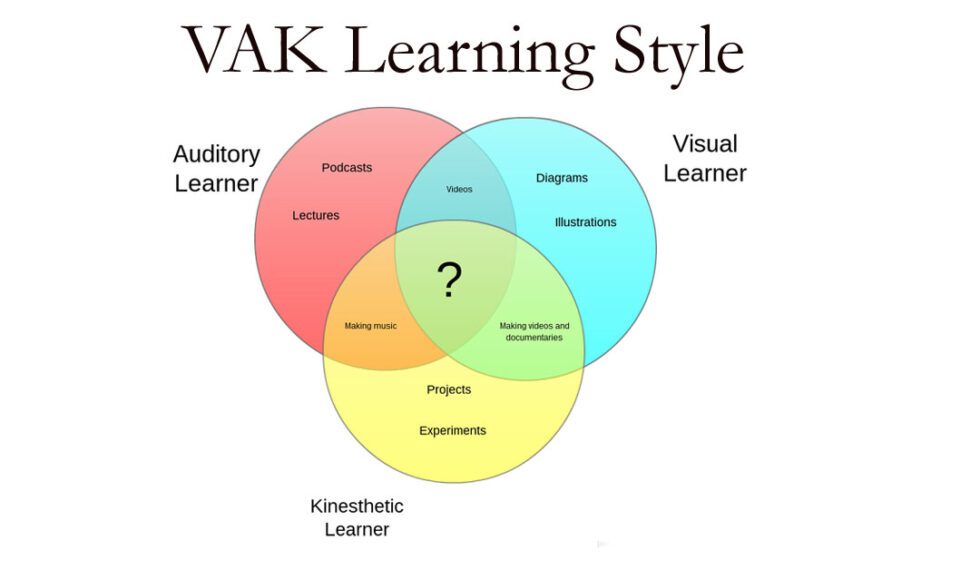
    Now VAK learning style is one of the most comfortable learning styles, making learning simple and effective as per your understanding. VAK stands for Visual-Auditory-Kinesthetic.

    This VAK learning style was introduced in the 1920s by some experts and psychologists. This VAK learning style contains three types of learning styles – Visual, Auditory, and Kinesthetic. But here is a point which type of learning should you follow. Everyone has a different way of approaching learning. Some take Visual as more effective than the other two while some take Auditory or Kinesthetic as their effective way of learning.

    So from the above, we can say that there is no right or wrong way to learn. It entirely depends upon you. 

    So we should generally analyze all the learning process and find any of the compelling methods of learning which fits on us.

    Researchers also suggest that different people choose different learning styles depending on the task.

    WHAT’S IN IT

    Dominant learning preference 

    Everyone has a dominant learning preference of their own from the early stage of life. That means someone learns something new more quickly and effectively by listening to it from the early stage are using Auditory learning as their dominant preference. In contrast, others find visual learning a way to learn a more effective way for them, their dominant learning preference. Also, others choose kinesthetic means practically learning style as more effective take it as dominant preference.

    According to researchers, everyone has their dominant one or two learning styles, which he uses for learning correctly; however, learning style is changing depending upon the learning situation. 

    It is also found that people also use all the learning modalities to learn new information, process it, etc.

    Characteristics of VAK learning style

    VAK learning style mainly focuses on increasing the learning ability that can be done by using the three styles of VAK:- Visual, Auditory, and Kinesthetic in a perfect way. The learner has to check which style of VAK is more useful to him.

    Visual ( Learners )

    These types of learners choose to learn the new learning by seeing it or also by visualizing in pictures or text format inside their minds.

    They learn more effectively when presented in the form of images, maps, diagrams, graphs, etc.

    Visual learners learn more effectively when they get content displayed with the main point in the text.

    They also include mind mapping, so charts, graphs, etc. are more likely to absorb in detail by these types of learners.

    The qualities of Visual learners are:-

    • Enjoy art, aesthetics, etc.
    • Always take many notes. 
    • Love to learn with graphs, diagrams, and pictures with written instructions.
    • They are excellent at spelling. 
    • They are more imaginative.
    • Most of the visual learners remember only faces, not the names.

    Auditory ( learners )

    This type of learner’s VAK learning style prefers listening as his / her best way of learning and always responds best to voice. They always love to learn with the verbal lesson, discussing, talking, speaking, etc.

    Most of the time, Auditory learners find talking to themselves according to the VAK learning style, and it is also found that they feel more difficulties while reading or writing tasks and focusing on those.

    The qualities of Auditory learners of VAK learning style are:-

    • Sensitive with the tone of voice, pitch, etc.
    • Comfortable with verbal instructions. 
    • Find easy-to-follow verbal instructions.
    • Prefer to record rather than making notes.
    • Tends to learn better while music is on. 
    • Good at oral presentation and group discussions.
    • They may be good speakers.
    • Remember only names rather than remembering faces.

    Kinesthetic ( learners )

    In this Kinesthetic VAK learning style, Learners always prefer to learn with real experience. They always want direct contact or motion with the learning material they get physically learning that ultimately helps them learn more efficiently. 

    The work Kinesthetic is derived from the Greek work Kineo and Aisthesis. The meaning of Kineo moves, and the meaning of aesthesis is sensation. Overall the meaning of kinesthetic is move – sensation.

    Researchers explain that this type of learner may lose their concentration more quickly when there is no external movement or stimulation. 

    Researchers also say that while listening to a lecture, these learners may take notes just because to move their hands and mostly use color highlighters.

    The qualities of Kinesthetic learners of the VAK learning style are

    • Enjoy learning physically. 
    • They are good at sports and physical activities. 
    • Always express themselves in a natural approach.
    • Are restless, always found in motion. 
    • Good at practical subjects like engineering.
    • Also good at problem-solving. 
    • They always enjoy playing sports and games.

    Helpful Steps For VAK Learning Style

    There are a lot of steps that VAK ( Visual – Auditory -Kinesthetic ) learners can use to improve their learning on any topic.

    Here we will discuss some helpful steps which a VAK learner uses to make their learning more comfortable and productive.

    For Visual Learners

    • If you are a Visual Learner, Take the information in the form of diagrams, charts, graphs, etc. rather than take it as in text format, it makes the information easy to learn and recall.
    • Always try to consume your learning through visuals, which will boost your learning.
    • Try to store the learning in the form of colours and pictures to remember it for a more extended period.
    • Use handouts and make notes on your learning topic and make keywords.
    • Try to create a mind map of the topic which you learned.
    • Always make a highlight on the essential points.
    • Whenever you only have a choice to learn a topic in the text format, try to relate the text with a picture inside your brain and create a visual form of that learning that makes you learn without complications.

    For Auditory Learners

    • The Auditory Learners have a vast capability of learning through audio rather than through any other format. So always prefer the Audio format for your learning, which will be more beneficial and useful to you.
    • Always try to make records as audio if possible rather than making learning as notes.
    • Background music can be helpful to you. But it’s upon you – If you find background music helpful to you, then play it while learning. It is also beneficial for recall.
    • Group discussions and oral presentations of a learning topic are found helpful to the Auditory Learners. So try to use it whenever you get any chance to do it.
    • Debates and Storytelling are also found helpful for Auditory Learners.
    • Discussing and repeating the learning topic makes it easy to remember that topic. So it is also a good idea for Auditory Learners to improve learning.

    For Kinesthetic Learners

    • Kinesthetic Learners mostly learn physically and practically. So if you are Kinesthetic learners, then try to learn everything in a practical way to make your learning easy, more productive, and can remember for a more extended period.
    • Try to choose practical courses as your career, if possible, so that you can do your job by enjoying it a lot.
    • Kinesthetic Learners are more likely to restless. They are always found in motion. So make sure that your restless nature is going in the right direction. For example, Kinesthetic Learners can use their restless nature in teamwork for a better result, which gives the right direction to their motion.
    • Always prefer to learn in practical format rather than any other format that is more helpful to you. Try to convert into practical if it is found in any other format like text, visual, audio, etc.

    Conclusion

    From the VAK learning style, We learn that learners have to identify their learning style whether they are Visual, Auditory, or Kinesthetic learners. They can also consider their Dominant learning preference.

    After finding which types of learners they are, they can use the helpful steps to improve their learning based on the preferred learning style.

    Another thing is that one can use different learning styles for different tasks if they are comfortable with this learning style.

    Also read our blog VAK Learning Styles – Discover Your Learning Style

    FAQ’s