Author: lapaasindia

  • The JD-R Model Analyzing and Improving Employee Well-Being

    The JD-R Model Analyzing and Improving Employee Well-Being

    JD-R model stands for Job Demands-Resources Model.

    It is a model that supports the functioning of employee well-being.

    JD-R model model is known as one of the leading job stress models which are used by managers and supervisors to manage employees’ involvement.

    This work stress model suggests that our stress arises from the imbalance between the requirements of the job & the resources the employee has available to meet those requirements.

    WHAT’S IN IT

    The Job Demands-Resources Model (JD-R model) Overview

    JD-R Model

    The Job Demands-Resources Model (JD-R model) was introduced in 2006 along with other models such as Karasek’s Job Demands Control (JD-C) model & Siegrist’s Effort Reward Imbalance (ERI) model for employee well-being.

    The authors of this JDR (Job Demands-Resources) Model are Eva Demerouti & Arnold Bakker.

    They published the results of a long-term study in The Journal of Managerial Psychology.

    Moreover, this Model became much popular among researchers.

    The present model states that high job demands lead to strain and Damaging the Health and high resources lead to increased motivation and higher productivity

    Types of components in the JD-R Model

    This model divides the working conditions into two Components or two Categories:

    They are job requirements and job resources.

    Their study before the creation of this JD-R model shows proof for the existence of these two parallelly occurring processes.

    A complex or difficult job demands a lot of both the mental and physical capacities of employees.

    This can lead to a decrease in our energy and other health problems.

    However, when the job resources don’t form a block these could improve the involvement of employees and the performance of the company or organisation as a whole.

    Generally, it is true for people with a high position.

    For people with a lower position, the availability of job resources doesn’t necessarily create extra motivation.

    Job Requirements

    It is also called Job Demands that relates to the physical, social or emotional features of the job and the work environment.

    This mainly concerns our factors such as time and work pressure, poor relationships, Heavy workload, role uncertainty, stressful environments and leadership.

    These often demand long-term physical effort and skills.

    Job Resources

    The job resources, also called positives, are the physical, organisational or social factors that help the employee or the worker to achieve the established objectives or the goal and reduce stress.

    Examples of these include coaching and monitoring, learning and career development opportunities, good/strong relationships, freedom and more.

    The JD-R model of engagement states that when job demands are high and job positives are low, stress and nervousness (Break down )are common.

    Good job positives can offset the effects of extreme job demands, and encourage or cheer motivation and engagement.

    The JD-R Model Explanation

    Let us learn the model After three years of JD-r Model implementation it includes work engagement in addition to burnout.

    Considering burnout & work engagement to be mediators of the relation between job demands, job resources, health problems, and etc.

    The revised JD-R model not only look out to explain a negative psychological state i.e., burnout but also its positive counterpart (work engagement).

    Work engagement refers to a positive, fulfilling, work-related state of mind that is characterized by high levels of energy and mental strength.

    This model assumes that burnout results from high job demands & poor job resources.

    Generally, it is assumed that burnout will lead to health problems, such as depression, cardiovascular or heart disease, or psychological complaints.

    As a result, burnout is expected to mediate the relation between the job demands and employee health and well-being through the slow draining of mental resources that is burnout.

    Hence, This is the energetic or health impairment process of the JD-R model.

    Revised JD-R model highlights

    Similarly, a motivational process operates that is sparked or flash by huge job resources.

    The revised JD-R model highlights the Stress motivational qualities of job resources.

    Job resources play an external motivational role, as they initiate the ability to spend compensatory effort.

    Thereby reducing job demands and encouraging in achieving goals. That is, job resources are important in achieving work goals.

    Moreover, they also play an internal motivational role, because they satisfy basic human needs for freedom.

    For instance, feedback may promote learning, thereby increasing job capacity whereas, decision latitude and social support convince needs for autonomy or freedom and relatedness, respectively. 

    In both these cases, job resources stimulate a positive work-related state of mind that is work engagement either through the achievement of work goals or the satisfaction of basic needs.

    So engagement is assumed to be an intermediate relation between job resources and organizational outcomes.

    Balance

    Balancing between the job resources in the JD-R model & the job requirements determines the degree to which employees feel energized by their job or work.

    If the balance is negative, and the work demands more in terms of energy than it yields.

    The negatives outcomes could be Lack of concentration, More mistakes, Negative working atmosphere.

    This will lead to burnout or physical symptoms. If The balance is positive when the job gives more energy than it costs.

    A positive outcome can be an employee is more productive, there is little absence or leave, the working atmosphere is quite good.

    This leads to an engagement visible in the attitude and behaviour of the employees.

    The Role of Involved Employees

    Both employee satisfaction or pleasure and employee involvement play a central role in the Job Demands-Resources Model (JD-R Model).

    Employee satisfaction indicates how happy or satisfies the employees are Satisfy employees more often have a good balance between both job resources and job requirements.

    A Satisfied employee is also generally more involved. And creates great value for the organization or the Company.

    Uses of Job Demands-Resources Model (JD-R Model)

    The JD-R model, shown below, can help us to understand and respond to our team’s needs.

    For instance, if job demands are high and resources are low, our team members are more likely to experience greater levels of stress.

    As a result, we are likely to see high absence and high employee turnover. In this situation, we should work to increase job positives.

    By doing the below activities you’ll reduce stress and increase people’s motivation.

    It is easy to apply and can be used at each position. Using the step-by-step plan can determine our work balance.

    Step-By-Step Plan to Determine Personal Balance

    the Jd-r model of engagement

    Step 1. Identify Job requirements

    Start by making a list of all the job requirements of the position.

    Job demands include all physical, psychological, social or organisational aspects of a job.

    Start by noting the stress that could hurt our team. These could include the following:

    • Short deadlines.
    • The bulk of work.
    • Complex/Difficult or boring projects.
    • An uncomfortable work environment.
    • Poor at working relationships.
    • High work pressure
    • Time pressure
    • Availability        
    • Limited or fewer opportunities for career growth

    Step 2: Address Job Demands

    There are Chances that we have a long list of factors that could negatively affect our team. It will be within your power to change many of these.

    So, separate the ones that we can influence from the ones that we can’t, and do what you can to reduce job demands.

    Some of the things to reduce job demands are:

    • Pleasant working Environment
    • Understanding the true purpose
    • Supporting Our team members
    • Team members are engaged in emotional labor

    Step 3: Identify Possible Job Resources

    The list of job requirements might look negative, but it isn’t necessary to have so.

    Below list includes examples and the job requirements differ per job.

    When we get the right resources available, this might even create extra motivation.

    • Firstly, Opportunities for career growth
    • Training and development opportunities
    • Mentoring or Coaching
    • Pleasant work environment
    • Good work relationships

    Step 4: Promote Job Resources

    Look for opportunities to encourage learning, Training and development.

    But don’t overlook low positives, such as good working relationships; these are highly important for reducing job stress.

    Provide regular constructive feedback to your people. This will help them to feel supported as they grow, build and develop. 

    Also, offer a wide range of training and development opportunities. Cross-training is great for developing people interestingly and easily.

    The JD-R Monitor

    As an example of practical usage of the JD-R:

    A large pool of reliable and valid short scales that assess job demands, job resources, personal resources, psychological states, and positive and negative outcomes.

    Which are available and can be included to dress up the JD-R model, depending on the information needed.

    The JD-R monitor is used in a particular seven-step cyclic process for evidence-based organizational consultancy. The below figure shows JD-R Monitor

    Step 1: The Problem

    An organization or Company may have a very general question, such as:

    How do the employees experience their work? But the problem could also be more specific such as:

    1. How can an employee’s levels of work engagement be increased?

    2. What are the risk factors for burnout?

    3. How can we keep older employees ready for work?

    Step 2: Designing the JD-R-Monitor :

    Together with key persons:

    Such as

    • HR officers
    • Management
    • Team members
    • Occupational physicians
    • Most relevant job stressors, personal and job resources, stress reactions, & outcomes are chosen or select and include in the JD-R monitor.

    It doesn’t know what the final content of the JD-R-monitor will be.

    Step 3: Internal Communication:

    Before taking out the survey, an internal communication campaign is a launch.

    This usually includes keeping a kick-off meeting with all employees, sending all announcements via the company’s network, and publishing background articles in the company’s magazines.

    The basic goal of the campaign is to highlight the importance of the survey and to underline the commitment of various Partners, including top management and unions.

    Step 4: Survey and Individual Feedback :

    All employees will receive an email with a link to the online JD-R monitor.

    It takes employees 15–30 min approximately to complete the survey, and response rates usually range from 65 % to 85 %, depending on how well the project is communicated to the employees.

    Privacy is the guarantee that nobody in the organization has access to the data of the employees.

     Moreover, in the case of a negative score, the feedback text invites the employee to take action.

     Step 5: Analysis and Reporting:

    The company report is based on total data, which means that average scores for the entire company and its various units are calculated.

    Like the individual feedback report, the company report gives an outline of the scores for each element of the JD-R monitor, including a comparison with a benchmark

    Step 6: Survey Feedback:

    The report discusses throughout the company at various levels, not only in the boardroom but also with the employees at the team or department level, or even in focus groups.

    Feeding back the results and discussing these critically with management, supervisors, and employees is much important to build commitment and trust for implementing interruptions or Interventions

    Step 7: Interventions:

    Base on the results of the JD-R monitor, two types of measures can be taken.

    First, the employees can take measures themselves to improve their own personal or job resources or to decrease their demands.

    But also team and organization-based interventions can be implemented.

    These may take on many different forms, ranging from the training programs for employees and supervisors to team-building, job redesign, or culture change.

    Step 8: Evaluation :

    After the intervention, the organization or Company can go through steps 1 to 7 again.

    For Example: To check whether the implemented intervention has been effective or not. The JD-R monitor is then used in a second cycle to investigate

    In the ideal case, the JD-R monitor is Combined in the annual HR cycle to monitor the quality of the company’s human capital, so that evidence-based HR policy decisions can be made.

    CONCLUSION

    The distinctive feature of the JD-R model is its generalization and flexibility, meaning that the model can be used in a broad array of situations Job Demands-Resources Model (JD-R Model).

    It is a model that studies the functioning of employees’ well-being.

    This model consists of two main elements:

    That is job requirements and job resources.

    Job requirements relate to the physical, social or emotional characteristics of the job and the work environment.

    The job resources comprise organisational or social factors that could help the employee to strive for objectives.

    Therefore, the balance between the above two factors is telling about the experienced stress levels and the well-being of the employees.

    The Job Demands-Resources Model can be used by everyone with a job or work to determine the balance.

    For this purpose, the user must create a list of the job requirements, and compare this to the list of job resources and positives.

    However, In the case of an unbalance, job resources must be pro-actively promoted.

    Making sure an employee is involved doesn’t just benefit the employee’s well-being, it also benefits the entire organization or Company through the extra value he/she offers.

    Also you can read our blog on 10 Ways to Stay Calm During in Crisis

    FAQ’S

  • Everything About Customer Service Framework

    Everything About Customer Service Framework

    Customer Service Framework plays an essential role in every business, let’s understand it deeply.

    When we start a business, we always talk about how we gonna sold the product to the customer, or we will going to attract them. But the thing which made a customer come back to you is the service you provide to them.

    If the customer is happy with your service, then that’s fine, but if you don’t provide proper service to them, then they are just going to tell everybody about the bad experience, and it is not suitable for your business. And it is very bad for the reputation of the business.

    For providing a great experience to the customers, you need to develop a customer service framework.

    WHAT’S IN IT

    Why it is Important to make a Customer Service Framework

    Why does a customer come back to you for purchase?

    Because of the Cheap rate, Quality, user friendly, luxury, and customer service, people often talk about the above four topics because they are exciting, and you can put all the new ideas in it.

    But customer service is just something your company should focus on.

    Apple and BMW are the companies that really for on their customer service; they make sure that their customers do not face any trouble after buying their product.

    And to give a good customer, you need to make a good customer service strategy and a good overall customer service framework.

    What is the Customer Service Framework 

    The Definition of customer service framework is the assistance, the advice provided by the company to customer buys a product or use it after buying.

    In simple words, if a customer comes to your company and wants to buy a product.

    You need to give him proper assistance and help them to purchase the product by giving them advice and also provide support after they buy your product.

    We can go like that when you start a business. You start doing marketing and all and try to sell the peoples your product. So you can divide the process of a person to become a regular customer into the following parts.

    1. Suspect
    2. Shopper
    3. Customer
    4. Advocate

    Suspect- It is the first stage where you don’t know the person. The person doesn’t know you, but still, the customer just giving you a try by seeing your marketing and all.

    Shopper- It is the second stage where a person buys something from the company just once.

    Customer- It is the third stage where he comes again to your company and buys another product. Because he likes the product, but now you can make him the regular customer by giving him the service of the product and make him feel like that he belongs here.

    Advocate- Once you made him feel that he belongs here. The customer will tell the people around him about the products and services you give, and it will help you lot to get the mouth promotion about your product.

    How to make a Customer Service Framework

    Customer Service Framework

    For making an excellent customer service framework the things you need to insure are

    Customer Service Strategy

    It is the most important thing to make. Customer service Strategy is a blueprint for how to interact with the customer, and for that, we need to follow the following points.

    Make a good team

    To make a good team first, you need to hire the right employee, the people who are good in communication skills having a good personality can do it. Then trained the employees.

    How to respond to complaints, How to be responsive to the customer, How to answer the call and your organization service standards.

    Common Purpose

    Building a lasting relationship by creating an enthusiastic fulfilling experience for everyone.

    This means that you need to build a relationship with the customer everyone in the team whether he is new or working for many they all need to be on the same page.

    In this, you just made a good relationship with the customer, and for that, you need to make a good team of people and trained them to talk and teach them how to connect with customers and taking care of them.

    Common purpose also means that the employees have to know what the company stands for what is the vision of the company. 

    Set a Benchmark

    As a company, you need to set the target, and employees try to reach it. Targets like employees need to solve x number of problems of the customers in a period. 

    Create a customer feedback system

    Customer Service Framework

    Creating a feedback system is very important in your business. It shows you how your customer thinks about your service where you should improve.

    And also shows that which member of your team is good and which are not.

    Give rewards to the employees

    Giving rewards for doing a good job is very important.

    It motivates your employee to do more such things, and this process increases the motivation of employees to do good work. You can give a gift or some appraisal money to them.

    Integrity

    It is very important to maintain integrity in a customer service framework. Integrity, you need to talk with honesty, for example, don’t tell something which is not practical like sometimes serviceman says that you don’t get any problem ever.

    Putting ever is wrong. You just need to be honest with the customer. As a company or a business, you have to fulfil the promise of the service you give to the customer.

    Sometimes you just need to do some extra like if you are repairing a certain part and you find a problem in another, which can harm the product later, then you have to tell the customer right now and fix it.

    Efficacy

    It is very important to work efficiently.

    For example, if you own a car company you just need to give service quickly, it should not like you take a whole day or something you need to be quick and finish the work as soon as possible.

    Listening

    Listening means you just take very feedback, and you need to react to it. If someone praises you, you have to say thank you.

    If customers complain, you need to address it quickly. Or if a customer just gives a bad review, it is your job to react to it and apologize for your mistake.

    This process gives confidence to your customer that you are listening to them and you are going to solve their very important problems your customers need to have confidence in you. 

    Culture

    You need to develop a culture in your business that you do service in a particular period example an employee repairs a certain part of a machine.

    But now he finds that there is another problem also in the machine now you have to fix it also, but you are busy for the whole day then in such case another employee should help him not to worry about the things like this work belong to him why should I have to do it. 

    For making such things happen, your business needs to have a culture like that where everybody helps each other.

    Another Example: Suppose you own a car company, and your customer comes to you for service, and now you drop him in your car to home in a case customer have to kids with him a, but you don’t have special seats for the kids.

    In such cases, you just don’t drop them in your car even if customers insist on that because it is not safe for them.

    Conclusion

    The customer service framework is a very important part of your business idea because if a customer is satisfied with your service, he comes back to you.

    But if he is not satisfied, then he is going to tell everybody and it just not good for your business so for making a business successful and making customer permanent you need to provide a good service by making a good customer service framework. 

    Also, you can read our blog on Employee Retention Strategy: Everything You Need To Know

    FAQ’s

  • Action Plan for Small Scale Planning Detailed Guide

    Action Plan for Small Scale Planning Detailed Guide

    Do you know what Action Plan is? Yes, you know what the Action Plan is. It is the process of completing any task or object on time. Do you know how Action Plans works for small scale business?

    Action Plan is a process of listing down all the task and objective of a business to analyse that which project or purpose is running late to improve their action plans to achieve their goal on time.

    So in this blog, I will discuss all the things about the action plan, which small scale businesses use to achieve their goals.

    WHAT’S IN IT

    Characteristic of Action Plan

    There are three Characteristic-

    • Timetable

    It is essential because it helps manage time and complete tasks on time.

    When the team sets a task or objective, they decide the deadline for all the employees to complete their task till at his deadline.

    This makes them not waste their time and can work efficiently in the organisation. This helps them to achieve their goal or complete their task on time.

    a time table is necessary for action plan
    • Goal-Oriented

    This is also another main point why it is so important because it is beneficial to set a timetable according to its goal.

    When the team sets a task, an action plan helps them develop the study accordingly, achieving its goal.

    This makes them not waste their time and work efficiently in the organisation. This helps them to achieve their goal or complete their task on time.

    • Clear Description

    This is also another main point why an action plan is essential because it clarifies its objective.

    When the team clears the company’s objective to the employees, they start working to achieve the goal.

    This makes them not waste their time and work efficiently in the organisation. This helps them to achieve their objective or complete their task on time.

    Process of Action Plan

    There are three steps to make it

    • Identify Tasks

    This is the first step to make the Plan. In this step, they identify all the tasks, the company’s goal, what is the current position, and what the work will in the future. So this step makes clear to all that what the objective of the company is.

    a lady identifying tasks for action plan
    • Analyse and Delegate Tasks

    After completing the first step, this is the second step in which when the team sets a task or objective, they analyse all the functions & employees and delegate the task to them according to their efficiency.

    And they decide the deadline for all the employees that everyone should complete their task on time. This makes them not waste their time and can work efficiently in the organisation.

    This helps them to achieve their goal or complete their task on time.

    • Double- Check the Action plan

    After completing the first and second steps, this is the last step in checking that the plan or task they have decided on includes everything to achieve the company’s final goal.

    If Yes, they stick to the plan, and if No, they again identify their company goals, then analyse & delegate tasks, then Double – Check their Plan.

    Importance

    • It helps the employees of the organisation to achieve their goals efficiently and effectively.
    • This helps to complete their work within a specific period.
    • It helps them to decide what to do and how to do it.
    • Top management analyses all the tasks & employees and delegates the job to them according to their efficiency.
    • This helps the organisation to measure the performance of all the employees.

    Limitations of Action Plan

    • It reduces creativity

    Once the Plan is made by top management, then all the employees blindly follow it.

    They stop giving suggestions and new ideas to the management for any changes due to change in a business environment.

    • It involves a considerable cost

    This process causes huge costs because the company has to hire experts to make the correct plan, which takes a considerable cost and time.

    There is no guarantee that the Plan they will make is always correct because of change in the business environment.

    • It is a time-consuming process
    action plan is a time consuming task

    It is a time-consuming process because experts take lots of time to execute the final plan, due to which action is delayed.

    So when the business environment changes, they have to start making a plan from the beginning, which involves lots of time.

    • It does not give any guarantee to success

    They do not give any guarantee that the plan will provide good results consistently. It is not guaranteed that the Plan that had worked successfully in the past will always work successfully in the future.

    The top management or experts must make changes in their plan regularly according to change in the business environment.

    • Lack of Accuracy

    This is another limitation of the action plan, which fails whole planning because the future is uncertain; every day, the business environment changes.

    The planning can be successful at present, but it is not confident that it will work in the future.

    Tips of Action Plan

    • We should use the visualize list while making an action plan for the company because whenever the particular action plan is completed, we can remove it from the list.
    • Every day we should record daily activities that tell us whether we are on the right path to achieve the company’s goals; if not, then start changing the action plan from time to time.
    • We should allow all the employees to give their opinions about the progress in their work. Whether there is any problem with the action plan, we can improve it and know whether there are any new ideas that we can implement to achieve the company’s goal quickly.
    • When we set tasks or objectives, we analyze all the tasks & employees and delegate them to employees according to their efficiency.
    • The top management or experts must make changes in their Plan regularly according to change in the business environment.

    Types of Action Plan

    There are three types of plans-

    • Strategic Plans- In this, the management analyses the company’s weakness and strengths and checks whether the company can survive in this competitive environment.
    • In this, Tactical Plans make the organization’s blueprint and made short-range objectives that are followed by middle and lower-level management.
    • Operational Plans- In this, they cover complete company goals and objectives, which are put in action to achieve strategic plans.

    Conclusion

    In my opinion, every company and organisation should make an action plan to achieve their goals. By following an action plan, we can analyse all the tasks & employees and delegate them to employees according to their efficiency.

    And we can decide the deadline for all the employees that everyone should complete their task on time. This makes them not waste their time and can work efficiently in the organisation.

    This helps them to achieve their goal or complete their task on time. But It is not guaranteed that the Plan that had worked successfully in the past will always work successfully in the future.

    The top management or experts must make changes in their plan regularly according to change in the business environment.

    Also, you can read our blog on What is an Action Priority Matrix?

    FAQ’s

  • Personal Assistant Job Description – Everything you want to know

    Personal Assistant Job Description – Everything you want to know

    A Personal Assistant directly works with the higher authority of the business and also he has to work hard to make things happen. It is a high responsibility job that can decide the graph of the business.

    So, here we are going to explain everything about the Personal Assistant job from start to finish.

    WHAT’S IN IT

    What is a Personal Assistant

    What is a Personal Assistant

    Basically, Personal Assistant work as the heart of the business. It has to deal with the higher authority of the business, travel arrangement, scheduling meetings, checking emails, sometimes replying to emails and things like that.

    In simple words, we can say that a Personal Assistant has to work one-on-one with higher-level managers to make their most of the time used.

    Personal assistants are very close to the business they work for, which is why people call them the heart of the business.

    A PA knows the business very carefully. He/she fully understands the business, and the PA must do so, as they have to help those who make significant decisions.

    In general, PA is the junior of the Executive Assistants. In some organizations, PA works as a senior, and Executive Assistant (EA) works as a junior because they are interchangeable with each other.

    Work of a Personal Assistant

    Work of a Personal Assistant

    A Personal Assistant works on behalf of the manager or an executive officer. A PA plays the role of a time saver for the executive by doing administrative and organizing tasks.

    So that the executive officer can save his time and give more time in executing strategies.

    Some responsibilities of a PA as follows:

    • PA is the first person to make or attend calls for deals and meetings.
    • PA schedules meetings and conferences.
    • Management of transports and events.
    • Typing work and preparing worksheets and results.
    • Reminding deadlines and scheduled meeting.
    • Managing appointments.
    • Management of emails and replying to them.
    • Managing systems, database, and client data.
    • Arranging tickets and managing expenses.

    A Personal Assistant job is a vast field. It is not made for only corporations or big organizations, PA also works for affluent families.

    In that case, PAs have to manage the home and personal life management related tasks.

    Like hiring a cook or managing the working staff. Many more responsibilities automatically added to the PAs’ role according to the situations.

    Skills required to be a PA

    Skills required to be a Personal Asistant

    A PA should be a multitasker who can manage several works together without getting irritated. The job of PA is all based on management skills and communication skills

    A PA indirectly or directly represents the high authority of the business. Here we are going to explain the number of skills that a PA required:

    • High management and organizing skills.
    • Excellent writing and communication skills.
    • Good knowledge of daily use software like Microsoft office.
    • Good knowledge of that business.
    • Better time management skills.
    • A good listener and good executer.
    • A PA should be punctual.
    • Progressive and stable mindset.

    What are the qualifications need to be a PA?

    As we have already explained that it is a vast field to work. There are no formal academic qualifications that are needed as the necessary qualification. It totally depends on the employers what do they want from their Personal Assistant.

    Sometimes employers focus on any certification or a degree in communication. If the candidate has a degree or certification in the business subjects of the employer’s field, this can work as a plus point in the candidate’s CV.

    Sometimes employers focus on the candidate’s experience in that business.

    Although many institutes are offering Personal Assistant Courses and they always advise a degree or certification in the PA course.

    Qualities of a Good Personal Assistant

    Qualities of a Good Personal Assistant

    You might find that behind every successful entrepreneur, celebrity, leader, there is a great PA working to make things successful.

    So, What are the qualities of a Good PA? To be a good PA, you should have some qualities that will make your career more effective.

    Good Communication Skills

    No doubt, a PA needs to have excellent communication skills because PAs have to manage calls, scheduling meetings, and the main thing is that he/she has to represent his/her boss. As a PA, you must have excellent communication skills.

    Great Management Skills

    Management Skills play an essential role in a PA’s life. It will help PAs to manage events, multiple projects, conferences, etc. Actually, management skills help them in every task that they have to do.

    Punctuality

    It does not matter whether you are a PA or in any other position in your organization, you have to be punctual. As a PA, if you are punctual, your managers will work independently, and they won’t have to take follow-ups again and again.

    Good listening skills

    Good listening skills are compelling, it shows that you are highly interested in their instructions. It makes things more understandable.

    Multitasking talent

    You can consider it as your talent. If you have multitasking talent, then it would be beneficial for your career. As a Personal Assistant, no doubt, you have to manage many tasks at a time.

    These are some of the essential qualities a PA needs to leave an impression on its field.

    How can I find a Personal Assistant job?

    Today’s world is the Internet world, You can find everything on the internet. So here we are going to share some sources to get a job as a Personal Assistant.

    There are many, many, and many websites available on the internet to find a job. But when it comes to professionalism, people look on LinkedIn.

    LinkedIn is specially made for business persons, you can hire people from there, and you can also get a job there. All you have to do is just create your account on LinkedIn and search for your job.

    If you want to work as a PA of any celebrity, it will be challenging to get a job of celebrity Personal Assistant on LinkedIn. You should have good connections in their field to get that job.

    Personal Assistant salary

    Personal Assistant salary

    Whenever we discuss any job, it doesn’t matter whether you want to join or not. Still, one point always makes people curious, and that is the salary. How much money I will get if I pursue this job. So let’s discuss the salary of a Personal Assistant. 

    As you know that a PA has all the responsibilities to run an organization. The salary of a PA totally depends on the size of the organization and the workload of the Personal Assistant.

    Salary of a Personal Assistant in India is started from the 20,000 Indian Rupees. The salary can be in the Lakhs of rupees if you work in a big organization or work for a celebrity.

    Conclusion

    Personal Assistant plays a significant role in any organization, he/she makes things easy for the managers. So as a PA, it is a very huge responsibility to fulfil the requirement of an organization.

    In this article, we have discussed everything about Personal Assistant jobs. The best part about this job is that this is a vast field that gives you more opportunity to choose your favorite area of work.

    Also read our blog on The job description of Executive Assistant (EA), complete Information

    FAQ’s

  • Surprising Facts About Putting Your Parenting Skills To Work

    Surprising Facts About Putting Your Parenting Skills To Work

    Get find all the knowledge of parenting skills like what is parenting skills and how you can improve them on your work, which is beneficial for every type of person like professionals, parents, teenagers, adults, homemakers, etc.

    So, to know everything about parenting skills and how to use them at your workplace. 

    WHAT’S IN IT 

    What is parenting skills?

    What is parenting skills

    When someone becomes a parent or come one more person in their life during that time everything. They learn as a parent which you didn’t know before in your life, and those skills you get are called parenting skills. 

    Parenting Skills are essential at work

    For any businessman, their companies are like their own babies for them & they care like babies. And I will explain some of the parenting skills you learn in your house when you became a parent & you can use parenting skills to work.

    Parenting Skill Number 1: Patience 

    This is the first and essential parenting skill you will need if you are a businessman or working as an employee in a company or organization. Then you should have patience lets understand this.

    For example, suppose you have a digital marketing company and you are want to rank your website on search engine then you have to keep patience

    Because it will not work instantly and give you the result ( positive or negative) & After becoming a parent you will learn this skill automatically and give benefits to your workplace. 

    Skill Number 2: Staying Positive 

    Staying Positive

    The second number on our list is staying positive, and it is the second parenting skill that helps you at the workplace because profit and losses will come in business from time to time.

    If you get lost in your company even then you have to stay positive and find the problem and focus on how to solve it

    Because if you focus on the loss you will never become a success. Just remember one thing that just focuses on doing hard work and never gives up. 

    This is a skill that you will learn during the period of parenting. 

    Skill Number 3: Multitasking

    Multi-tasking the simple meaning of this word is you have to work on many types of work because in the company.

    If you are an employee then maybe they can tell you to do multiple jobs and if you are an owner of the company even then you have to work on multiple things 

    Similarly, As a parent does, parents not only do one thing for their babies they do multiple jobs like giving bath to their babies, skincare, and choosing the best food products, shopping, toys, and many more things you will do after becoming a parent. 

    So, multitasking is very beneficial, this is also an excellent parenting skill to work 

    Skill Number 4: Time Management 

    Parenting Skills Time Management

    As you understand by the name of the skill, which is time management, is a crucial skill that everyone does not have. This skill is different and helps you to grow in your career fast. 

    Most companies find these skills in the team leaders, secretaries, or managers because only they are the person who needs these skills like leaders and managers have to manage their team.

    They take care of that every employee completes their work on a given time. & secretaries especially will work on scheduling the time of the meeting. 

    Skill Number 5: Maintain budget 

    This is the skill that you can learn when you become a parent. In most cases, women will do this work more efficiently because they will manage the house, and they perfectly know how to spend all money on the budget.

    This person is responsible for all the expenses related to the company, For maintaining the budget of the company is the toughest thing,

    That’s why companies hire people who will master it, and they only manage this work because if its mind is diverted in another work maybe it will make some mistakes to maintain a budget. 

    Skill Number 6: Problem-Solving Mindset

    Problem Solving Mindset

    It is one more useful skill in this list you can build when you become a parent because you have to handle your baby in many places & situations, maybe when you’re at a party, marriage, at night, and many more places.

    This is the skill that every person should have if they want to grow in their career because if they don’t have a problem-solving mindset,

    you are not able to solve some simple problems, and you will depend on the other person

    which wastes so much time of the company and increases the burden on other employees. So, companies don’t want these types of candidates in their company. 

    Skill Number 7: Teamwork 

    If you are newly becoming a parent then you will learn this skill because you have to take care of your baby together (husband and wife) you have to put in every type of effort like physically, mentally.

    If you work as a team only then will easily manage your job and family; otherwise, it will become very tough for both of you. 

    This parenting skill name is Teamwork which teaches you how to work in a team, and this also gives you benefits in your career

    Because in the company you will work in a team & if you already know that skill it is a plus point for you & you don’t face more problems to work with the team. 

    Conclusion 

    Finally, this article concludes that everything that you do in your life will teach you something & it’s not a waste,

    And you can even use it in your professional life to grow your career. As I told you above section you will learn these types of skills through parenting & able to use them in your career 

    Also read our blog 5 Stage Model Of Skill Acquisition

    FAQ’s

  • Self mastery-Learning personal leadership

    Self mastery-Learning personal leadership

    You have come across one person in your life like friends, relatives, or co-workers who are always winning in almost all situations. Because they have self mastery leadership qualities to achieve the goal by knowing their thoughts, goals, purpose in life.

    They achieve this by mastering themselves which is self-mastery leadership or also called personal mastery leadership.

    WHAT’S IN IT

    What is self mastery?

    self mastery

    In simple words, it’s a continuous process of knowing and improving yourself. Self-mastery is a process neither a journey nor a thing? In my words self-mastery defined as it’s a way in which we should live and work meaningfully along with a goal, determination, discipline, values, and a state of mind of learning constantly about our own.

    Why self-mastery learning personal leadership is important?

    In this decade of technology, you should know who you are before an algorithm of AI and social platforms know you.

    I think before being honest with others, you should be honest with yourself by knowing who you are? What are my purposes? Where my happiness lies?

    Every organization wants a leader who is problem-solving and confident as you are hired for their problems only.

    But if you are capable and still doubt yourself then you should self check and start working on yourself and start becoming a self-mastery leadership.

    It is important and helpful to become effective. It also helps to give productivity, sales, and returns.

    Know your inner voice

    Know your inner voice

    Everyone had someone inside their mind talking always on almost everything in the way of thoughts making a sensible decision and also sometimes helping you and your capabilities.

    That inner voice is you, you inside you. You should always know your thoughts, your inner voice, and note them down.

    Try to understand that thought why it’s coming and what it is indicating.

    You should always talk to yourself make your inner ones stronger

    It will help you more to become stronger outside.

    If you don’t listen to your inner voice, then the external body will take over the situation

    and it will make a decision that sometimes you do not want to happen.

    So always control your body with inner ones by having mindfulness.

    Loving yourself is key to a leader

    Self mastery-Learning personal leadership

    I want to explain to you through an example that you have a 1 crore rupee car. What kind of facility do you provide after it?

    You probably have a service in an expensive service station where experts are available. You might hire security personnel for it and a person to maintaining and cleaning purposes

    Also, some can hire professional drivers for that expensive car right.

    Now just stop here and think of yourself as giving the same care and facility to your own just as you give to that expensive car.

    I will let you know that you and your life are more expensive than that car.

    In this busy schedule, life racing towards success and money we just forget about ourselves by forgetting the efforts and time and care we want for maximizing high performance and it will help in self-leadership and personal mastery.

    You are more valuable than your cars, you deserve better polishing, servicing. Your company or society needs you, they need your help, they need your contribution as a leader.   

    Have a proper routine

    You can have a proper routine by following things

    Strength

    Self mastery-Learning personal leadership

    In achieving self-mastery and leadership you should give priority to your body first as soon as the day begins. Use your body strength in exercising and developing yourself with physical activities.

    You can train your body and make it strong, which also helps in boosting your confidence, increases your working capacity.

    Peace

    So I suggest you take one hour of your day every morning for your body.

    If you sweat more in the morning it can help you to sweat less for the rest of the day in handling your clients, meetings, teams, email, etc.

    So if you can conquer yourself it will help you to conquer the rest of the things with ease.

    Also along with exercise make sure you have a proper diet including fruits and vegetables with necessary vitamins and nutrients.

    Vision

    Many famous leaders say that we always have the ideas of the end of our goal in a plan.

    Those who want self mastery-learning personal leadership should actively invest their focus, energy, and their valuable time in deciding the vision.

    A clear vision can help you in avoiding being thrown out from your success path by the difficulties in the way by resisting them.

    A vision is a picture of the upcoming result of the hard work that you want and you are working on it with a purpose.

    During achieving the goal there will be many difficulties and many constraints and challenges by our society and world.

    But we should tackle the difficulties with our vision and that is what self-mastery and leadership are.

    Another important thing a leader does is they’re their vision with their teams. They tell them what you have to achieve and what you have to do for it.

    Not just ordering them for following the step towards a vision, a leader starts working with them in this step.

    Even if you are the CEO of a giant company, you should also have a check of the ground the reality of what is happening at the bottom and base team of our organization.

    Values

    Self mastery-Learning personal leadership

    Everyone knows that the company that owns the titanic prefers aesthetics against safety which results in a tragic incident.

    As you have seen that they can have many lifeboats on the ship but they did not take the lifeboats to the deck because they did not take safety as propriety.

    At the time of the sinking, you might have seen that VIP and the first-class passengers had the opportunity to escape first, due to limited numbers of boats which shows the value of inequality towards the human and their life

    But you will not be in a situation like titanic in day to day life but it will be as challenging as that.

    So a leader has to make decisions with the alignment of the values of your own, coworkers, and organization to lead towards growth.

    Learn self-mastery and leadership in terms of values would be challenging but you have to learn it to become a good leader.

    Purpose

    Also, have an action plan with purpose. You must have enthusiasm and eagerness to achieve the goal which results in decision making.

    This decision making came through purpose to help influence you and you towards your goal. We should have a meaningful and sensible purpose that never lets us have the thought of giving up.

    An influence of a leader with a high purpose will also help to influence its teams and organization. Be determined and make your team too.

    So you should have a higher purpose to get the best success.

    Remember no vision or goal can be achieved alone, there is always a team backing from behind. Share your vision and purpose with the team so they can also know their role in achieving this target.

    Good communication and team learning

    Self mastery-Learning personal leadership

    If you want to self master leadership along with working as a team, you also have to work with the ideas and think together as a team.

    In many giants companies, there are large numbers of teams and employees working together in multiple projects simultaneously.

    But with good communication and constant follow up with each other even with the bottom line of an organization helps in achieving the vision, which gives more returns to the company.

    You should always have a habit of self-learning through various things like seminars, reading books, meeting other professionals.

    So if you have self-learning then you as a leader can help the team also to learn and which results in great teamwork.

    Ability to take responsibility

    Self mastery-Learning personal leadership

    As a leader one should have to take responsibility for everything in success and failures also.

    Before taking this tough step of responsibility of a team you should take responsibility for yourself by self mastering and learning, through your behaviours, actions, words, and even thoughts.

    A leader should not misuse the above thing instead take a strong step in influencing and motivating the team by taking responsibilities and leading from the front not just by ordering them.

    Self-mastery as millennial

    I think in this 21st century no one should wait until you get opportunities to become a leader stage to think about what type of leader I want to be and what type of skills and vision I want to become a good leader and should I achieve this skill.

    In this era no one would feed the food to the mouth except your parents, no industry will tell you and take responsibility for your development and skill learning. Your goals and vision about your life is known to you and so you should start working on your own

    So you only have to take responsibilities and start learning and start as soon as possible not just when opportunities come.

    Conclusion

    It is important to know yourself, before growing others you should grow yourself. Before leading a team, the organization you should know how to lead yourself first. If you want to change the world, you change yourself first. Also by self-mastery leadership if possible.

    Also read our blog on Personal Goal Setting: How to Set a Goal

    FAQ’s

  • Emotional Intelligence- Developing Strong “People Skills”

    Emotional Intelligence- Developing Strong “People Skills”

    Emotional intelligence is one of the critical elements of people skills so you need in this world to sustain and live a happy life. 

    Hence, skills are required and must be focused to develop alongside your career. 

    These skills will help you excel and attract lots of people to praise you personally and professionally. 

    So in this article, we will learn about people skills and practical people skills, i.e., emotional intelligence, in detail.

    WHAT’S IN IT

    What are people skills?

    people skills are necessary for developing emotional intelligence.

    As you know, every professional possesses some skill so to set to get through their daily work life. A software engineer should learn every new language developed. A doctor should determine every unique medicine effect and side effects arise thereon.  

    As the famous saying goes, “Learning is the eye of the mind.” So you are never late to learn something. Moreover, the skills you acquired lately will pay you one day for sure. 

    Also, there are some people skills you should learn immediately are; Communication skills, Decision making, the ability to listen and patience and Emotional intelligence, etc.

    Remember, every new thing requires time, and the one who starts slow may not be the first to achieve there, but he or she will go far for sure. 

    So, That’s where our emotional intelligence to deal with happenings in our life come into play.

    So now, let’s dive into the emotional intelligence concept.

    What is Emotional Intelligence:

    Meanwhile, Emotional intelligence is the Ability and function that one possesses to control his emotions, behavior, and other people. 

    So, This Ability is rarely found in people as everyone is fishing for how to criticise the other person. 

    However, You will receive criticism more than appreciation when you grow better and do well in your life. That’s called jealousy and insecurity complex, which is not a good thing in our society.

    For instance, if people will always criticise other people, that will cause conflicts between them, and that’s the last thing we want as a part of this society. 

    Also, this skill is very much crucial in the corporate sector as well as in the service industry. 

    The more we appreciate others, the greater appreciation we will get.

    How to improve Emotional Intelligence?

    So now, you will be curious about how we can develop this skill. However, this skill is not inherent in human beings, so that you can learn and improve it every day. 

    That’s why you need to keep in mind the following points for your comfort;

    • So, learn to listen first, collect all the facts, and give your opinion, don’t just rush to advise someone for the sack of it. Observe your viewpoint and beliefs. Are you cliche towards that, or are you reacting correctly?
    • Before taking for granted the person, imagine yourself in their situation and answer what you would do in that situation.
    • Also, Evaluate your workspace and colleague’s behavior towards you and your behavior towards them. However, you should rejoice in the humility you get from them. That will help you to grow better only.
    understanding Different Types of emotions is necessary for developing emotional intelligence.
    • Inspect yourself on how you perform your work in stressful situations. Try to flush out all the negatives and turn them into better positives for efficient work performance.
    • Don’t hesitate to say sorry whenever you hurt someone’s feelings. You should know we’re humans, and we can make mistakes, so nothing wrong with it unless you do it twice. 
    • So, Don’t get back to take responsibility for your needs. It will only build you strong enough to face difficult situations.
    • Always remember to appreciate others and give credit for their work publicly. It will only increase their respect for you.
    • Always be positive in a hostile environment when everyone is panicking. Remember that this time shall be passed.

    What are the five characteristics of emotional intelligence:

    There are various components of emotional intelligence that you should know about. These elements will get you there smoothly without any hindrance. 

    Following are the five components of emotional intelligence;

    Self-Awareness 

    It is an essential element in emotional intelligence. You should be aware of every minute thing that is happening around your professional and personal life. 

    Awareness only makes you more relevant to the situation to take prompt steps and guide others. 

    However, like most people are in the present, people take them seriously and are aware of every conversation that is going on at that moment.

    Motivation:

    Every person needs motivation in their life to go on with their daily routine. Emotional intelligence helps you to make people motivated throughout a process of action.

    However, a motivated person performs well and gets through challenging situations quickly. So it is a foundation for that matter of concern.

    Empathy:

    Empathy is very much needed in the management levels as they have to take care of every employee’s work-life and performance record. So they can’t be rude in that matter. 

    The empathy of understanding the person’s difficulties is also a skill.

    Social Skills:

    This is helpful in board meetings as well as in the seminars and acquiring different clients. Social skills make you comfortable with anybody without any hesitation. 

    The other person also can be impressed with this. Moreover, you need to instruct your employees in a sweet gesture to get them to work for the company.

    Self-regulation:

    This applies to every individual in their professional as well as social life. One must evaluate himself or herself first, then judge the other person. Self-regulation prompts you to introspect and raise positives from you.

    Emotional Intelligence for Leaders:

    The following factors involved in Emotional Intelligence for the leaders;

    • Communication with all level employees
    • Approach to please investors remain invested
    • Customer relationship
    • Well structured vision for the company’s future
    • Immediate Decision making
    • Ability to resolve conflicts in employees
    Both IQ and EQ are necessary for engagement.

    Conclusion: 

    Emotional intelligence is the critical factor that blossoms with time as long as you are ready to give it. However, it is never-ending learning; you will learn something new every day from it.

    Moreover, the better you manage to do it in a critical situation, you will benefit from it by developing potential employees or maintaining your relationship personally or being relevant in every case through awareness.

    Lastly, as Daniel Goleman said, “If you are tuned out of your own emotions, you will be poor at reading them in other people.”

    Also, you can read our blog on How Emotional Intelligence Are You? 11 Ways to Improve your EQ

    FAQ’s

  • Number Shape Mnemonics System – A Guide to Improve Memorisation

    Number Shape Mnemonics System – A Guide to Improve Memorisation

    Number Shape Mnemonics System is one of the particular types of mnemonic memory method so for remembering the number. You can create familiar images for shapes following the number. Then link your helpful image to your number.

    Also, That’s a kind of mnemonic peg system. Let’s see an example the digit-1 might look like the shape of a pencil. Here the pencil is a helpful image for your digit1 because it resembles the form of 1, and you are so familiar with that picture.

    WHAT’S IN IT

    How to Use Number Shape Mnemonics System

    It converts all the single digits into a visually memorable and familiar image because pictures are easy to remember. Keep in mind, should create photographs of real-life objects that you have seen.

    Also, As you see in the image below, every digit I have converted into a unique and exciting idea. But you can make your own also if you don’t want to rely on my pictures.

    Let me tell you another method in which you can convert digital numbers into the alphabet by matching their shapes to each other mentally.

    Like this

    According to thyme, this is not so good if you convert “3” into the “M” alphabet. Then how you will not be able to memorise a long list of digits quick.

    So, You again have to convert the “M” alphabet into a word that you can visualise that you can make the image in your mind.

    For Example, you can make a word Monkey or McDonald something like this. Its a long process and takes a bit more effort the another one of my technique.

    Mcdonald logo as a Mnemonic for letter M

    In this condition, you will not be able to associate images with each other and make a memorable journey. This is not a good memorisation trick, in my opinion.

    But if you master the number shape technique that I have told you above, because you create a familiar or visualise an able image that matches your digit shape, the”digit 2” will be converted into “swan” because one looks like to based on form. This is the best memorisation of remembering numbers.

    Examples of this Mnemonic Technique

    Let’s start from the elementary example; suppose you have to remember two-digit numbers.

    Remember 2-Digit Number

    Like – 21

    • Firstly break down these two-digits into one digit.
    • Now, remember the associated picture that you have to choose for a particular digit.
    • Link those images to each other and make an exciting story.

    What was the shape resembling images you had created for that 1? Yeah, exactly Pencil and what was for that digit “2” a Swan.

    Imagine a beautiful white giant Swan is floating on a kind of pond that resembles a pencil’s shape.

    Memorise Long-Digit Number

    You can easily remember a long list by the Number shape mnemonics system. Take a look.

    Let’s take a bit complex to assume if you want to remember a mobile number of somebody and what to do. Because mobile number usually so long, between 9 digits to 11 or 12 digits.

    The trick you have to break down long digits into small chunks known as the mnemonic peg system, also known as a word peg system.

    Example

    Like – 8004501737

    If you want to remember this long digit number, First change this into this–>

    80-04-50-17-37

    I call it a two-word package system because we make terms of two digits.  This world packing system makes it easy to remember or apply your number shape in the mnemonic system.

    Now apply the same methodology that I have used above. I think you have understood correctly; let’s take a look.

    Imagine you are running on a big race track and so many people are watching you and shouting how fast you are running but soon suddenly. A yellow colour egg falls upon you and burst.

    Number shape mnemonics system

    Your cloth becomes so sticky and dirty when you will change your clothes in the bathroom then again a white colour egg fall upon your head from the shower of the bathroom.

    Anyway, you have changed your cloth and going out of the bathroom. They’re what you see; a big old boat is floating on the ground of the land without water.

    After that, a pirate comes out from the boat, has a big hook on his hand, lifts you by his turn, and drops in their ship.

    Then you and that pirate become close friend then that pirate gives you a white egg as a gift. In return for that, you are giving a golden pencil to your close friend pirate. Then what next? You both are playing hockey and having so much fun.

    While playing hockey, a beautiful butterfly comes up from somewhere, and the shocking thing is that the butterfly kisses you on your cheeks.

    butterfly as a mnemonic memory method

    You feel so happy and that kind of great feeling that is not explainable after that you give your hockey stick to butterfly.

    This is the end of your story 

    And hope you had fun and learned in a fun way.

    Some Points of a Mnemonic Technique

    • You may have noticed that I have included so much humour in my journey. So much humour in my story
    • Don’t copy other person shapes of the digit; my advice is to create your own yourself.
    • A self-created mnemonic image is always more powerful
    • Try to include movement motions in such a way that it looks like a movie scene.
    • Remember, is it possible to include yourself as a hero? Don’t wait for it first.
    • Practice after making your name only journey. Otherwise, you might forget.
    • Use vivid and colourful pictures.
    • Try to make a weird and awkward story.

    Conclusion

    So finally, Today, you have learned the Number shape mnemonics system, which is so powerful for learning digits like a mobile number, phone number or historical letter informational data like this.

    If you master this mnemonic technique, you will become good in this word peg system technique, and you will never have fear from remembering a long list of digits.

    You have read that you have to create a visual image that resembles the shape of the digit and associate the image to the number. This is a basic formula of this memory trick. So, that’s all about the Number shape mnemonics system.

    I have also shown you some examples by applying this practice. I hope you have fun.

    Do practise!!

    Also, you can read our blog on VAK Learning Styles – Discover Your Learning Style

    FAQ’s

  • The Charette Procedure-Brainstorm Ideas With Multiple Stakeholders

    The Charette Procedure-Brainstorm Ideas With Multiple Stakeholders

    Sometimes we find that it is way more challenging to reach a conclusion or a proper. It may require expertise about the topic, experience in the field you are working in. But, hardly we can say, a person has all these qualities.

    It became a prevalent problem in itself. Everybody who was facing  problems when working needed a solution to overcome such difficulties to work alone on such issues.

    This problem gave birth to the concept of ‘Brainstorming’. It is a method of solving problems or creating better designs by gathering multiple ideas from various persons. 

    It may help find more appropriate solutions to the problems as it includes expertise, experience and knowledge of more than one person. 

    So let’s learn Charette Procedure to brainstorm ideas

    WHAT’S IN IT

    Evolution of Brainstorming  & Charette Procedure

    In 1939, a well known American author, advertising executive and the co-founder of BBDO(a worldwide advertising agency), ‘Alex F. Osborn’ innovated the concept of Brainstorming. 

    image of BBDO logo

    To overcome the problem of employees’ inability to develop creative ideas working individually for ad campaigns. 

    Meanwhile, he started organising group discussions and gathering meetings to seek a solution to different problems altogether.

    As a result, he got more qualitative and quantitative ideas. 

    He first termed the process as “Organized Ideation”, but later they changed the process name to “Brainstorming Sessions”.

    Also, Osborn started writing on creative thinking, and the first book he published was “How To Think Up” in 1942.

    Charette Procedure

    Brainstorming has many sub-techniques, such as round-robin,wildest-idea, double reversal, starbursting, and The Charette Procedure.

    The earlier concept of brainstorming was limited up to simple problems only. Many issues arose when large numbers of people represented their multiple ideas relating to a single question. 

    Due to the discussions made by many people, the problems and the solutions or ideas got so complex. Hence, it was limited to a specific number of people and too simple issues only.

    It gave rise to “The Charette Procedure”. This process is a developed technique of brainstorming, which deals with more complex problems.

    This process helps conduct a brainstorming session when dealing with multiple people’s ideas by subdividing them into small groups. Thus, it resulted in more effective solutions and ideas. 

    So, The word charette is derived from the French term “cart” or “chariot”. The architecture students in École des Beaux-Arts in Paris circulated a charette to collect their projects, scale models and other works for review.

    The furious continuation of their work to apply the finishing touches came to refer to as working in the charrette, “in the cart.

    Role of Stakeholders in Brainstorming

    The “Stakeholders” are the individuals or the group of persons having any kind of interest in or a connection to a project or a firm, company, etc.

    For example, in a body corporate, the stakeholders may include creditors, directors, employees, government (and its agencies), owners (shareholders), suppliers, unions, and the community from which the business draws its resources. 

    So, Stakeholders can affect or be affected by the organisation’s actions, objectives and policies. Talking about brainstorming the different matters and addressing the problems in an organisation, other stakeholders are involved at different levels.

    image of a man brainstorming

    For example, managerial level employees in the organisation are involving in brainstorming matters relating to departmental level decisions in the short term.

    In contrast, Directors are engaging in significant and high-level decisions that affect the organisation’s overall performance and influence them. 

    Also, the owners(shareholders in the company) are the primary decision-makers involve in brainstorming long term decisions.    

    When to Follow The Procedure?

    Some of the problems in a body corporate are to face with all the stakeholders’ opinion. Also, in the case where some critical decisions require the suggestions or opinion of the stakeholders, a session concerning these problems has to conduct.   

    Follow the procedure when:

    • Multiple ideas are required to be designed
    • Opinions needed from various stakeholders
    • Complex problems are to be discussed
    • A lot of work to be done in a limited time

    How to run the procedure?

    The procedure is where multiple topics get discussion by different groups of stakeholders. Hence, you may deal with numerous problems or ideas in a specific period, including a large number of people. 

    The procedure would be easier than before when you appoint someone as the ‘Recorder’. In short, he is a chairman who divides the number of people in the group into subgroups, differentiates the topics and allocates them into these different groups.

    Also, organises the session, conducts the session as per the procedures require to be undertaken. 

    So, He also has to maintain the documentation of the sub-sessions conducted within the subgroups. He also performs these documents throughout all the groups.

    Steps regarding the procedure:

    1. The matter to which the sessions are to address is to be decided first. So, these topics divide into sub-topics to allocate to different groups. 
    1. The persons’ group shall divide into different subgroups divided according to their number or kind of stake in the firm or company.
    image of groups
    1. Each of these subgroups has to choose their topic to discuss with and for their brainstorming session. If the number of groups is larger than the number of issues, then two subgroups may decide on the same topic but have to brainstorm on such a topic separately. 
    1. Each subgroup starts discussing the matter they have chosen to brainstorm with, and the recorder starts maintaining the records about the discussion. Hence, It collects all the ideas of different subgroups separately. 
    1. Basically, the recorder collects the ideas from one group and circulates them through other subgroups for getting mix ideas and better solutions in all. New ideas may generate on these ideas collected by the recorder through the documents.

    So, the recorder repeats the same process and circulates every idea through all subgroups, and they discuss the same and think it over, use the same in brainstorming sessions.

    1. Also, at the end of the discussion by all the subgroups, they have to assess the data prioritised by the importance of matters and the significance of ideas.
    1. The recorder now collects all the finalised ideas from all the subgroups and summarises the arguments for better output and overall understanding of the discussion.
    1. Finally, each group gathers to discuss the group discussion’s final results, discussed as per the priority. The result of such a meeting may be the following action plan.   

    Advantages of Brainstorming

    Promotes creative thinking:

    Brainstorming challenges you to become more creative. By sitting down with your co-workers, you have to think critically and imaginatively and develop ideas that make you stand out.

    You can also take concepts and opinions that other people bring to the table and build on them to develop great solutions.

    Discovering new perspectives: 

    Brainstorming gives a vision and perspective where these elements may not have existed before. It encourages free speech and creativity, helping to reveal new ideas and solutions.

    Defining problems: 

    Basically, Spontaneous thinking in a low-pressure environment can often help determine a question to the point where new alternative solutions start to appear.

    Equal participation:

    Brainstorming helps avoid conflict and give everybody a chance to air their views without immediate evaluation or judgment.

    So, In a brainstorming session, everybody should have an equal opportunity to participate in the discussions.

    Exciting and straightforward:

    The concept of brainstorming itself is not a hard thing to comprehend. You simply start with a problem or a situation, and then you merely map out any ideas that lead to the mind as a solution.

    The very nature of the group structure can often make it a fun and exciting process.

    Disadvantages of brainstorming

    Facilitator required: 

    Basically, Brainstorming requires a leader or facilitator who will control the sessions and ensure it reaches satisfactory conclusions. 

    Promotes fights and arguments: 

    Many believe that brainstorming only leads to criticism since people usually judge others’ ideas and statements. It can lead to great ideas, but this doesn’t always mean that they come from peaceful discussions. 

    Not consistently practical:

    Basically, Brainstorming is dependent on several factors like communication skills, correct technique, etc. It becomes ineffective if one of these factors is not present.

    Time-consuming:

    Although, Brainstorming can take time. It could be hours or even days before a solution is reached. 

    Conclusion

    The Charette Procedure is a branch of Brainstorming, which has been innovating for overcoming the limitations of simple Brainstorming. The process is generally for addressing complex problems successfully to the best results or solutions.

    This process is beneficial when discussing multiple topics and involving different people in such a discussion in a limited period. It helps to overcome the problems faced by simple brainstorming techniques. 

    Also, read our blog on How to use Cause and Effect Analysis to Easily Solve any Problem

    FAQ’s

  • Learning Curves – Improving Efficiency Through Faster Learning

    Learning Curves – Improving Efficiency Through Faster Learning

    Before knowing about the learning curve theory let us know what is learning? so If we talk about the term learning, it is the process of acquiring new or modifying existing knowledge, behaviors, skills, values, or preferences. The ability to learn is in possession by humans, animals & some machines. 

    Any changes in our behaviour as a result of a new experience is said to be learning. Learning takes place at all ages, and one knows, when put in a unique situation, to make sense and be more comfortable.

    WHAT’S IN IT?

    LEARNING CURVES

    Meanwhile, Psychologists describe the progress in learning by drawing a line on a line on graph paper. This line is in a curve form, not straight. So, it is called a learning curve. Hence, A learning curve is a graphical representation of the correlation between a learner’s performance on a particular task and the number of attempts or time required to complete the job.

    In 1885 Hermann Ebbinghaus described the learning curve. Arthur Bills gave a more detailed description of learning curves in 1934. He also discussed the properties of different learning curves, such as negative acceleration and positive acceleration.

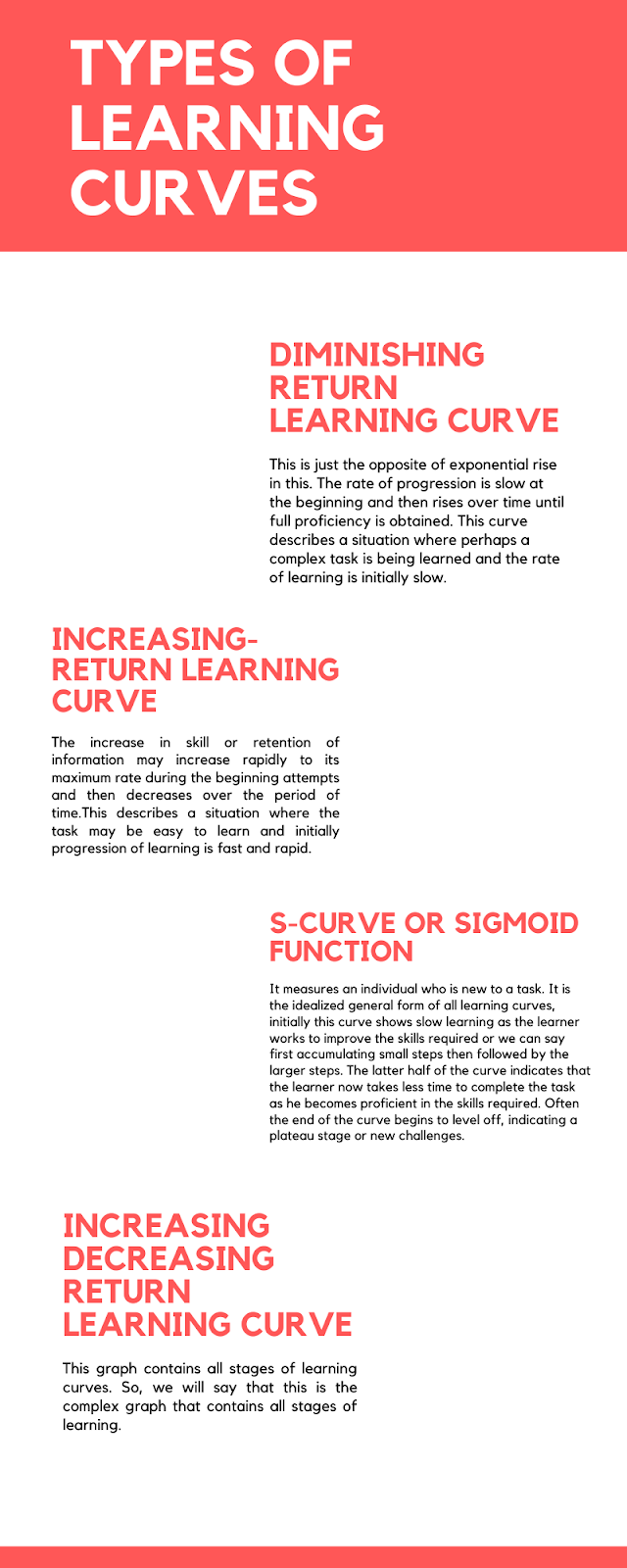
    types of learning curve

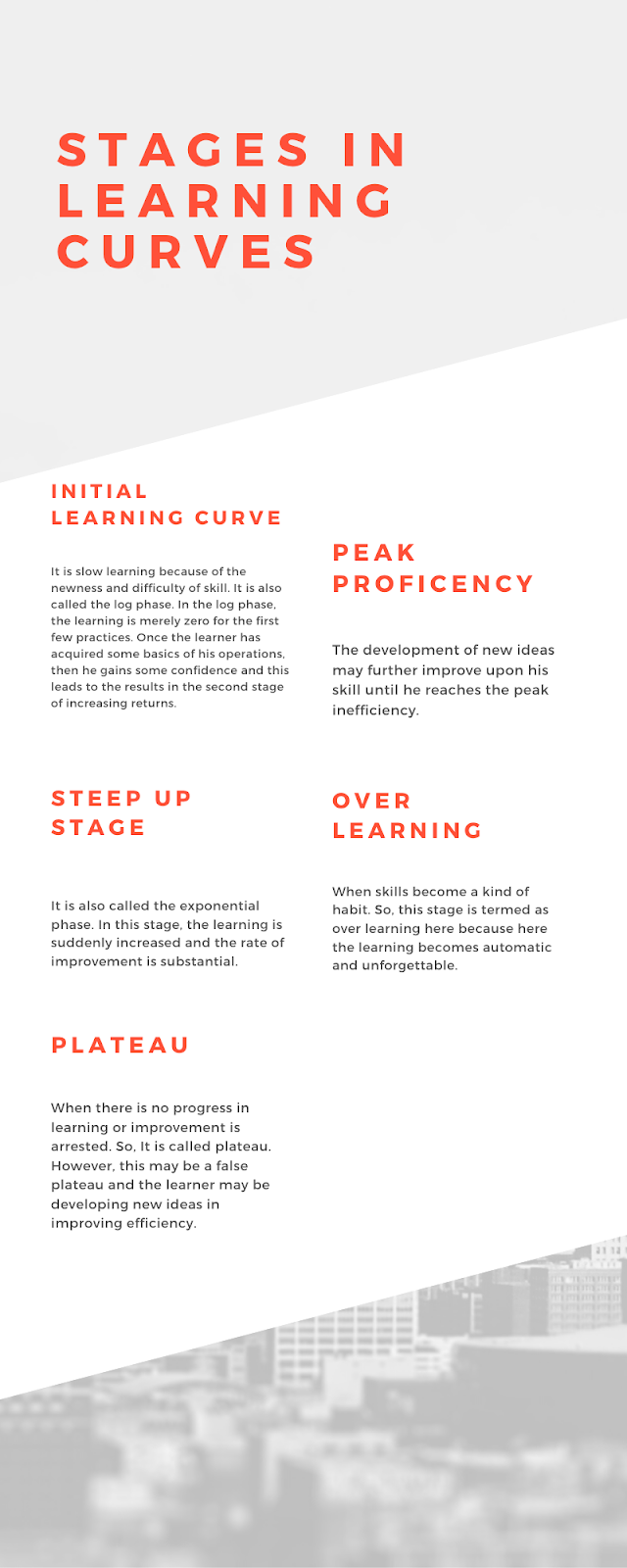
    STAGES IN LEARNING CURVES

    Initial learning curve:-

    It is slow learning because of the newness and difficulty of skill. It is also called the log phase. So, In the log phase, the teaching is merely zero for the first few practices. Once the learner has acquired some basics of his operations, he gains some confidence, leading to the second stage of increasing returns.

    Steep up stage:-

    It is also called the exponential phase. Also, In this stage, the learning is suddenly increased, and the rate of improvement is substantial.

    Plateau:-

    When there is no progress in learning or improvement is arrested. So, It is called a plateau. However, this may be a false plateau, and the learner may be developing new ideas in improving efficiency.

    Peak proficiency:-

    The development of new ideas may further improve upon his skill until he reaches the peak of inefficiency.

    Over learning:-

    When skills become a kind of habit, this stage is termed as over learning here because here, the learning becomes automatic and unforgettable.

    Types Of Learning Curves

    Diminishing Return Learning Curve:-

    So, This is just the opposite of an exponential rise in this. The progression rate is slow at the beginning and then rises over time until full proficiency is obtained. This curve describes a situation where perhaps a complex task is being learned, and the rate of learning is initially slow.

    Increasing-Return Learning Curve:-

    The increase in skill or retention of information may increase rapidly to its maximum rate during the beginning attempts and then decreases over the period.

    Also, This describes a situation where the task may be easy to learn, and the initial progression of learning is fast and rapid.

    S-Curve or Sigmoid Function:-

    It measures an individual who is new to a task. So, It is the idealized general form of all learning curves; initially, this curve shows slow learning. Also, The learner works to improve the skills required or, say, first accumulate small steps, followed by the more significant stages. 

    Meanwhile, The latter half of the curve indicates that the learner now takes less time to complete the task as he becomes proficient in the skills required. Often the end of the turn begins to level off, indicating a plateau stage or new challenges.

    Increasing -Decreasing-Return Learning Curve:-

    So, This graph contains all stages of learning curves. So, we will say that this is a complex graph that includes all stages of learning.

    STEEP LEARNING CURVES

    • We can define these curves as challenging to learn, and that takes more time and effort so that a steep increase would mean a quick increment of skill. However, the term is mainly used in everyday English with the meaning of a complex initial learning process.
    • If two products have similar functionality, more enormous, then probably the one with a “steep” curve is better because it can be learned quickly.
    • If two products have different functionality, then probably one with a short curve and have limited functionality may not be as good as one with a long arc and has greater functionality. 
    • Short and long learning curves
    • Product A has less functionality and a short learning curve. Product B has more extensive functionality, but it takes longer to learn.

    Learning curves theory

    • It is concerned with the idea that when a new job, process, or activity performs for the first time, likely, the workforce involved will not achieve maximum efficiency immediately. The learning curve theory states that completing a task should take less time and effort; the more the job is done over time.
    • Repetition of the task is likely to make people more confident and knowledgeable, and it will eventually result in more efficient and rapid operations. Ultimately, the learning process will stop after continually repeating a particular job.
    • Due to this, completing a task will initially decline and then increase once efficient working is good. The cumulative average time per unit is assumed to decrease by a constant percentage every time outputs double.

    Transfer of Learning

    Transfer of learning is the ability to learn in one context and applying it to another.

    Positive Transfer:-

    It helps you apply skills or knowledge to a new topic, whereas negative transfer hurts you.

    Zero Transfer:-

    It means that old skills and knowledge do not affect learning new skills or experience.

    Negative Transfer:-

    It refers to the interference of previous knowledge with new learning.

    Bilateral Transfer:-

    A skill within a particular task by practice can often be took over to the other hand. This whole process is called a bilateral transfer.

    Lateral Transfer:-

    The lateral transfer involves a learning achievement at the same level but in a different context.

    Horizontal Transfer:-

    The horizontal transfer generally refers to learning in one situation on learning in a different case.

    Vertical Transfer:-

    The vertical transfer requires that learning at a lower level must be transferring to an upgrade of cognitive skills.

    Production rate according to phases in learning

    First Phase:- 

    There will be a gradual increase in the production rate until the maximum expectation is reachable.

    Second Phase:- 

    The learning rate will gradually deteriorate because of the limitations of the equipment.

    Third phase:-

    The production rate begins to decrease due to a reduction in customer requirements and an increase in cost.

    Consequences areas of the industry when you apply learning curves

    image of a labour
    •  A standard costing system would need to be set standard labour times after the learning curve has been reached the plateau 
    •  A budgetary control system incorporating labour variances will have to make an allowance.
    •  Identification of the learning curve will help the company better plan marketing, work scheduling, recruitment, and material acquisition activities.
    •  As employees gain more experience, then they are more trying to reduce material wastage.

    Application of Learning Curves

    • Direct Labour:- Direct labour is the general application area of a learning curve since only people can learn. The learning curve is mainly applicable to new activities and labour force, whether employed on new or old activities.
    • Material:- Materials respond to learning only in an indirect way under specific circumstances. The learning curve applies mainly to sub contract or fabrication orders placed outside or components purchased from suppliers. The details you bought features will be deciding through labour and supplier.
    • Spoilage And Defective Work:- This also an area of learning because, with the acquisition of more skill and efficiency, losses on account of spoilage and defective production will decline.

    Features of Learning Curves

    • The learning curve does not cost reduction techniques; it is a naturally occurring human phenomenon.
    • It is a human characteristic that a person engaged in a repetitive task will improve his performance over time.
    • In the initial stage of production, generally, the workers do not have the confidence of completing the job successfully; when they produce few units, they gain confidence; people learn from errors.
    • When workers produce more and more units, they come to know the problems and their reasons. Now they can avoid the issues.
    • The workers can find a new method of doing the job; they can complete the task less.
    • Better equipment and tools to develop.
    • Better product design leads to increased efficiency.

    Factors Affecting Learning Curves

    • While pricing for bids tends, only people can learn to set up a very high initial labour cost to show a high learning curve, making the learning curves useless and sometimes misleading.
    • When labour turnover is high, management has to train new workers frequently in such a situation, and the company may never reach its maximum efficiency potential.
    • Changes in the production or the methods in the production designs, machinery, and the tools used to affect the slope of learning curves.
    • Labour strikes, lockout, and shutdowns also affect the learning curve.

    Pros and cons of learning curve theory

    Pros:-

    • The learning curve concept suggests the basis of correct staffing in continuously expanding production.
    • It provides a means of evaluating the effectiveness of the training program.
    • And It is frequently used in conjunction with establishing a bid price for contracts.
    • It helps in finding out working capital.
    • Knowledge of the learning curve assists in planning the inventories at material work in progress and finished goods.
    • The learning rate is also considered consistent enough to establish trends using the learning curve.
    • Useful in exercising control.
    • It will be helpful to make or buy decisions.

    Cons:- 

    • It is only helpful for new operations where machines do not contribute a significant part to production. It does not apply to all products.
    • Changes other than learning may affect the learning curve.
    • A learning curve that may not show expected results would need further analysis to determine the underlying variables impacting its shape, as the angle does not change everything.
    • The learning curve assumes that production will continue without any significant interruption. But if the work is under interruption, the angle may be defected or accept a new slope.
    • The characteristics of 80% of the learning curve initially getting in the USA’s air force industry are usually taken as the percentage is applying to all sectors. Studies show that there cannot be a unique percentage that can be universally used.

    Conclusion

    The learning curve plays a significant role in the management and running of projects.

    This theory is primarily used in repeating tasks and long-term projects to improve the work’s performance.

    Many organisations prefer to use the learning curve, which is cheaper and easy to use and provide better performance and expertise. It will be seen that the learning curve affects both short and long term projects. 

    Also, you can read our blog on VAK Learning Styles – Discover Your Learning Style

    FAQ’s