Author: lapaasindia

  • Lean Manufacturing – Most Effective Way of Production

    Lean Manufacturing – Most Effective Way of Production

    Lean manufacturing is a process where the focus is to reduce waste. Also, to increase productivity during the manufacture of the product.

    We all know that a lot of waste gets created while manufacturing any goods. The customers are also not ready to pay for the trash.

    Hence, today the companies are trying to find ways to reduce waste production while manufacturing any product.

    Lean manufacturing has a lot of benefits. We will discuss each of them.

    We will also cover various other aspects of lean manufacturing.

    What is in it for you?

    What is Lean Manufacturing

    Lean manufacturing is the process of reducing waste generated while manufacturing a product. At the same time, the focus is also on increasing productivity.

    In research, we found that 60% of the production process is waste. Also, customers only pay for the value and not the trash. So, if they do not find value in the product, then they avoid buying that product.

    Lean manufacturing, also known as lean production or lean, provides many benefits to the company. We will discuss it in the following sections.

    Some of the companies using lean manufacturing systems are Toyota, Intel, Nike, etc.

    The Theory Of Constraints And Lean Manufacturing - W H Meanor ...

    Lean Manufacturing Principles

    There are five principles of lean manufacturing. They are as follows:

    Identify value from the customer’s perspective.

    Companies manufacture the product as per their perspective. The value of the product from the company’s point of view and the customer’s point of view is very different.

    It might happen that as per you, the product you are manufacturing provides high value to customers. But the same might not be accurate. It can be possible that the customers are not finding much value from your product.

    Hence, it is vital to see from the customer’s perspective. Then only you can deliver them with high-value products and meet their needs. It will be a more point as compared to your other competitors.

    By doing this, you can determine how much a customer will be willing to pay for your product.

    So, you see. Lean manufacturing is essential for your company.

    Value Stream Mapping

    Now, what does this mean? Value stream mapping means you have to analyze every process and stage of production. From there, you will get the information.

    What kind of information?

    By analyzing, you will get to know which stages and processes of production are doing very well. Also, you will get to know which are not doing well. Hence, those stages of production need improvement in it.

    If you find that there is a production of enormous waste, you can drop that step, stage, or process. It not only reduces waste production but also reduces the cost of production.

    Hence, the value stream mapping is essential.

    Create Flow

    There must be a flow in manufacturing a product. So lean manufacturing helps in bring circulation to the production. It eliminates any hindrance that is waste in the production process.

    Hence, you can produce and can deliver the product on time. It is where you bring effectiveness and efficiency in your manufacturing unit.

    So, lean manufacturing brings flow in your company’s production process.

    Establish a Pull System

    Lean manufacturing helps in establishing a pull system. It means you start production only when there is a demand for it.

    There are two types of systems. One is a push system, and the other is a pull system. In a push system, you manufacture the product based on the forecast of your product’s demand.

    You bring all the resources and start producing based on the forecast. Also, it is to note that the estimate is inaccurate. It can either lead to too much inventory or less inventory.

    But when you opt for lean manufacturing and go for a pull system, you start manufacturing when you see the demand for your product.

    We know that the lean manufacturing process reduces waste. So when you apply a pull system, you avoid the raw material from getting wasted by producing based on the demand forecast.

    Continual Process Improvement

    It is also known as Kaizen. By implementing the lean manufacturing system, you get to analyze every stage. In the continuous analysis, you find the area of improvement.

    Hence, whenever required, you improve the system. That is why it said to be a continual process of improvement.

    lean manufacturing

    Types of Waste in Manufacturing

    There is a lot of waste that gets generated while manufacturing any product. That is why it is said to install the lean manufacturing system. The lean methodology says to remove waste generation from your production process.

    So, let us have a look into what are the types of waste generated. Then we will see how lean manufacturing tools can help reduce it.

    • Unnecessary transportation
    • Excess inventory
    • The unnecessary motion of people, equipment and machinery
    • Idle time of people or equipment
    • Overproduction than demand
    • Over-processing where it is not required
    • Defects that need more cost and effort to correct

    So these are some of the waste generated while manufacturing. Due to this waste, only customers do not want to pay. Hence, they get less value from your product and get less willing to pay.

    In the next section, you will learn how to reduce these wastes by applying lean manufacturing tools and techniques.

    lean manufacturing

    5s of Lean Manufacturing

    5s of lean manufacturing is all about keeping the work in an organized form. It helps in increasing the efficiency, effectiveness, and safety of the work environment.

    It leads to an organized working of the employees. They do their work without wasting time and effort.

    These 5s terms originated from the 5 Japanese words.

    Japanese WordsEnglish Translation
    SeiriSort
    SeitonSet in Order
    SeisoShine
    SeiketsuStandardize
    ShitsukeSustain

    Sort

    Here sort means you should have a check on each material present in the workplace. Check the raw materials and their usage.

    If some of the raw materials are there, which you do not need them, remove it. It increases your workspace.

    Unnecessary materials eat up your workspace and mess up the whole production area. So try to analyze the materials and ask the employees working for them. They can better tell you whether that material need is there or not.

    So, sorting helps you in cleaning up your workspace. If you do not need any material, you can do any of the following things:

    • Give it to some other department
    • Recycle it
    • Throw it
    • Sell it
    • Keep them in the storage area

    Set in Order

    After sorting out the raw materials, you now have a bunch of them you need during manufacturing.

    The next step in the 5s of lean manufacturing is that you have to set it in order. Like you need to identify when and which material should be used.

    It gives you the clarity of using the material. You get to know the process and series of when and what to put it in use.

    Shine

    By the term, you must be clear that shining means keeping the work environment clean. You should always try to make your employees the habit of keeping their workspace clean.

    It involves sweeping, mopping, dusting, wiping down the surface, etc. It also means that you should keep the tools and materials in their proper place.

    Also to this, perform regular maintenance of equipment and machinery. It should not be left for the work of cleaning staff only. But make sure that the employees also do it.

    By this, they become responsible, pushing them to feel like they have ownership of the space. Hence, they are ready to take responsibility and keep their workplace clean and organized.

    Standardize

    After sorting, setting things in order, and keeping the workplace clean, the next thing is to standardize the work.

    Now the question is… How?

    To install standardization, make a schedule of every work. Set a target for every task and give it a time frame. By that time frame, you must complete the assigned work.

    It increases efficiency, and you can complete the task in an organized way. Hence, standardization is essential in 5s of lean manufacturing.

    Sustain

    After all the 4s, the final one is, sustain—the 5th s. Now here sustain means after working on all the 4s, you have to make it sustainable.

    You should keep a check that it gets implemented for an extended time. It also indicates the participation of managers in the workplace. The employees feel energetic as they get motivation from time-to-time.

    Hence, they work with zeal. So it is vital that whatever you have worked on improving the system must get followed.

    An organized and clean workplace is better than the chaotic one.

    So, these were the 5s of lean manufacturing. Make sure if you are running or having a manufacturing unit, then you apply this 5s tool. It has been proved to be very useful.
    lean manufacturing

    Conclusion

    So that was it. I have tried explaining lean manufacturing terms in detail. I hope it proved to be beneficial for you. Also, we covered various sub-topics of lean manufacturing.

    So, we can conclude how essential lean management is for any company. If you have your company, try to install it. It will be beneficial to you.

    FAQs

    1. What is six sigma?

    Six sigma or 6 sigma is a set of tools and techniques to improve the manufacturing process. It was first introduced by an American engineer Bill Smith in 1986 while working with the company Motorola.

    2. What are different lean manufacturing tools?

    Some of the lean manufacturing tools are:
    1. 5s tool
    2. Andon
    3. Kaizen
    4. Kanban
    5. Bottleneck Analysis
    6. Muda
    7. KPI (Key Performance Indicators)
    8. Gemba
    9. Heijunka
    There are many more such lean tools. These were some of them.

    3. Which company applied lean manufacturing first?

    Toyota was the company that introduced lean manufacturing in the market. Toyota production system is so effective that they are manufacturing their cars with least waste production.
    Also, their production process is very organized and clean. Hence, all companies must practice this method.

    4. What is an inventory management system?

    It is a system that tracks the inventory of any company. The technique takes the help of both hardware and software devices.
    So, all the activities related to inventory are done by the system. The activities can be stock available, raw materials to be ordered, storing, etc.

  • Sales Strategy 2020 – A Guide to Run Successful Business

    Sales Strategy 2020 – A Guide to Run Successful Business

    Sales strategy means you make a strategy to sell your product to the customer. It is very clear from the term itself.

    We all have to face a challenge in every field. There is a need to show that you are the best. Then only you become the center of attraction. People start to know you.

    You build up your image in the market. You stand out of the competition as showcase yourself as the best.

    The same is the case in this corporate world. All have participated in a race and are running to win it. So, they do not want to let anybody else take the trophy.

    Thus, in that case, how to stand out when the competition is very tough?

    That is what you are going to learn in this blog.

    Let’s get started.

    What is in it for you?

    What is Sales Strategy?

    Suppose you are doing business, and there is a lot of competition in your sector. Every company is trying to sell their products to the target consumer. Those consumers are also your customers.

    All they are trying to portray their product as the best one in the market among all other competitors.

    So, in that case, you have to stand out from the competition. You have to take specific steps where you can be ahead of your competitors.

    Hence, this is where the sales strategy comes into force. Sales strategy helps you to form strategies where you can beat up your competitors. You build a unique image of your company in the market.

    The customers start getting attracted to your company’s product. Hence, it leads to an increase in sales and profit.

    By now, you must have understood what sales strategy is. In the next topic, we will see what types of sales strategy are.

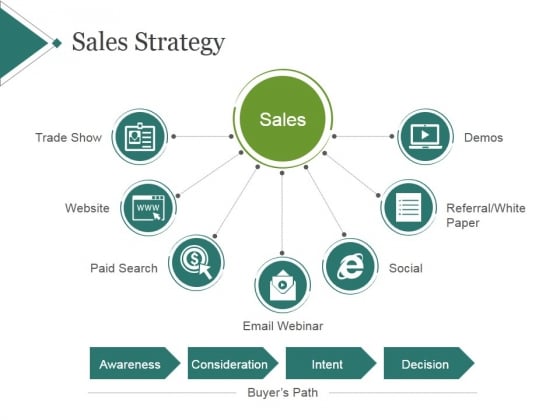
    Sales Strategy Template 2 Ppt PowerPoint Presentation Infographic ...

    Types of Sales Strategy

    Sales strategy helps in achieving your sales target. A key to doing more sales has robust strategic marketing plans.

    Now, it does not mean that after implementing the strong sales strategy, you will reach your sales target. Make sure that the marketing strategies applied gets handled by the sales department.

    Sales strategy helps you in building up your brand. So it is a must that you and the employees understand the nature of the business. Then only you will be able to design effective and robust marketing strategies.

    If your company has a strong sales strategy, then you will be able to attract more customers. Otherwise, you will not only lose your customers but also demotivate your shareholders and employees.

    So you see, there is a chain connecting every function of your business.

    We will be learning about some of the types of a sales strategy that you can install on your business.

    Know the Product

    The person selling the product must know the product very well. Instead, not the seller, but the whole employee team should know about the company’s product.

    Suppose the salesperson does not know about the product, how will he or she sell it? Without knowing the product, you cannot sell it.

    When the person itself does not know about it, how will he answer the customers’ queries?

    Leave about the queries, but the first and most important thing is how the salesperson will convince the customer?

    So make sure that they are given training in sales. Also, make them study the products. Then only they will get the confidence to approach the customers and explain to them about the goods.

    Also, they should not only study your company’s product but also know about your competitors’ products. Then only they will be able to differentiate the goods and stand apart from the competition.

    sales strategy

    Knowing the Customer

    Again you must know your customer. Without knowing them, their likes and dislikes, etc., you will not be able to sell your product.

    Study about your target consumers. It will give you an idea of who your actual customers are, who you should target.

    Suppose you sell stylish, elegant, premium, and high-quality products. You have kept the price very high, which only the upper section of the society can afford. If you approach the lower or middle segment of the community, do you expect them to buy?

    They do not have that much money. Hence, they cannot buy your product because your product’s price is way too high for them. Also, it might happen that they are not interested in those kinds of goods.

    So you see, when you have not done the homework of studying your customer, you fail. You start thinking that this business is a failure because people do not like your product, etc.

    Hence, you must understand your customer. There is a segmentation study where you get to know about them, and you can make a proper customer profile.

    Translate Features into Benefits

    There are certain features found in a product. Try to translate those features into benefits. Make the customer believe that your product can change their life.

    If they start using it, it will be very beneficial to them. It will make their work easy. Like this, you can make them understand the specialty of your product.

    Once they start believing it, they will start consuming your product. Also, if they find it useful, they will become your loyal customers. Not only that, but they can also even become your salesman.

    It means they will start recommending your product to their friends, family members, etc. Hence, it is known as word of mouth marketing strategy.

    Your company will receive a promotion for your product without any effort. Hence, this sales strategy is very beneficial.

    Show Visuals

    It means you have to show the customers what you are speaking. If you are telling them that your product is superior to the other competitors, then how?

    Show them by giving them the trials. Once they see it, they get more convinced in buying your product. So make sure that you have the product in hand for trial purposes.

    Everything is in your Hands: Customer Retention : Price2Spy® Blog

    Customer Retention

    You should have the goal of increasing customer size. Your main target is to capture the vast market.

    But in that race, do not forget the old customers. If you add new customers to your service line, make sure you are not losing your past customers.

    So there should be a proper system where you can connect with them from time to time. Keep them engaged with your company’s activities, offers, etc.

    Hence, customer retention is essential in the sales strategy plan.

    Engage with Customers

    As I said in the above point, do not lose your old customers. Try to keep them and gain their loyalty towards your company.

    There are many ways you can connect with your customers. Currently, CRM is very much in use. CRM means Customer Relationship Management. Build a system where you can engage with them.

    Also, study about e-CRM. It is an electronic Customer Relationship Management. Here you connect and manage your customers with the electric model. It makes it easy for your company to store the data of your consumers.

    sales strategy

    Feedback

    It is a must that you take feedback from your customer. From this, you get to know how the customer is feeling after using your product.

    The feedback can be good or bad. If it is good, then try to continue it and keep it stable. But if the input is terrible, then you must work on it and try to improve.

    Hence, the main lesson here is when the customer gives you the feedback, do not ignore it. Take their feedback and work on it. It helps you to improve your product or service.

    Post Sales Service

    Your duty does not end in selling the product. But it continues even after that and is known as post-sales service.

    After selling the goods or services, you should be in touch with the customer. Ask them from time to time, whether they are facing any problem in using the product or not.

    If yes, then send your team to serve them and solve the problem. It is a beneficial sales strategy that you can apply to. Here a message goes to the customer that the company cares about its customers.

    Buy-Sell Hierarchy as a Sales Strategy

    Now, allow me to introduce you with a new term Buy Sell Hierarchy. It means identifying your current position in the market and planning where you want to be. It is also a perfect sales strategy.

    This method helps you to analyze how well you get connected with your customers. Also, how to improve the customer relationship.

    This term was coined by two consultants, Robert Miller and Stephen Heiman. They introduced this term in 2005 in their book ‘The New Successful Large Account Management.’

    This sales strategy is divided into five levels. Let us understand in detail.

    Buy-Sell Hierarchy, Sales Strategy

    The commodity corner

    It is the first and lowest level in the buy-sell hierarchy sales strategy. Here you are seen as the potential supplier. That’s it. All the suppliers meeting the least specifications are placed on this level.

    This place is not secure. With you, there are many other suppliers. There is no harm in staying on this level. You can still build a relationship with your customers. But this will not be a long term relationship.

    They will see you the same way as they see your competitors who are with you at this level. So products from you or other suppliers will not make any difference.

    Providing good product

    Here you jump to the upper level that is the second level of sales strategy. In this, you get recognized as a supplier of the right quality product or service.

    The customers can differentiate you from your competitors. But still, this position is also not very good. Others are also trying to improve their products. If they become successful in it and move ahead from you, you again come to the first level.

    So try to improve from time to time and provide the right product or service.

    sales strategy

    Dedicated service

    The third level in this sales strategy is a dedicated service. Now the customers no more see you as a product supplier or service provider.

    They can differentiate you from your competitors. They find that you are taking extra effort to provide service. Hence, they become loyal customers.

    Crossing the chasm to business issues

    It is the fourth level in this sales strategy.

    Here you give some more effort to make your unique in the market. Now, you do not try to sell your product or service to the customers but also provide some ancillary services to them. It is needed not to be related to the product you sell. It can be any other service.

    For example, you are making your customer aware of fraud activities, and providing information to them in different areas, giving knowledge about how to use any device. It can be any other thing apart from these.

    It makes your customers feel that you do not focus on selling your product and serves them in various fields. Hence, they stick to your product only as they start feeling connected with your firm.

    Becoming Account’s External Asset

    It is the fifth and the topmost level in this method of sales strategy. Now, you no more are seen as a vendor but as a trusted advisor.

    People now start seeking your help in various other fields. You give them advice and help them whenever they must. It shows that you have built trust in them. They no more hesitate in purchasing your product and have confidence in you and your company.

    It is where you have come out of the competition and have to build your empire. Now, it is tough for other competitors even to think to destroy your empire and snatch the position.

    So these were the five levels of buy-sell hierarchy as a sales strategy. I hope you have understood this method.

    Conclusion

    I hope you have understood the term sales strategy. Also, the sales strategy buy sell hierarchy. It is a very effective one.

    Many companies focus on this. They form a vision of where they want to see themselves in the future.

    Hence, I tried explaining sales methodology in a straightforward language. I hope you find this blog helpful.

    FAQs

    1. Why sales strategy is important?

    Sales strategy is essential so that you can survive in the market. There are many competitors in the market. So you need to form plans to outcompete them and apply strong selling technique

    2. Who is Miller Heiman?

    They are two different people, Robert Miller and Stephen Heiman. They made the strategy known as a buy-sell hierarchy. So, this method is also known as Miller Heiman Strategic Selling. They also have their official site named as Miller Heiman Group.

    3. What is the difference between marketing and sales?

    Marketing is a broader concept. A sale is a narrow concept. It comes under marketing.

    4. What are effective marketing strategies?

    There are various marketing strategies that you can apply. Some of them are as follows:
    1. Traditional method
    2. Word of mouth
    3. Celebrity endorsement
    4. Sponsorship marketing
    5. Digital marketing
    6. Social media marketing

  • Backward and Forward Integration – How Companies Use Them?

    Backward and Forward Integration – How Companies Use Them?

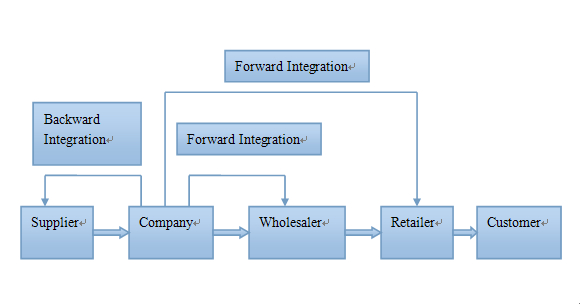
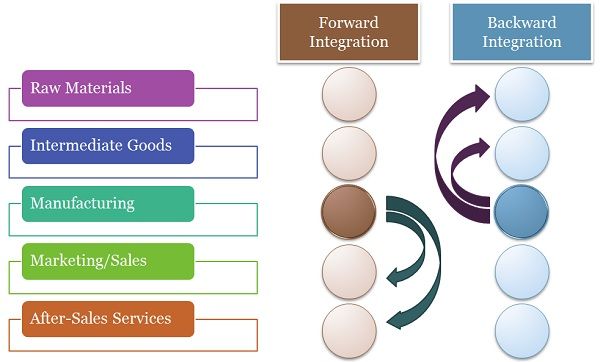
    Backward integration and forward integration both are the two types of vertical integration. In these two types of methods, companies either can choose backward vertical strategy or can choose the forward vertical strategy. Thus they can choose both strategies. 

    So in this blog, you will know everything about backward integration and forward integration. Also, you will understand the different strategies and examples of companies. How they use those techniques to enhance work. Without a delay, let’s get started.

    You will know

    1.Backward Integration

    If I talk about backward integration, this is a strategy of the business. This technique is also called backwards vertical integration. But why? Yes, I’m here to tell you.

    So backward integration means one company acquires the supply chain process companies for better supplies. Now you might be confused! Wait, I will explain everything with examples.

    Backward Integration - Overview, How It Works, Advantages

    Backward Vertical Integration

    Important to realize that, it is a type of vertical integration. In the vertical integration, one company started working with a different level of the value chain company or can acquire raw materials company. So that they have better resources for product manufacturing.

    For example, one clothing manufacturing company started working with a fabric company or can acquire a fabric wholesale company so they have enough raw materials for making dresses. This is a backward integration where a company integrated its business by a move back to the supply chain processes. 

    Supply Chain Management: From Raw Materials to Finished Products ...

    Supply Chain Process 

    Take a quick look at the supply chain process. Supply chain means a system from raw materials to consumers.

    Firstly, raw materials

    Secondly, manufacturing

    Thirdly, finished products

    Fourthly, packaging

    After that marketing 

    Then shipping or transporting 

    And then go to distributors and retailers

    At last, going to customers or consumers.

    In the same way, take another example of a furniture company. If a furniture manufacturing company wants to expand its company then they can acquire a wood supply company so that the firm has enough sources of wood to make furniture.

    The best example of a backward vertical integrated company is IKEA who acquired the forest company.

    2. Advantages of Backward Integration Strategy 

    Now you must be looking for the advantages of strategies used by companies. Of course, here are all advantages behind backwards vertical integration. 

    So whenever companies choose to move backwards they have some reasons behind it.

    Firstly, control the raw materials. 

    Secondly, when firms or companies control their raw supplies then they can also control the production. 

    Thirdly, when they control the production they can manage the overall operations. 

    Also, they have access to improve their products. Because raw materials are the most important thing in business. Only because of it, products make better.

    Mostly manufacturing industry using backwards integration so they can manage the overall manufacturing process. As you saw earlier, dress manufacture processes. There are several other manufacturers using this backwards integration for controlling the production. 

    Forward Integration Has Become a Strategic Trend in Abrasives Industry

    3. Forward Integration 

    Now let’s understand the forward integration. As you saw earlier, that backwards means a company acquires those companies who provide the raw materials for manufacturing products. 

    In this case, forward means one company acquires the distributions or sales channel for a move forward. In the supply chain system, you already saw how supply management processes go on. If you have any doubt then you can check our other blog on vertical and horizontal integration.

    Forward Vertical Integration 

    So whenever companies want to control their distribution process they acquire distribution or sales companies. 

    For this reason, one company can expand its businesses globally. Also, they lead the industry.

    For example, again I use the furniture company as an example. So if the furniture company wants to enhance its sales they can acquire distribution and retail channels. In this case, the furniture company has more will power to control its sales.

    IKEA is the best example of backward integration. Recently in April 2020, IKEA acquired an AI imaging startup called Geomagical Labs. Who provides supercharge room visualisation. 

    I know, you might think that IKEA is the best example of a backwards integration strategy. Then why I give you an example of forward integration? 

    Then you need to realise that one company can maintain both types of integration strategies. Yes, I will discuss this after sometime later. Although you can take a look at the advantages of this integration first.

    Backward Integration

    4. Advantages of Forward Integration Strategy

    Forward integration is the best strategy to take control of the overall distribution channel. As you can see IKEA use this technique for better consumer visualisation. The supercharge 3d visualisation will impact on the overall business. Because it will give the consumer the best experience. When the customer will be satisfied with their services, IKEA will be more profitable. So now you can understand what is the advantage of this method.

    Forward means move forward, as the supply system has two parts one is backwards and another one is forward. Right now IKEA uses both of them to capture the overall market.

    Secondly, the company uses this technique for a better supply system. Undoubtedly, sales and distribution channels are the key factors of any business. So definitely a company wants to enhance its distribution channel to all over the world so they can reach more and more customers. 

    Thirdly, when the firm acquires the distribution channels then they have all control of the overall system. Such as they can build up their own distribution network and also control by their own.  

    So let’s take another example of Apple.

    Backward Integration

    Apple Business Integration 

    Apple has its own selling distribution channel. As well as it has its own manufacturing process. In this case, Apple uses both the backwards and forwards integration strategies.

    Apple has its own software, hardware and retail stores. Also, have their own services company. Apple is the only company who uses all techniques and we can say that it is vertically integrated into everything. 

    So now you can understand how its impact if a company chose both integration strategies.

    5. Backwards and Forward Integration 

    Still, now, you already understand the concept of integration. Then you also realise that if a company uses both strategies for developing and expanding its business then the company is called vertically integrated into both.

    However, not all companies use those techniques because larger is not always nicer. Because both techniques have some advantages and disadvantages as I already indicated above. 

    Then look at some examples of both integrated companies. 

    Backward Integration

    Amazon Strategy 

    Amazon is the biggest e-commerce business in the world right now. But did you ever ask yourself how Amazon became this big? Of course, maybe you have answers or maybe not.

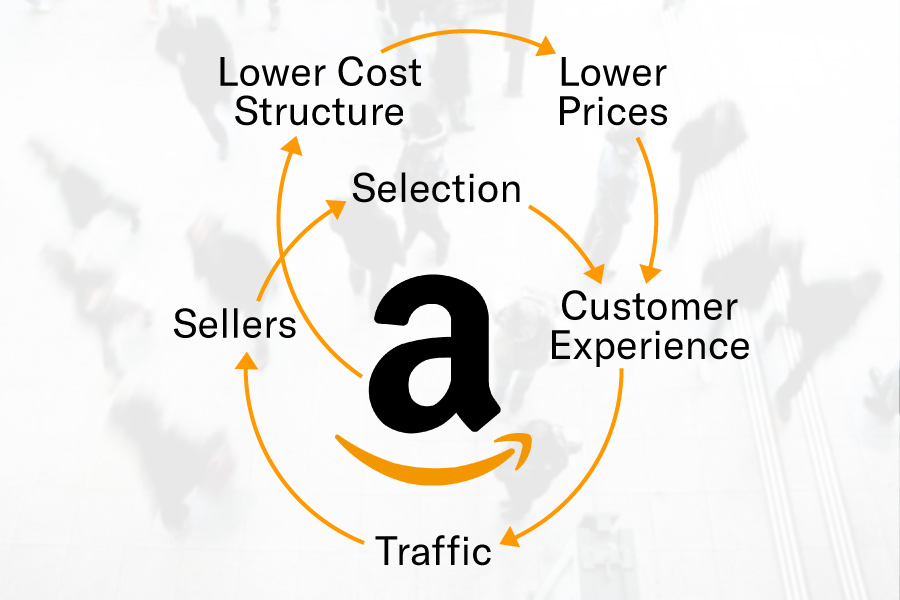
    Amazon became big because of its smart techniques. While Amazon has its own selling system and it also has its own distribution channel. In this case, it enhances its business by forward vertical integration. 

    Similarly, it has its own manufacturing process where Amazon provides its own branded products. Now, this time it is integrated backwards. 

    In this situation, where it monitors both the strategies similarly, it expands the overall market and captures the whole world. 

    Take a look at another example, Netflix.

    Backward Integration

    Netflix Strategy 

    It is also well known for its vertically integrated into both sides. Undoubtedly, the forward and backwards strategy.

    Netflix started as a DVD rental organization but now it started its own movie or series making production house. Who started creating Netflix original content series. In this case, it is also vertically integrated by both sides. While on the one hand, they start creating the series on their own so they don’t depend on tv or outsource. On the other hand, they vertically integrated into the distribution system. So it can capture the overall market and industry.

    Ford Strategy 

    Similarly, we all know that Ford is an automotive company who once started making their own engine. Later on, they started their own manufacturing to all distribution and sales channels so they can control and take the power of everything.

    But, this equal integration technique does not benefit them. Because I already told you earlier that when a company becomes too big, it is always not helpful. You can also check how geographical expansion affects the business expansion, for better analysis.

    So as you realize how integrations sometimes are helpful for companies and sometimes not. 

    Conclusion 

    In conclusion, I must say that you have clear information about all. Although, take a quick look at everything in shortly. So backwards integration and forward integration are two types of vertical integration strategies.

    On one hand, backwards use for better resources and on the other hand forwards control the overall distribution systems. Different companies use those techniques for global expansion.

    Also, some companies use both techniques for capturing the overall industry and overall industry. So you can choose on your own if you realize you need to expand your business by both sides.

    FAQs 

    1. Types of Integration Strategy

    As I already discussed above that integration has two types, one is Vertical and another one is Horizontal. Also, vertical integration divided by forward and backwards integration.

    2. What are some examples of Backward Integration?

    It can be a bakery who collects wheat and other raw materials from farmers. Or can be the juice distributors who collect fruits from farmers or can acquire fruit supply companies. Or a fabric company who collects cotton yarn from farmers.

    3. What are some examples of Forward Integration?

    It can be a mobile company who acquires an advanced technology group for better consumer experience. Or can acquire retail channels so they can do better supply.
    Similarly, Disney acquires lots of retail stores so that they can sell its Disney character. It is also a forward vertical integration.

    4. Is Nestle Vertically Integrated? 

    Yes nestle is vertically integrated. This company uses both backwards and forwards integration for better productivity.

    Backward Integration?

    Backward integration means one company acquires the supply chain process companies for better supplies. For Example It can be a bakery who collects wheat and other raw materials from farmers. Or can be the juice distributors who collect fruits from farmers or can acquire fruit supply companies. Or a fabric company who collects cotton yarn from farmers.

    Advantages of Forward Integration

    Forward means one company acquires the distributions or sales channel for a move forward. In the supply chain system, you already saw how supply management processes go on.

  • What is a Sales funnel? Beginner to Advanced Full Guide

    What is a Sales funnel? Beginner to Advanced Full Guide

    Do you sell products or you wanna retain your buyers for years, then you should know what is a sales funnel and you need to apply effective sales-funnel so that you can significantly increase your customers for a lifetime.

    What’s in it for me?

    1. What is a Sales Funnel?
    2. Why are Sales Funnel Important?
    3. Stages of Sales Funnel
    4. Online Sales Funnel
    5. Conclusion
    6. FAQs

    What is a Sales Funnel?

    The word sales-funnel has 2 words, so, first of all, let us know what is a funnel.
    Funnel means a step by step process to do anything or task.

    The first word sales means to sell anything.

    Here sales-funnel means a step by step process to sell our product or service.

    Why are Sales Funnel Important?

    Sales funnel is very important for each and every kind of business.

    Your business might be a small retail shop or you’re selling a big product, the sales funnel is gonna help you to get more customers and make them loyal.

    Many people want to sell their products as soon as they launch it. It’s human psychology, everyone wants to become rich, every CEO or founder of any company wants to make their company profitable as soon as possible, and many people try to do it.

    It’s too hard to sell a product or service launched by any new company.

    So here comes the part of the sales funnel which will help you to sell your products and acquire customers for a lifetime.

    Let us know how the sales funnel helps you to generate leads with examples.

    Let’s imagine I have opened a new company and launched a new product,

    No one knows about my company or my product, so I can’t even expect any initial sales.

    First of all, I need people to be aware that I have launched a new product so that if anyone needs my product they can buy it.

    Here sales funnel will help you to acquire customers and sell products.

    There are a few stages for a perfect sales funnel.

    Stages of Sales Funnel

    Basically there are 4 stages of the sales funnel.

    • Awareness
    • Interest
    • Desire
    • Action
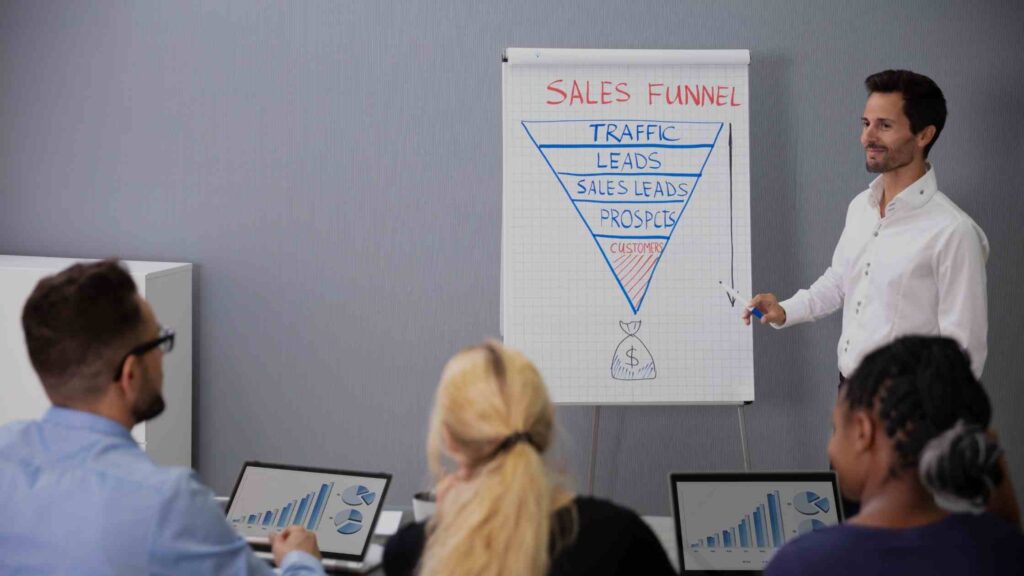
    the-purchase-funnel

    Awareness  

    In the first step, we need to aware of people of your product/service. If your customer doesn’t even know about the existence of your product, then how can you even think they will buy it.

    So first you need to aware people about your product.

    You can aware audience in many ways,

    It might be advertisements on television or anything else.

    Your motive should be to tell the audience that you are selling this product or service.

    If people need your product then few may buy-in first go.

    But many people don’t trust new brands or new products.

    So here comes the second thing to bring audience interest in your product.

    Interest 

    Here in step 2, we need to bring people interested in our product.

    In the first step  we have to inform people about our product when we advertise or do any other thing.

    When people see our advertisement many times they get familiar with our brand.

    We need to offer something special or need to give discounts so that people can notice our products and check it out.

    If people are using the same product or wanted to buy in future then they might have already opened our ad and checked it.

    If we are offering a great deal then customers may get converted in the 2nd step only.

    Desire

    Now in step 3, we have to create a desire in people’s hearts.

    The people who have visited our page it means they are interested in our product or in the offer we are giving them.

    Here we can remarket the people who have visited our page, we need to remarket as much as we can.

    People do many things all over the day so they might forget about your product.

    So we need to show them ads again so that we can get into their minds.

    Now we should show our product/service and also the reviews which old customers gave as ( if we have ) about our service.

    Action

    Now our audience has got to know about our brand, our products, we have built our brand authority in people’s minds.

    So now if we pitch our product the chances of buying is too high.

    If we don’t pitch and if consumers need our products then they will buy from us.

    Because we have entered into their minds by appearing to them again and again.

    So they will start thinking that we are an old and established brand.

    Example: A few days back I went to a restaurant with my friends, after having some fun when we came out we saw there was a hall next to the restaurant.

    There was a big banner and it was written that ” free consultation to grow your business” I got excited and went inside, It was a big hall and there were many people inside, the seminar was going on and in the whole seminar, he explained basics of marketing, he promoted his first course which was too cheap.

    Almost all the people present in that hall bought that course, by selling this course he might have recovered all the cost he spent on this seminar.

    The cheap course was very helpful for beginners and in the course, he promoted his 2nd course which was a little advanced course and it was a medium budget.

    The second course was also nice. It was for average people, where he explained a few strategies and a few techniques, and again he promoted his thought course which was quite expensive and it was the advanced course, those who want to learn the advanced techniques and advanced strategies they might do both this course.

    How to Set Up Your First Online Sales Funnel

    Online Sales Funnel

    It’s easy to create an online sales funnel nowadays everyone is on social media, many people like to buy online.

    No one goes offline stores and choosing from limited products.

    Online we can get many options and we can buy anything just in a few clicks.

    To create an online sales funnel the main thing we need is a great landing page, We need to create a good website to generate leads online, and the 4 stages of sales funnel.

    We can be aware of people by using social media, we can upload pics of our products on social media.

    You can write articles about our products, how it is helpful to people, how useful it is.

    We can also aware people by advertising on  social media like Facebook, Instagram, Twitter, etc 

    Advertising on social media is the best way to make people aware of your product.

    Now we need to do the second step, we need to give some discount codes or something so that people open our ads and check out our website.

    When they come on our landing page then we can automatically take their email.

    The third step we should remarket them and we can also do email marketing, we can send them special offers by email.

    We also need to run google ads here because when. People are doing research or on google and they see our name on the top, so they know us before the changes in buying from us increases a lot.

    By doing this you may get leads, if your product and website are great then they might become your loyal customers easily.

    I prefer online shopping rather than offline.

    Conclusion

    Always remember if you try to sell your products on the first go, no one gonna buy it.

    If you do so your customers gonna run away.

    First aware your customers about your products, tell them how it’s useful to them, 

    Then if they need it so create interest in them,

    The next step is to create the desire in their minds,

    Now the final step is to pitch your product and ask them to buy.

    This is the right way of the sales funnel.

    FAQs

    1. Why is the sales funnel important?

    Sales funnel is important for every business no matter if your business is small or big, a sales funnel means finding your targeted audience and selling your product to your customers.

    2. How to build a sales funnel fast?

    Sales funnel is a step by step process where you find your audience, it takes time, you can do it fast by using the internet and by online ads.

    3. What are the stages of the sales funnel?

    The  4 stages of the sales funnel Awareness, interest, desire, action.

    4. Does the sales funnel really work?

    Yes, It always works. According to me, the sales funnel is never gonna die, it’s the best way to generate leads and sell your products.

    5. Who invented the sales funnel?

    E St Elmo Lewis in the year 1898 invented the sales funnel, actually many other businessmen were doing it before but officially he announced this technique.

    6. What are online sales funnels?

    Finding and Targeting our audience using the internet with social media or by running ads online is known as an online sales funnel.

    7. How does sales funnel work?

    There are 4 stages in the funnel-
    First, we need to aware people,
    Interest in our products,
    In the third step create a desire in people’s heart who are interested,
    Then in the final step people will buy our products

  • Product Life Cycle – Different Stages and Examples

    Product Life Cycle – Different Stages and Examples

    This concept is in use by management and by marketing professionals as a factor in deciding when it is appropriate to increase advertising, reduce prices, expand to new markets, or redesign packaging.

    It is the nature that the old one replaces by the new one.

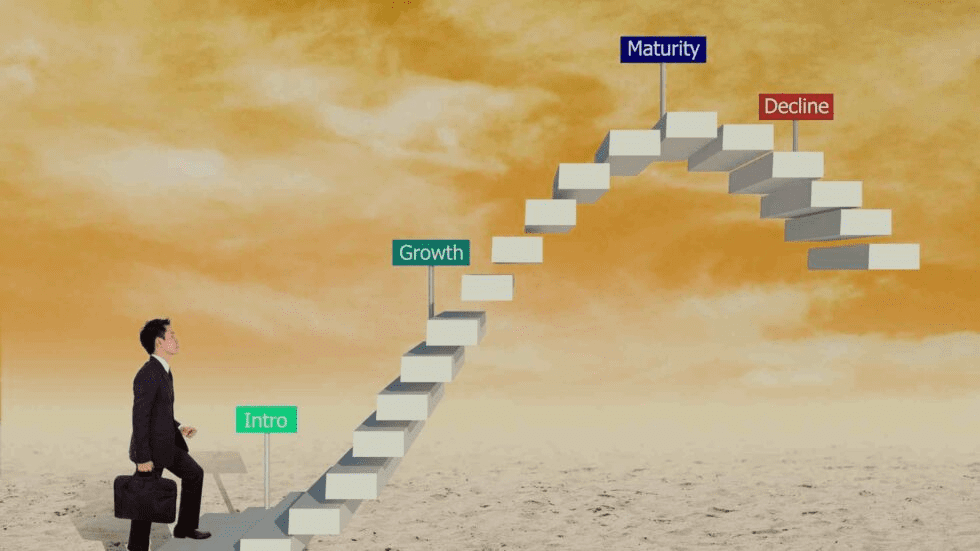
    Product Life Cycle is the period of a product that introduces to the consumer in the market up to the reaching of its decline stage.  

    The product life cycle is a very familiar term people know about it but very few are using it effectively.

    Hence, A good product passes through a certain recognizable stages.

    Eventually, it is the strategy to keep the product long players by adopting technology and removing fault.

    Whats in it for me-

    Different Stages of Product Life Cycle

    product life cycle

    Market Development 

    The demand for a particular product people is not aware of the product so the marketing and advertising price is high.

    When management introduces a new product to the market it is new for the consumer so it is necessary that demand is there.

    Whether the product fulfill the consumer demand depends on several factors.

    The complexity of the product, degree of newness, easy to handle, presence of the competitive product.

    Most companies did not take the initiative to launch a new product and practice product life cycle because it takes lots of research, innovation, and risk. 

    They avoid taking the first byte.

    Market Growth 

    There is a demand for the product as the product that presents to the audience so demand starts accelerating.

    Consider it as a take-off stage.

    At this stage product sale is at its high Potential competitor has had seen development at the first stage start coping ideas product packaging branding and positioning start seeing at the phase.

    As product acceptance starts increasing it becomes easy the best channel of distribution, as it increases profit get high and attract more competitor.

    Marketing Maturity

    Demand levels off and grows, for the most part, only at the replacement and new family-formation rate. 

    The product reaches to the target audience. The marketing budget reduces because it almost reaches to the consumer. 

    The product starts moving to the saturation phase. Don’t make a distributor. Pricing at this stage tending to be competitive.

    It starts falling due to the pressure of outside like competitors as well as low demand at this phase to explore new demographic companies starts innovating changing or developing their product. 

    The maturity stage may last long or short time depending on the product .the maturity stage of coca-cola is very large.

    Market Decline 

    The product lost its demand. 

    Generally, all the products try to keep the product in the maturity stage.

    At this phase, product sales decline, as well as the demand.

    These are the different stages of the product life cycle and through every new product gone through.

    Product Life Cycle Examples

    We have many examples which show that how a product which was good at a certain period of time gradually replace by another one just by changing according to the need of time.

    Typewriters

    product life cycle

    In the 19th century, it was popular because it increases the ease of writing accurately. 

    But as the laptop, pc, and mobile came in existence it replaces the typewriter, it reduces the cost as well as demand. 

    The typewriter is at its decline stage people as considering laptop and mobile for the purpose it serves earlier.

    As we move in product life cycle examples we another one 

    VCR

    product life cycle

    Many of us grow or I can say 

    We can now say the loyal video cassette recorder (VCR) to the list of gone because it is almost extinct. T, Funai Corp. of Japan announces that it is going to stop the production of VCR since its demand decrease. Funai was the last manufacturer of VCR.

    According to the company, they could sell only 750,000 units worldwide in 2015, it is no more beneficial for the company.

    VCR has come into existence in 1950. The product was so good, in 1950 and they could sell each unit to $50000 and it gets the utmost 100 orders in the first week.

    But as Netflix came in market VCR cost as well demand declining people start shifting towards Netflix and amazon prime since it captures people’s attention as well it was cheap.

     Maruti 800 Product Life Cycle 

    product life cycle

    Maruti 800 was known for a small city car that was manufactured by Maruti Suzuki from 1983 in India from 1983 to  18 January 2014.

    This car was a revolutionize step in the history of automobile sector .

    It was the affordable car for a common public Maruti Udyog limited launched its first Maruti 800 in 1983  in the Indian market.

    Maruti 800 growth stage

    • Maruti 800 came up with new feature ac system and music in the car 
    • Sale gradually increase  from 852 to 20 269 and reach up to 31314 

    Here strategy was

    •  The customer was its center 
    •  Maruti establish its service center to every 50 km 

    Maruti 800 maturity stage

    • In 1997 Maruti launch a new car with Belly Jean shape but it was not accepted by the customer 
    • Launched new version of Maruti 800 exes with new engine shock absorber, coil spring suspension but this mode 1 however it lost its sale.
    • As I told you at this stage competitor starts entering the market just like that general motors, Ford, Tata.
    • In 2002 Maruti launched alto with a bigger and stylish version of Maruti 800 

    Also introduce Maruti 

    Strategy Adopted By Maruti At This stage 

    • It develops a different source of income like Maruti insurance and Maruti finance.
    • Since new also join the market, therefore, it develops a new facelift model based on market feedback and response.
    • Made partnership with State Bank Of India 

     Maruti 800 decline stage (2002-2014)

     Many other competitors get into the market like  Hyundai i10 and Chevrolet  due to which its sales start declining 

    The biggest competitor was tata Nano that offers cars at low prices and with more space .

    Other product life cycle example is 3D Televisions Blue Ray Players: DVD Players Video Recorders: Holographic  Tablet PCs:Projection: Laptops  Typewriters: 

    Test Marketing 

    Test marketing is an experiment, in a field laboratory (the test market) comprising of actual stores and real-life buying situations, without the buyers knowing they are participating in an evaluation exercise.

    Product life cycle include a development  stage where it  Went through phase 

    Before conducting a test marketing a  marketing executive must go with three kind of question:

    When should conduct a test ,market ?

    What can you learn from a test market?

    How should you use information from a test market?

    Product Management 

    Product Management is an organisational function within a company dealing with new product development, business justification, planning, verification, forecasting, pricing, product launch, and marketing of a product or products at all stages of the product lifecycle. 

    Conclusion 

    As a human fist take birth and live his childhood then enjoy his adulthood going through adult age and finally reach to the old age. Same like that product passes through different stages for it is developed by seeing its demand in the market. Then it grows in the market people starts knowing and utilising it. And after that it reaches to its maturity stage hence its marketing cost decreases because now user trust on it  and also aware of it. At its demand starts declining and it is replaced by some other product.

    FAQs

    1. Why product life cycle is important for marketing?

    It is important  for marketing because when any new product is launch in market it reach to the users through the marketing.
    At this stage marketing cost is high  while  at maturity stage marketing cost is low because it reached to the consumer so if a marketer know about product life cycle then they market it properly.

    2. When to use product life cycle?

    This concept  is used by management and market professional  to decide when to reduce cost ,redesign, advertise ,launch new product.

    3. Which product life cycle stage is the riskiest?

    When you launch your product by doing research and planning ,it is consider as riskiest stage since you don’t know whether customer accept it or not.

    4. How product life cycle can be extended?

    Product is extended when it reaches to the decline stage. Here product is presented by adding new feature, redesign, and present it in a new way.

  • Market Segmentation – Definition, Types, and Benefits

    Market Segmentation – Definition, Types, and Benefits

    Market segmentation is essentially the identification of subsets of buyers within a market that share similar needs and demonstrate similar buyer behavior.

    So, The world has billions of buyers with their sets of needs and behavior.

    Also, Segmentation aims to match a group of purchasers with the same set of needs and buyers’ behavior.

    Such a group is known as a segment.

    So, The process of defining and subdividing a large homogenous market into a clearly identifiable segment having similar needs want, or demand characteristics is called segmentation.

    Hence, Its objective is to design a marketing mix that precisely matches the expectation of customers in the targeted segment.

    What’s in it for me-

    Market Segment Definition 

    We have two definitions of a Market Segment that is given below :

    Market segmentation is the subdividing of customers into a homogeneous subset of customers where any subset may conceivably select as a market target to be reached with a distinct marketing mix.” – Philip Kotler

    “Market segmentation consists of taking the total heterogeneous market for a product and dividing it into several submarkets of segment each of which tends to be homogeneous is full of significant aspects.”  – William Stanton

    So, Market segmentation divides a market into well-defined slices.

    A market segment consists of a group of customers who share a similar set of needs and wants.

    Also, The market task is to identify which set of segments should be the target.

    So, We use two broad broad groups of variables to segment the consumer market.

    Also, Some researchers define segments by focusing on descriptive characteristics like geographic, demographic, and psychographic.

    While other researchers look segment but behavior characteristics like consumer response to benefits, usage occasion, or brands.

    For Instance, It does not matter which type of segment you are using important thing is adjusting the market program to recognize customer differences.

    Types of Marketing Segmentation

    market segmentation - types of marekt segmentation
    1. Demographic Segmentation 
    2. Geographic Segmentation 
    3. Psychographic Segmentation 
    4. Behavioral Segmentation 

    1. Demographic Segmentation

    Demographic Segmentation

    So, It is associated with market needs, wants. Another important thing is that it is easy to measure.

    Age and Life Cycle Stage 

    Consumers need change with age. So, the Toothpaste brand launches different products for different age groups like it has products for children, adults, and old people.

    Hence, Market of pampers divide into prenatal (0-5) months.baby (6-12) ,toddler (13-23) month,and preschooler (24 month +)

    So, We can see an example of a honda which run adds shows sexy college student do party near the car at the beach.

    Life Stage 

    Many life stages that are not pre-define life such as getting through a divorce, going to involve in the second marriage want to care for their old parents, take a new home.

    So, On the data shows that  average US couple spend almost 27000 $

    Also, On of the data shows that newlyweds couples in the US spend 70 billion $ in the house in the first six months.

    Gender 

    So, Women are more communal minded, girls are love to do talk and are curious about their environment. Men first read about the product while women bring it by relating it to a personal level.

    So, Major areas of gender differentiation are clothing, hairstyle, cosmetics, Avon.

    Generation 

    Hence, Each generation is influenced by their time. also, It may be movie, politics, song, and any unique incident of that time.

    2. Geographic Segmentation 

    It divides the segmentation into geographic units like nations, countries, cities, or neighborhoods.

    So, The company operates in a few units.in this way, it can operate its marketing program.

    Grass root success was responsible for Nike initial success.

    Retail Firms such as Starbucks, Costco, trader, Joc’s get their success by targeting the local market.

    Geographic Segmentation Examples

    • ZIP code
    • City
    • Country
    • Radius around a certain location
    • Climate
    • Urban or rural

    We can understand it by taking an example if any company of luxury car wants to sell the car and the company decided to establish its plant in the local area where the condition of the road is not good .and people don’t spend their money on a luxury item then it would be a bad decision.

    Choosing a geographic location for the business is a very serious decision that is taken by a proper concern from the expert.

    3. Psychographic Segmentation 

    psychographic-segmentation

    Hence, Psychographic is the science of using psychology and demographics to better understand consumers.

    So, People who are the in same demographic group and have different psychographic profiles. 

    Also, Psychographic segmentation buyers are divide into groups based on psychological /personality traits, lifestyle, or values.

    So, Consumers are inspired by one of three primary motivations: ideal achievement, and self-expression.

    Example of Psychographic Segmentation 

    • Personality traits
    • Social Class 
    • Personality 
    • Belief 
    • Values
    • Attitudes
    • Interests
    • Lifestyles
    • Psychological influences
    • Subconscious and conscious beliefs
    • Motivations
    • Priorities

    4. Behavior Segmentation 

    behavioral-segmentation

    So, Behavior segmentation divides consumers into a group according to their observed behavior. Also, Many believe that behavior variables are superior to demographic and geographic for building market segment and some analysts have suggested that behavior segmentation is killing off demographic. Typical behavior variables and their descriptors include :

    Purchase /Usage occasion: Regular occasion, Special occasion, Festive occasion, Gift giving

    Benefit Sought: Economy, Quality, Service, Level, Convenience, Access,

    User status: First Time User, Regular User, Non User

    Usage rate/Purchase frequency: Light user, Moderate user, Heavy user

    Loyalty status: Loyalty switcher , Non-loyal , Lapsed

    Buyer readiness: Unaware, Aware, Intention, To Buy

    Benefits and Limitations of Market Segmentation 

    Benefits 

    1. The organization gets to know its customer better 
    2. Provides guidelines for resources for resource allocation.
    3. It helps to focus on the strategy of the organization 

    Limitation 

    1. Target multiple segments increase marketing costs if a company has one market segment then it has low cost but as the segment increases budget also increases.
    2. Segmentation can lead to proliferation(large no.) of products. So the problem that creates is that it becomes hard to manage that.
    3. Narrowly segmenting a market can hamper the development of broad brand equity .when we manage small areas broader hamper badly.
    4. Also, Sometimes don’t achieve the desired goal.

    Four Factors That Effect Market Segmentation 

    1. Clear identification of the segment. It gets unclear which would our market segment. Selecting our segment is a tough job
    2. Measurability of its effective size
    3. So, Its accessibility through promotional efforts and 
    4. Also, Its appropriateness to the policies and resources of the company.

    Conclusion 

    Marketing  Segmentation is the way of segment customers on the basis of demographic, psychographic, geography, behavior. While doing it marketers find it difficult to segment customers, because it is possible that we select the customer from a demographic of the same need and wants but have a different psychology.

    FAQs

    1. How market segmentation increase sales?

    It helps many ways to increase sales it target customer on the basis of their past habit as well as bring the repeated customer.

    2. Why market segmentation is important in business?

    It helps the business to segment customers. So, By this, business can choose which segment of market it want to serve.

    3. Can market segmentation be applied in insurance business?

    Yes of course. Also, Market segmentation helps insurance business to segment the customer of the same need and wants

  • How to Develop an Effective Marketing Plan in Just 7 Steps

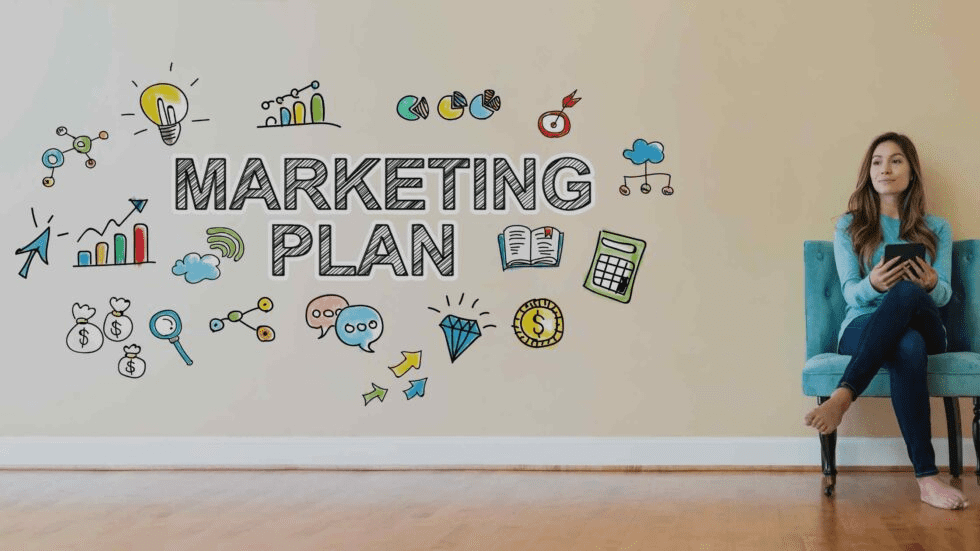
    How to Develop an Effective Marketing Plan in Just 7 Steps

    Planning always plays a vital role in any work or task, because work without a plan can always lead to losing. In that way, marketing also needs complete planning and after that effective way to develop.

    Let learn, How you can develop your marketing plan effectively in 7 steps:

    Define your Goals

    goal setting

    All starts with an objective or a goal. Suppose, you go to the bus stand and sit on any bus, but don’t know where to go. Then, what will happen? Of course, your whole journey will ruin.

    The same thing happens in marketing also. If you don’t have any goal, then your whole marketing budget will become wasteful.

    Always ask question to yourself, why you want to do marketing. It can be done for only Brand awareness, lead generation, more online sales, to increase audience etc.

    You have to always pick one objective which you want to accomplish with the help of marketing, because your whole marketing process will always varies from objective to objective.

    Situation Analysis

    swot analysis

    It refers to the process in which a company examines its overall situation that impacts business which is mostly done through SWOT analysis.

    It helps you understand the current situation of the business so that you can plan ahead. This is crucial, as any marketing activity you undertake, has to be in line with your business objectives.

    So, let’s learn to perform an effective situation analysis.

    In this process, companies had to analyze mainly two factors:

    • Internal factors
    • External factors

    The internal factors are factors that businesses have complete control over it. It include ‘Strengths’ and ‘Weakness’ such as your resources.

    The external factors include ‘Opportunities’ and ‘Threats’ such as market, competition and market.

    Let’s take the example of HCL. It analyzed its company with the help of SWOT (Strengths, Weaknesses, Opportunities, and Threats) analysis.

    1. Strength

    It organization in India for digital transformation.

    2. Weakness

    Low brand recall

    3. Opportunities

    i) To launch digitization business in global market.

    ii) Drive business growth in Europe.

    4. Threats

    Existing Competitors.

    HCl decided to leverage its top position in India to pursue other markets such as Europe and improve its top-of-mind recall over that of its competitors.

    Another way to analyse a situation is by considering the four layers that are present in any organisation:

    • Customer
    • Industry
    • Competitors
    • Company

    Customers

    1. How are your marketing activities reaching your consumer?

    2. How engaged are they?

    3. Are there any advocates?

    Industry

    1. How is your industry rated in the Digital Marketing field?

    2. What maturity stage it has reached; is it still in the beginner phase or has it matured?

    3. And what are the marketing channels which perform well in your industry.

    For example consider the online medicine industry, which is still in the early phases of digital penetration, whereas the e-commerce industry is close to maturity now.

    GSK would be in the early stages of digital penetration, whereas Amazon is in a matured industry of mobile commerce.

    Competitors

    1. How are you placed with respect to your competitors?

    2. Do your competitors have multiple services or touch points on the marketing channels that you don’t.

    Company

    This stage is self-explanatory. So at this stage, you need to introspect and understand how your company currently uses marketing. The SWOT analysis you learnt above is a great way to do this.

    Always consider these four factors to perform the situation analysis and also gather insights to build your integrated marketing strategy.

    Understand your Customers

    understanding your customers

    It is necessary to know that who would buy your product?

    The ideal way to understand your customer is by creating buyer persona.

    Buyer Persona: A buyer persona is a semi-fictional representation of your ideal customer based on market research and real data about your existing customers. 

    Lets learn how you can build an effective buyer persona to know your customers.

    1. Research your Target Audience

    The first and basic step of marketing is to search your audience. By researching, it will help you to create realistic persona.

     To start, look at your current customers. Who they are? This will enable you to explore more interesting facts about your customers.

    By finding commonalities among your best customers, you can create a persona that’ll help you attract more great customers.

    You can gather details from an online survey, forms etc.

    To gather information, you can ask some question related to their personal life and some following famous questions:

    When do you open your emails?

    What questions do you have about [Insert your industry]?

    What kind of content would you like to receive from me?

    Or what challenges do you face?

    2. Narrow Down the Most Common Details

    After completing the research, narrow down your details with most relevant answers received by audience.

    Following are the information, you should determine from the audience:

    a. Demographics ( age, occupation etc. )

    b. Behaviors ( skill set, interest in your product offering, how they use your product or service, what they read and watch, etc.)

    c.  Challenges and interests.

    d. Notification preference.

    3. Create Different Personas

    Now, you have narrowed your audience and now is the time of organization which means you have to organize the data which are relevant.

    You can do this by identifying same people who have common challenges and goals.

    For example, If you have a restaurant, you may find that some people’s main preference is to eat cheap and some prefer quality food. Since both have different goals, you can create 2 separate personas.

    Assess your Key Strengths

    The next step is to know your key strengths. It is like if you are good at content marketing but other marketers are good at some other marketing channels.

    Just because marketing has all these different channels, It does not mean you should focus on all of them at once.

    Yes, eventually, you want to take an omnichannel approach, which is leveraging all the different channels, but at beginning you need to assess your key strengths, and then leverage those first.

    If you don’t know your strengths, You are going to be spinning your wheels, focusing on strategies that are going to take much longer for you to produce results.

    But, if you are focusing on what you are already good at, you can get good results in very short times.

    Competitor Research

    compititiors research

    Competitor analysis is the process of evaluating your competitors’ companies, products, and marketing strategies.

    You have to find out the answers of some questions from the competitors research:

    a. Which marketing campaigns are most successful of competitors?

    b. Which marketing campaigns touches pain points of consumer?

    c.  Which thing you don’t have in your marketing but your competitors have?

    You can take help of various tools available in the marketing.

    After the analyzing you competitors, you have to decide that which thing you should have to replicate in your marketing and which thing you have to avoid which are not likeable for customers.

    Picking Up Marketing Channel

    marketing-channels

    When you are entering in the world of marketing, it is a good idea to pick just one marketing channel, for the moment which is more appropriate.

    But for the long term, don’t rely on just one marketing channel, as this can have negative effects on your business.

    You also had to figure out that where your most of the customers are active. It can be online or offline.

    If online, you can choose SEO, social media ads, etc. and you can use pamphlets, banners etc. in case of offline.

    At starting, focus on one marketing channel. But, when you begin to see results, consider working on another marketing channel, as soon as possible.

    Purpose of Marketing

    In the last step, you need to figure out that, how your marketing will make money.

    It can be in form of creating funnels, upsells or downsells.

    Most of the brands adopt this following formula in marketing:

    Increase brand awareness -> Build trust and authority among consumers -> Sell your Product.

    Above described method is proven and generally works on every type of business.

    Conclusion

    So, these are the steps which you can follow and launch successful marketing campaigns. You do not have to completely depend on these steps. You had to analyze your results after some days and find which things are going right and which need improvement.

    FAQs

    Q1. What can be a marketing plan for hand sanitizer?

    Ans: You can provide free samples as to increase brand awareness and if your product good, thin it can get sales.

    Q2. What is the difference between marketing plan and marketing strategy?

    Ans: Marketing plan refers to the activities you will perform in future and marketing strategy refers to your approach to achieve your desired results.

    Q3. What is the difference between marketing plan and business plan?

    Ans: A business plan includes the complete information about business i.e. overall strategy, financial plans, target markets, sales, products and services etc. On the other side, marketing plans contain only the information about marketing campaigns, marketing mix, budget etc.

  • Jung’s personality theory- 4 functions and 8 types

    Jung’s personality theory- 4 functions and 8 types

    Carl Jung was a Swiss psychiatrist and psychoanalyst who founded analytical psychology. Jung’s work was influential in the fields of psychiatry, anthropology, archaeology, literature, philosophy, and religious studies.

    Jung also worked as a research scientist at the famous Burghölzli hospital, under Eugen Bleuler.

    Carl jung was initially influenced by Freud, but later he choose a different route. It led to the development of the Myers-Briggs personality test.

    Jung’s personality theory was actually invented to demonstrate the complexity personality of human and its consequences. It was actually developed to label people based on their personality types.

    It was more focused on the complexity of human mind.

    You will get:

    Jung’s personality theory was built on the basis of two attitude of personality i.e. Introversion and Extroversion.

    Introversion

    introvert

    It refers to the personality theory of persons whose psyche energy only limits their own thoughts and feelings. They thinks always about themselves.

    Introverts are considered a shy person. They always focus on their own thoughts. They do not want opinions from other persons in the world.

    There are some traits which signify that you are a introvert person:

    1. You need quiet to concentrate.
    2. So, You are reflective
    3. You are self-aware.
    4. Also, You generally take time for decisions.
    5. You feel more comfortable being alone.
    6. So, You don’t like to work in a group or want to work alone.
    7. You prefer to write more than talk.
    8. You feel tired after being in a crowd.

    If you have any of the above traits, then you can consider yourself as a introvert person.

    Introverts know what they like and don’t like. They are deeply connected with their values and know what they want to get out of life. Such strong self confidence makes one more attractive, sophisticated, and desirable.

    Facts about Introverts

    Researchers have found that introverts have a higher blood flow to their frontal lobe. This part of the brain helps you remember things, solve problems, and plan ahead.

    Extroverts

    extrovert

    Extroverts is a personality theory type of people. It is the opposite of introversion. The psyche energy flows towards the outer world and other people. These types of persons are very social able and very open-minded.

    Extroverts are often described as the life of the party. Their outgoing, vibrant nature draws people to them, and they have a hard time turning away the attention. They thrive off the interaction.

    There are some traits which signify that you are a Extrovert person:

    • You enjoy social settings.
    • So, You don’t want to live alone for a long time.
    • You thrive around people.
    • Also, You are a friend of many people.
    • You prefer to talk out about problems and solutions.
    • For Instance, You are outgoing and optimistic.
    • You are not afraid of risk.
    • You are flexible.

    Above symbols shows that a person have an extroverted personality.

    A person who is an extrovert, take pleasure in activities that involve large social gatherings, such as parties, community activities, public demonstrations, and business or political groups.

    They also tend to work well in groups.

    An extrovert person is likely to enjoy time spent with people and find less reward in time spent alone. They tend to be energized when around other people, and they are more prone to boredom when they are by themselves.

    Carl Jung also told that all people in this world consists both personality attitudes.

    For example, if a person has more traits of extroversion than introversion, then he will be called an extroverted person.
    The rest personality attitude is transferred to the unconscious mind.

    Carl Jung also described the four function of human personality which are:

    1. Sensation
    2. Thinking
    3. Feeling
    4. Intuition 

    Lets learn these functions briefly:

    1. Sensation

    A mental condition or physical feeling resulting from stimulation of a sense organ or from internal bodily change, as cold or pain.

    A state of excited feeling or interest caused among a number of persons or throughout a community, as by some rumor or occurrence.

    It is completely reverse of the function Intuition. It refers to the process of gathering the information directly from the sensory organs rather than from the unconscious.

    2. Thinking

    Thinking is a core function in human personality. This function mostly uses logic and reasons and focus n less emotions.

    Thinking means that when a person observes anything around himself and around the environment and thinks about that thing and which he wants to explore more.

    Also, a person thinks after any discussion or event.

    3. Feelings

    Jung defined feeling as “primarily a process that takes place between the ego and a given content.

    It is like something you want to express. For example, Happiness, sadness, excitements, etc. are the feeling which a person can feel.

    4. Intuition

    This is the last function of human’s personality. It refers to the ability to understand something quickly without the conscious reasoning.

    It is that psychological function which transmits perceptions in an unconscious way. For example, Love at first site.

    Sometimes, person see somebody and falls in love immediately without any deep thinking. This is an intuition which plays important role in human’s life.

    Now the two attitudes of human that we discussed already i.e. Introversion and Extroversion are combined with previously discussed four functions, which results in formation of 8 functional variations.

    Functional Variations Are Also Known As Types of Personality Which Are Following:

    A. Extroverted thinking

    These are person who are generally very strict in their life. They follow all the rules and regulations very strictly. They are very punctual which means they are always on time.

    Mainly, they work on every task for their own objective. They always think first for themselves and afterwards for others. At last, we can say that they are like foolish people.

    B. Introverted thinking:

    They are the people who are mostly interested in their own thoughts and feeling. They don’t like to work in groups.

    Also, they feel tired after being in a crowd. They feels more comfortable by living alone most of the time.

    They are very creative persons but only exert their creativity when they are alone.

    C. Extroverted sensation:

    These people are considering as the extremely happy people. They always finds happiness in society.

    Extrverts do not think about any matter, but only lives for happiness. They also want to see other people and mostly attract positive energy. They always seeks for happiness and pleasure.

    D. Introverted sensation:

    These are people who do not expect anything from the other people. They want to create things by themselves as much as possible.

    In other words, we can say that these folks do not depend on society. Also, they do not care about what is happening in the society.

    E. Extroverted feeling:

    These people are very emotional and sensitive. They judge and reacts every single moment happens in their life and takes seriously when something hearts them.

    Extrovert’s are also very sociable which is completely reverse of introverted thinking. They likes group engagements, parties etc. And they show their creativity in public. They always prefer to work in a group rather than working alone.

    They like exchanging thoughts with other people.

    F. Introverted feeling:

    These types of persons always doubt themselves. They always focus on finding reasons or backend history of anything they do. They are very deep thinkers.

    Also, they do not share their feeling with someone. They resolve most of the issues of their life alone.

    Introverted Feeling deals with morals and what the person truly believes. Introverted Feeling is more in depth and complex. It is also known as the ‘judging function’ because these type of people often judge other people very easily.

    G. Extroverted intuition:

    Extroverted intuition is perceiving (gathering information) function. Their minds are very creative. They always try finding new things for experiment. Also, they gather lots of information of anything they absorb in their life.

    They are very motivated persons in nature. They stays always motivated in any situation and also motivate other persons.

    Some people ask, how can they develop extroverted intuition? The answer is simple:

    ·   Learn more and question more.

    ·   Be persistent. Don’t give up to easily on the things you are learning.

    ·   Be quiet. You must give some time yourself to sit in silence.

    ·   Write or talk about your ideas.

    H. Introverted intuition:

    Introverted Intuition is focused inwards, on the internal world of thoughts, ideas, and concepts. These types of people are more focused in their unconscious mind rather than their daily life. They do not enjoy their routine.

    Generally, they make a dream life in their mind and always think about that life and enjoys. They does not focus on the reality.  They focus on the internal world of the unconscious mind.

    Conclusion

    There are many personality types that a human adopts according to the Carl’s jung.

    FAQs

    Can a person have both personality i.e. Introvert and Extrovert?

    Yes, it depends on traits a person has. If a person has traits from both attitudes, then he can be both.

    What is collective unconscious?

    This term was introduced by Carl Jung to represent a form of unconscious common to humans originating in the inherited structure of the brain.

    What is the best Carl Jung book to start with?

    If you want to start with Jung himself, Collected Works Volume 7, two Essays on Analytical Psychology is the best place to start

    Carl Jung Functions

    Carl Jung was a Swiss psychiatrist and psychoanalyst who founded analytical psychology. Jung’s work was influential in the fields of psychiatry, anthropology, archaeology, literature, philosophy, and religious studies.

  • 4 steps to build your own unique brand persona | Just like Coca-cola

    4 steps to build your own unique brand persona | Just like Coca-cola

    Do you know what Coca-Cola is? Absolutely, a soft drink brand that serves their drinks all over the world. It is the Brand persona. The image that is created in your mind about Coca-Cola is its brand image. This image is created by Coca-cola with the help of their marketing campaigns, appealing stories, etc.

    You can also make your brand like coca-cola in just 4 steps:

    Lets deep into these concepts:

    1. Research your target audience

    Why do you want to build a brand persona?

    Answer is for your audience. To accomplish this question, you need to research your target audience.

    This is essential because if you start building your brand without any target audience, then it can’t become successful.

    This concept is also described by Philip Kotler named as ‘targeting and segmentation’. Therefore, it always starts with market segmentation. A single business can not satisfy everyone.

    So firstly, you need to identify the profiles of different buyers in your niche who might prefer your goods and services.

    Market segments can be identified by examining:

    market-segmentation

    The firms then decides which segments presents the best customers.

    You can take help of a well-known tool- Survey money. With the help of this, you can conduct surveys in different cities according to your niche to research best audience.

    After selecting your targeted audience, you need to find that what your audiences mostly prefer to buy? What brands are they like? What they don’t like?

    You can our another blog on What is STP? – it will guide you through Market Segmentation.

    Let’s take an example of market segmentation of famous shoes brand persona- Nike.

    Demographics:

    nike market segmentation

    Nike primarily targets consumers who are between the ages of 15-40.

    The company treats to both men and women athletes, They are now increasing focus on teens to build long-term brand persona loyalty.

    Nike labels this segment by creating marketing campaigns about young adults who aims to be like their athlete idols.

    For example, right before the 2014 World Cup, Nike sponsored soccer athletes with teenage soccer players.

    Geographic:

      demographic market segmentation

    Nike uses this segmentation to address  nations, regions, cities etc.

    For example, Nike focuses on American football and baseball in the U.S.A. It deploys many advertisements and marketing campaigns about football and baseball products.

    Psychographics:

    Nike also uses psychographic segmentation to target individuals with specific lifestyles and personalities.

    Nike targets individuals who enjoy sports to use this variable effectively. It can be playing, watching or simply talking about sports, these activities give insights about personalities and lifestyles.

    Nike’s marketing efforts are targeted at creating a “feeling” to g beyond the product. Nike encourage an attitude, it develops a lifestyle.

    Behavioral differences:

    Targeting based on this attribute is the genius of Nike.

    While Nike occasionally focuses on admire particular product features, the company largely focuses on feeling of buyer after using their product. The benefit expectations of the company’s products are clearly defined:

    ‘You are an athlete. Nike products make you feel athletic!’

    2. Create and enhance your visibility

    The second step is the visibility of your business. How your business will appear to the consumer whether online or offline matters.

    You have to create visibility in a way that people treats as a brand.

    To enhance your visibility, you need to focus on the following things:

    Let’s elaborate these things for brand persona.

    Website:

    Combination of web pages is called a website. In this era, having an website becomes a necessary part of building a brand whether your business is small or big. It is like an online shop which shows your all business online.

    If you do not own your business website, then you already lost many sales or leads.

    Firstly create a effective website for your business which describes your business. You can add your products, services, blogs and other information.

    Also, you have to optimize your website according to search engines or search engine friendly. Because, search engine mostly show optimized websites. You can outsource this service.

    Professional logo:

    Second step for a brand persona is creating a professional logo for your business. ‘Logo refers to a graphic representation or symbol of a company name.’

    You have to create a eye catching logo.

    You can create logo of name of your business like Coca-Cola or you can select any symbol which represents your business like Nike. Nike has symbol of tick mark.

    Also keep in mind the color scheme. You have to choose color which can relate your business. Lets take example of Netflix, it uses red and black color. Red symbolizes passion and energy while black is chosen as neutral symbol.

    Social media:

    King of branding is social media. It is a platform which you can leverage to build a brand in less time. Social mdia includes facebook, Instagram, Snapchat, quora, Youtube etc.

    Now there are steps which you can follow to build a brand:

    1. Sign up on all social media platforms.

    2. Complete your profile with all information.

    3. Upload your compnay’s logo as profile picture.

    4. Consistently upload different posts which can relate your business.

    5. Engage with your audience.

    6. Also, provide some free valuable information to users.

    Effective slogans: 

    Slogan refers to a short and striking or memorable phrase used in advertising.

    You can create slogans of your business to make memorable brand. Because some people identifies brands by listening their slogans.

    Following are the slogans of some famous brands:

    • Nike – “Just Do it”
    • Apple – “Think Different”
    • L’Oreal – “Because you’re worth it”
    • KFC – “It’s finger lickin’ good”
    • Coca-Cola – “Open Happiness”
    • Dunkin’ Donuts – “America runs on Dunkin’”
    • McDonald’s – “I’m lovin’ it”
    brand slogans
    Five tips to write effective slogans for your business:

    1. Highlights the key benefits. It should differentiate your product or service from others.

    2. Explain your company’s commitment or purpose.

    3. Keep it short.

    4. Organize it in a rhyme.

    5. Stay honest.

    Typography:

    It refers to the text or fonts you are using in your business. It should be in combination. The same font you are using in your online presence should also be used in your offline presence.

    3. Research your competitors

    Third step is to find out what your competitors are doing in the market. What type of campaigns are they running?

    You had to analyze what are their strengths and weakness. You can adapt their weakness and the things which they are avoiding in their brand.

    The things you need to follow for successful competitor research:

    • Firstly, you need to find who your competitors are. You can take help of various tools.

    Competition can be in various forms. They can be new start ups or any old established brand or also from other niches who are trying to expand in your category.

    • In the second step, we need to research following things:

    A. Clarity of message: You need to understand what message they are conveying to their customers.

    B. Design and user experience: What type of digital and traditional appearance are they providing to consumers. You also need to find out about their customer support.

    C. Channel efficiency: Which type of marketing channels they are using. It can be different social media, banners etc.

    D. Reputation : How their customer treats their brands? What are their ratings and feedback?

    E. Differentiators: What tools, medium and things they are using to differentiate their brand from others.

    • You gathered the all information about your competitors. Now, you need to convert that data into an understandable form.

    You can interrupt data in form of charts, diagram and tables etc. This is because; you had to take decisions on the basis of that report.  

    4. Deliver your message

    Now, it is the time to take action. You have done complete research and optimize your presence.

    You had to deliver your message to your audience.  Message in the sense, why you enter in market? What problems are you solving?  What makes you different from others?

    You can take help of different marketing channels. But, you had to analyze that channels on which most of your audience is active. It can be online or offline.

    You need to run appealing stories can make feel consumer friendly with brand.

    One thing also keep in mind that don’t run ads which may hurt any specific category, religious etc.

    Conclusion Of Brand Persona

    In conclusion, we can say that building band is like creating an asset. For example, apple’s worth in market is 1 trillion, which includes more share of their goodwill or brand.

    FAQs Of Brand Persona

    What are the different digital marketing channels for brand building?

    Ans: Different channels for digital marketing:
    PPC (Pay per click)
    SEO (Search engine optimization)
    SMM (Social media marketing)
    Content marketing
    Social media advertising
    PR (Public relation)
    Video advertising

    Who can build a brand? (Small or big business)

    Anybody can build a brand whether a small business or large business. In reality, Most of the businesses starts from small business and became large business by building a brand.

    What is the cost for building a unique brand?

    It depends on your marketing budget. It can be from $1 to $1 million. You can also take help of organic growth but it takes too much time.

  • Demand and supply curves | Meaning, Definition, Example, and Laws

    Demand and supply curves | Meaning, Definition, Example, and Laws

    Do you know the price of anything you buy? Obviously, yes. But most of the people don’t know the backbone of the price i.e. Demand and Supply. Therefore, these terms play an important role in deciding the price of a commodity.

    Let’s learn these concepts clearly:

    Concept of Demand

    Ordinarily, the terms desire and demand are used interchangeably. But in economics, demand has a distinct meaning. Supposing, you desire to have a LED TV, but you do not have enough money to buy it. Then, this desire will remain just wishful thinking; it will not be called demand.
    And, if in spite of having enough money, you are not willing to spend it on LED TV, demand does not emerge. The desire becomes demand only when you are ready to spend money to buy LED TV.

    Thus, demand for a commodity is the desire to buy a commodity with sufficient purchasing power and willingness to spend.

    There are two terms i.e. demand and quantity demanded. Some person considers these terms as same but both are different from each other.

    Demand: It refers to different possible quantities of a commodity that the consumer is ready to buy at different possible prices.

    Quantity Demanded: It refers to a specific quantity to be purchased against a specific price of the commodity.

    Demand Schedule: It refers to the table showing the relationship between different quantities to be purchased at different prices of that commodity.

    “The table relating to price and quantity demanded is called demand schedule”

    Demand curves are always created on the basis of demand schedule.

                                      Table 1: Demand Schedule of Apple 

    Demand Schedule of Apple

    Table1. shows that as the price of apple increases, the quantity demanded tends to decrease. When the price is 1rs., the consumer demands 4 units and when the price rises to 4 then the consumer’s demand tend to decrease to 1 unit.

    Demand curves are always drawn on the basis on a Law named Law of Demand. Let’s understand this clearly:

    Law of Demand

    It states that, other things remain constant, quantity demanded increases with a decrease in own price of commodity, and vice versa. In other words, we can say that quantity demanded and price has an inverse relationship and other things remain constant.

    The term ‘other things remain constant’ implies that other determinants ( affects the demand ) excluding price remains constant.

    Let us know more about Demand and supply curves.

    Demand curves

    Demand curve is a graphic presentation showing how quantity demanded of a commodity is related to its own price.

    It is prepared with the help of demand schedule which we talked earlier.

    It has two types:

    1.   Individual demand curve,

    2.   Market demand curve.

    Individual demand curve: It is a curve showing different quantities of a commodity that one particular buyer is ready to buy at possible prices. In other words, we can say that it shows demand curve of a Individual buyer.

    Individual demand curve

    Fig1. Shows the demand curve for the individual buyer. Quantity is showed on X-axis and price on Y-axis. D is the demand curve.

    Demand curve has a downward slope which indicates the inverse relationship between price and quantity. It implies that buyer intend to buy more quantity at less price.

    Market demand curve:  It refers to a curve showing the demand for the whole market not for an individual. In other words, it is the sum total of an individual’s demand curve which means every individual’s demand curve is integrated in order to make the whole market demand curve.

    For example, A and B are two buyers in market. Fig.2(i) is A’s demand curve. Fig. 2(ii) is B’s demand curve. Fig.2(iii) is the market demand curve. When the price is 1rs. , A’s demand is 4 and B’s demand is 5 . Accordingly, market demand is 4+5=9 when the price is 1rs.

    Let us know about Demand and supply curves.

    Concept of Supply

    Ask a producer: how much of a number of goods he willing to sell? ‘Depends on price’ should be hi obvious answer and that the right. At a higher price, he should be willing to sell more, while at a lower price, he should be willing to sell less. Accordingly, that’s the concept of supply.

    In other words, we can say that it is completely reverse of demand. In demand, consumer wants to buy more at a cheap price but on the other side, the seller wants to sell less at cheaper price. Both wants to maximize their profit.

    Sometimes we consider supply and stock as same concepts but they are not. Let understand it with an example:

    Suppose, A seller has 100 tones of wheat and prevailing price 500rs. per ton. Seller is ready to sell only 10 tones of wheat at this price. In this case, 100 tones is stock and only 10 tones is considered as supply.

    Stock of goods refers to total quantity which is available with the seller at the point of time and Supply refers to that part of stock which a seller is presently ready to sell at a given price.

    Supply and Quantity Supplied:

    Supply: It refers to schedule showing various quantities which a seller is ready to sell at different possible prices.

    Quantity Supplied: It refers to specific quantity which a producer is ready to sell at specific price.

    Quantity Supplied:

     Supply schedule of apple in the above table, different quantities are shown with the different price, these are all supply, and the seller only agrees to sell 30 units at the price of 15, this is the quantity supplied.

    Law of supply: It states that other things remaining constant, quantity supplied increase with an increase in the price of a good. This implies a positive relationship between price and quantity supplied. Thus, more at supplied at a higher price and less at a lower price.

                                         Table 3: Law of supply

    table showing price versus quantity supplied

    Table 3 shows that the quantity supplied increases from 100 to 200 units when the own price increases from rs.10 to rs.11 per unit. Likewise, it increases from 200 to 300 units when price increases from rs.11 to rs.12 per unit. Implying that there is a positive relationship between their own price and its quantity supplied.

    Supply Curve

    It is graphic presentation of supply schedule, showing various quantities offered for sale at different possible prices of that commodity.

    It also has 2 aspects:

    1. Individual supply curve

    2. Market supply curve

    Individual supply curve

    It is a graphic presentation of supply schedule of an individual firm in the market. In other words, it shows only supply curve of an individual seller.

    This figure is drawn on the basis on schedule of individual supply. S curve has a positive slope, showing the quantity supplied increase in response to an rise in price.

    Market supply curve

    It is a graphic presentation of market supply which means it represents the whole industry not an individual.

    market supply curve

    A and B are two different firms. Figre© has market suplly curve. At rs. 10, A’s firms supply 10 units and B supplies 5 units. Therefore, total market supply is ( 10+5=15 ).

    Slope refers to ratio between change in price and change in quantity supplied.  Generally, slope of supply curve slopes upward, which indicates a positive relationship between price of a commodity.

    Market Equilibrium

    Now, we have learned the concepts of demand and supply which implies that both seller and buyer always tries to maximize their profit but if this scenario always happens, then anybody does not believe on market because seller always sells at higher price and buyer wants to buy at lower price. That’s where market equilibrium stands.

    Market equilibrium refers to state of market when demand for a commodity is equal to its supply, corresponding to price. Thus, in state of equilibrium, the market clears itself: market demand = market supply i.e. Dx=Sx. There is neither excess demand nor excess supply.

    graph showing market equilibirium

    In that case, both buyer and seller agrees at a particular price..

    In such situation, that price in market is called equilibrium price and Quantity supplied/demanded is called equilibrium quantity.

    Determination of Market equilibrium:

    Market equilibrium is determined by the forces of (i) market demand, and (ii) market supply.

    Market equilibrium is struck when, at the prevailing price in the market, quantity demanded is equal to quantity supplied. There is no excess demand or excess supply in the market.

    chart showing determination of Market equilibrium
    Figure 1

    Figure 1 shows that when price of apple is rs. 5, market supply= 50 units and market demand = 10 units. This is situation of excess supply.

    At a given price, producers are willing to sell more then what buyers are willing to pay. Pressure of excess supply reduce the market price. Supposing, the price reduces from rs. 5 to 44.

    Reduction in own price leads to rise in quantity demanded and fall in quantity supplied. Consequently, quantity demanded increases to 20 unirs whereas supply reduces to 40 units.

    Even at the price, market is not cleared: market demand<market supply. Pressure of excess supply still exists. This will lead to further reduaction in price. Now, it reduces to rs.3.

    Now, demand increase to 30 units and supply reduces to 30 units. Tus, demand and supply both are equal at rs.3. Accordingly, rs.3 is the equilibrium price and 30 units is the equilibrium quantity.

    Conclusion: Demand and supply curves

    Hence, these are the curves on which all market depends. Also, demand and supply is influenced by many factors which also includes price.

    FAQs: Demand and supply curves

    What is point at which demand and supply curves intersects?

    Demand and supply curves intersect at a equilibrium point which normally termed as ‘E’. At that point, both curves are equal to each other.

    What are the demand and supply curves for complementary goods?

    Complementary goods are the goods that are consumed together like pen and ink. The demand and suppl curves also shift. If price of one good increase then the demand for other good decreases and shifts backwards and supply curve forward.

    What is and equilibrium?

    It refers to point where quantity demanded and quantity supplied equals or intersect each other.

    What are the demand and supply curve for labor?

    A change in anything else that affects demand for labor causes a shift in the demand curve. Changes in the wage rate (the price of labor) cause a movement along the supply curve