When you use/ consume any product or service from any company, if you feel good and fulfill your needs, you may recommend it to your friends and family.
The product maker or the company uses a measurement system to evaluate the customer experience, customer loyalty, and customer satisfaction.
This measurement is based on scores & it is called Net Promoter Score (NPS).
What’s in this article?
What is the Net Promoter Score?
FRED Reichheld developed Net Promoter Score at Payne & co. in 2003.
Net Promoter Score (NPS) is a natural, reliable, and customer-centric tool for the company’s management to measure customer loyalty and satisfaction with their products or services.
NPS used by a small medium and large company to assess their customers
It is an essential metric for growth-driven technology businesses.
You can measure it by asking one simple question to your customers
“How likely are you suggest our company’s products or services to your friends/colleagues/family?”
How to Calculate NPS?
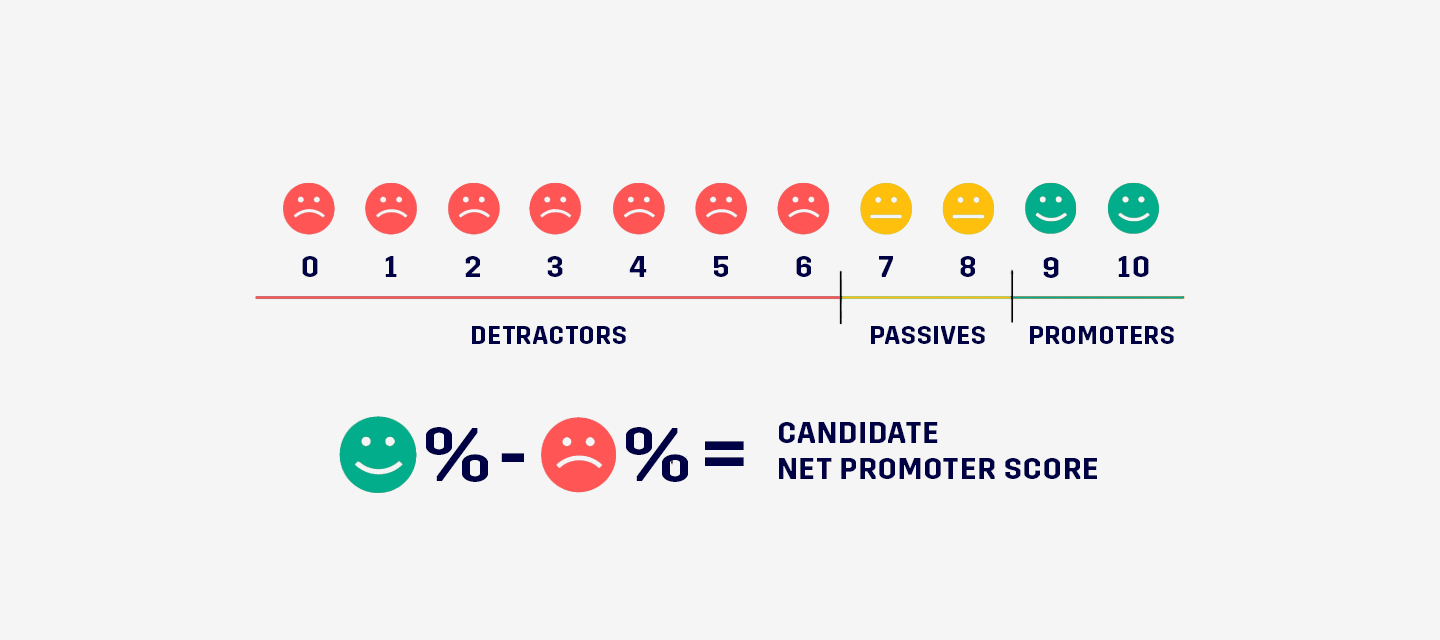
For NPS calculation you need to ask your customer through a survey on how likely you would recommend our products or services to your friends and family on a scale of 0 to 10,
Categorize all responses according to their scores :
Detractor, if customers gave you scores between 0 to 6.
Passives, if customers gave you ratings between 7 to 8.
Promoters, if customers gave you scores between 9 to10.
Now subtract the percentage of detectors responses from the percentage of promoter responses to determine your NPS that maybe range from – 100 to 100.
Promoters are loyal and well-wisher customers.
Leveraging Promoters (9-10)
Referral program
Ask them to leave reviews
Testimonials
Social sharing
Send them swag
Nature of a Promoter (9-10)
Defenders/advocates of your brand
Loyal and Enthusiastic
Always refer you to others.
Renew, Expand, and promote your product.
Passives are Satisfied with your Products but not like Promoters
Nature of a Passives (7-8)
Satisfied with your product but not enough like a promoter.
Unenthusiastic
Not loyal too much.
If your competitor gives them a better deal, they may switch.
They are Price sensitive.
Detractors are unsatisfied with your services, centers who won’t buy from you again, and may even intimidate others from buying from you
Nature of a Detractor (0-6)
They Speak louder than your promoters.
They might share negative experiences.
Hicustomer’sof customer’s switch
You could not build loyalty or a long-lasting relationship with them till yet
They are dissatisfied with your product.
Why NPS Matters?
It helps to Identify the market position and ideal customers
It helps to increase sales and revenue dramatically
Helps to gain key messages
Helps to prepare for objections
Consistent referrals and references
NPS helps to create Customer stories and personal Interactions
Trends and themes to inform product development
It gives motivation for prospects tell lead scoring
NPS reduces the volume of future support needed
How to Take NPS Data?
To collect data for Net Promoter Score you need to make a feedback form and you have to request your customer to fill that form in order to enhance customer experience.
.
When to Survey?
Establish a regular Don’t cycle
Don’t survey too frequently
Align your transactional survey with essential points in the customer journey
Avoid batch of customers
Coordinate with other teams to have a comprehensive survey plan
Who to Survey?
All contacts, including customers, policymakers, and key shareholders.
Don’t avoid surveying unhappy customers.
Don’t survey too early
Don’t incentivize
Where to Survey?
In-App
Pros
Higher response rate
More relevant feedback
E-mail
Pros
Less likely to be based on a particular transaction or workflow
Cons
Lower response rates, resulting in less accurate results.
Examples of Some NPS survey Question
You may ask some questions in the NPS survey form like
On a scale of 0-10, how likely are you to recommend our products/services to your friends?
What is the primary reason for your score?
How can we improve your experience?
Which product/ service features do you like?
What was disappointing in your experience with us?
Why is NPS Important?
It helps to measure the loyalty of your customer
2. It helps to improve your services
3. It improves customer’s experience
4. It can find detractors so that we can reach them and improve the loopholes.
How to Increase your Response Rate?
Send your survey from a human
Set expectations in the subject line
Make your call to action clear
Ask no more than 2-3 questions
Send a survey reminder
Follow up with everyone who responds
Send more than one survey per year and be consistent.
Conclusion
Measurement of NPS is essential for every business so that they can improve and give better customer experience to their customer.
The product maker or the company uses a measurement system to evaluate the customer experience, customer loyalty, and customer satisfaction. This measurement is based on scores. Hence it is called Net Promoter Score.
FAQs
1. Who are the Detractors?
Detractors are some unhappy customers who do not feel satisfied with your product and services.
2. Why do we use NPS?
NPS is a measurement system. It helps to improve customer’s experience.
3. Why is NPS important?
Customer ‘ses customer’s recommendations and referrals.
4. What are the cons of an app NPS survey/
More tresemailsg than emails Only works for specific segments
In today’s era, Businesses changed from being transactional to relational.
Meanwhile, Organizations make sure that customers are satisfied with their products and services for increasing customer loyalty and retention.
One satisfied customer can bring 6 new customers with him while on the contrary, one dissatisfied customer carries off 6 customers.
That’s why they start using this approach Customer relationship management for identifying, acquiring, and retaining the customers, and therefore managing a healthy relationship with them.
Here in this chapter, we will discuss:
What is CRM?
Customer relationship management (CRM) is a mixture of practices, strategies, and technologies that businesses use to manage and analyze customer interactions and data all over the customer lifecycle.
So, It helps businesses to improve a relationship with their existing customers and creates customer loyalty and retention.
After all, customer loyalty and retention are qualities that affect a company’s income. Hence, It is a management strategy that helps in increasing profit for a business.
Meanwhile, It helps businesses improve customer experience, satisfaction, retention, and service.
Why CRM is important?
Today, every business is full of competition, so it is more important than ever to gain new customers and retain the existing ones.
Customer Relationship Management makes your company more customer-centric so that you are more likely to get 60% of more profit than without CRM business.
So, A good relationship with your customer can bring you more loyal customers.
CRM Software
Hence, Nowadays, Customer relationship management is done by some software and applications, and it is the biggest software market in the world.
So, CRM software is a tool to bring your sales, marketing, and customer support activities together, and simplify your process, policy, and people in one platform.
It also helps you to manage the relationship between team members, vendors, partners, and collaborators.
So, Customer relationship management software takes data from communication channels, the company’s website, telephone, email, live chat, marketing materials, and social media.
Hence, It enables businesses to learn more about their target audience and develop the best product according to their customers’ needs and desires.
Also, Through the CRM system, companies stay connected to customers, processes, and improve profitability.
How Can a CRM system Grow Your Business?
It helps to make improvements to your backend.
Identify and categorize sales opportunities.
Also, Helps to Increase preferences from existing customers.
It helps to offer better customer service.
It helps to develop products and services.
Components of CRM
Mainly CRM software integrates customer interactions and information into a single database so that company users can more easily access and control it.
1. Marketing Automation: Marketing automationis a component of Customer Relationship Management software. It can automate recurring tasks to minimize marketing efforts.
For example, as sales opportunities come into the system, they automatically send the marketing materials, offer details, and product pricing details via email or social media or notifications.
So, The main aim of marketing automation is to increase sales by converting potential customers.
2. Salesforce Automation: Hence, In the CRM software, Salesforce automation is a tool that traces customer interactivity and automates many business functions of the sales cycle that are necessary to follow and attract new potential customers.
3. Call center Automation: Meanwhile, In managing the excellent relationship with the customer CRM system, integrate call centers. So, Call center automation helps assist customer problems through pre-recorded audio and information. It also allows agents to handle customer requests and simplify customer service processes.
Geo-location technology or place-based services: Also, These systems can generate geographic marketing campaigns based on customers’ physical location. It is also used to serve customers and find out new potential customers based on site.
Workload automation: These systems systematically organize all work so that employees do their work in a minimal effort with less time.
Sales lead management: So, Through these systems, sales team manage all inputs, and analyze data for converting potential customers.
Types of CRMs
1. Sales CRM
So, The main aims of comapnies is making profit, and sales can make a profit. Hence, CRM provides better features, processes, and advanced tools for making sales through customer interactions.
Meanwhile, It allows you to build a sales funnel, track leads, and find sales opportunities. It simplifies workflows and enables customer data such as chat, voice, email, and social media touchpoints on a single platform.
So, This system is all- in – one sales CRM system for sales professionals. Hence, It involves Sales Leads, contacts, opportunities, accounts, quotations, and proposals, etc.
Below are some names of few softwares:
Pipedrive
Close
SugarCRM
Dialpad
2. Service CRM
Customer service is a vital part of customer relationship management. It contains exclusive tools for customer service and support.
It is used by multiple departments such as sales, marketing, and customer service professionals to enhance customer experience and resolve customer inquiries quickly and smoothly.
So, These systems have customer phone, email, online forms, live chat, social media contact, and online interactions.
When a customer raises any service related issue, service CRM identifies the problem and sends it to the relevant concern department to resolve the customer’s issue as soon as possible.
There are some service CRM listed below:
Agile
NextOS
Zendesk
SugarCRM
3. Marketing CRM
Marketing is the most essential part of any business.
It establishes a better relationship and building your brand with the customer.
Basically it automates all marketing activities to make your product brand top of other brands and also more likely to increase sales.
Also, it helps you to know how many engagements you are getting on your website, what marketing links customers are more likely to click, and the personal data they shared on a form.
Marketing CRM form marketing campaigns and also automate them across all marketing channels, get information about the status of mail sent whether it is opened or not by the customer, click-through rate, and use customer interactions to modify the landing page.
Some marketing CRMs are:
HubSpot
Drip eCRM
Keep – (formerly Infusionsoft)
Creation (previously BPM’Online Marketing)
Zendesk Sunshine
Mailchimp
CRM for Small Business
There is some CRM system that is made only for small businesses.
Small business owners are looking out for simple, automatic layout and operating in low data interactions, this software integrate and manage their small business.
If you have been running a small business, then you can use following software for your business:
Nimble
NoCRM.io
Copper
Capsule
Insightly
Zoho
Freshsales
HubSpot CRM
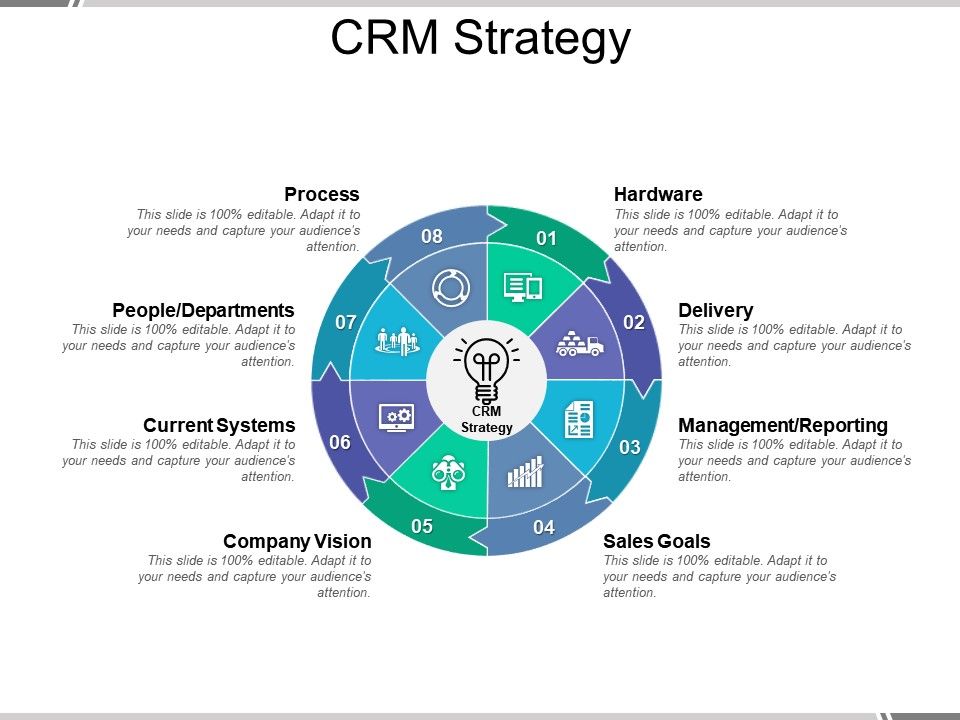
CRM Strategy
Set a target
Be a customer-centric company
Remove all communication barriers
Track your customer interaction
Sync every data on your system
Measure, analyze and improve
Examples
Social CRM: It includes attracting potential customers directly from social media like Facebook, Twitter, LinkedIn, etc. social media is an open platform for all customers to share experiences and promote your products as well.
Contact Centre: Sales and marketing teams acquire data and update the CRS system with information throughout the customer lifecycle.
The agents of contact centres collect data and revise customer records through service calls and technical support interactions.
Mobile CRM: These applications are made for smartphones, and tabs are a tool for sales and marketing employees. Through mobile CRM, they can access customer data anywhere and do their work when they are not in the office.
Conclusion
Nowadays, businesses are more concerned with customer-centric rather than only sales-centric.
That is why customer relationship management comes into existence.
It is now in the software, which records all customer interactions and sends output to the user when required.
FAQs
1. Which is the biggest software market in the world?
The CRM software market is the biggest software market in the world.
2. What is customer relationship management?
Customer relationship management is a mixture of practices, strategies, and technologies that businesses used to manage and analyze customer interactions and data all over the customer lifecycle.
3. What is CRM software?
CRM software is a tool to bring your sales, marketing, and customer support activities together, and simplify your process, policy, and people in one platform. It also helps you to manage the relationship between team members, vendors, partners, and collaborators.
Have you ever seen ads on TV or any posts on social media platforms where ordinary people share their positive experiences with that particular product? hence, These types of ads are part of communal marketing.
So, In this blog, we will learn what is communal marketing and how you can implement it in your business.
What’s in it for me?
Definition
So, Communal marketing is the type of marketing in which companies invite their consumer to be a part of the company’s campaign for advertising and marketing.
Also, The customer’s involvement in any marketing campaign of the company builds trust and brand value for that particular company.
In Communal marketing, the idea is so simple. Hence In it, companies invite their past consumers for their next advertising campaign.
Generally, communal marketing focuses on customers to share their experience with the company and their products and spread the story.
but This activity helps the company to get vast leads and trust value among all new consumers, increasing the company’s sales graph and growth rate.
For example, you start a new business which provides all beauty services at home and service is available only for female. also, Suppose you serve beauty services to 10 females in their place, and you want your customers to review you.
You start a marketing campaign with that past customers and invite them to make a short video about their overall experience of beauty services and share it with you. also, And for that, you will give them an extra 20% off on the next Bill.
so, For that 20% discount, ladies make small videos about their experience and share them with you. And with the help of this campaign or marketing strategy, you have got trust and Brand value as well as videos for the company’s advertisement.
Communal Marketing is different from Viral Marketing and Word Mouth marketing. hence, In viral marketing or mouth publicity, the company gets a small number of leads.
Still, in Communal Marketing, it targets the related community of that consumers and creates high value with a high conversion rate.
Users of Communal Marketing
All the businessman are the primary users of Communal Marketing who also believe in the Word of mouth publicity and Viral marketing.
But Communal marketing is far way effective than this marketing medium. So, That’s why it is trendy among all the companies.
hence, It works in the 80/20 rule. so, Here 20% of past customers give the sale up to 80% to the company. It happens because sharing a review of any product for a particular company builds a high level of trust in other consumers’ minds.
also, This campaign creates a sensation on social media, a new user will trust your company, and your brand will get more leads and growth rate after this campaign.
The Strategy of Communal Marketing
To plan a successful communal marketing campaign, an advertising team of the company should follow the following steps:-
We should start a communal campaign for past consumers with some necessary steps and apply it very carefully.
Share this campaign idea with their past consumers and invites them to participate in that campaign.
also, Request them to share some stories of user experience of the particular product and give rating, review, and feedback.
meanwhile, Monitor the shared posts, ratings, and reviews and respond to them appropriately.
Select the Best Post for your ad and boost it as per the commitment.
Let’s understand these steps with the example:-
so, You have seen many photos contest or challenge campaign on social media.
meanwhile, Let assume you are an owner of a company that makes small baby’s diaper with an age limit of 0 to 2 years. And you are starting an ad campaign with their parents who have bought your products.
In this campaign, you invite your customers to click an image or make a small video of your baby, which shows that this diaper is so comfortable for your baby and share it on Facebook, Instagram or Twitter with hashtag #CompoftWithDieper.
You will select the top 10 images from these and featured a baby’s image on the packaging of your product.
Why Communal Marketing
There are various points which well answer the question of why Communal Marketing. So let’s check some of the essential points that why Communl marketing:-
Communal Marketing generates a healthy relationship between the company and its consumers, including the company’s repeated customers.
so, It creates a high trust value and brand value in front of other people, increasing the company’s sales rate.
also, You can generate new customers through this marketing campaign.
Job Profile in Communal Marketing
So, There are various posts in Communal advertising and Marketing. Major Job Profiles in Communal Marketing field are as follows:-
Market Research Analyst
Public Relation Specialist
Advertising Promotions and Marketing Manager
Market Research Analyst
Salary (Annually in INR)
1.2 lakh- 4.8 Lakhs
Minimum Qualification
Bachelor’s Degree in Market Research, administrations, statistics, social science, or related fields.
Works
Gather past consumer’s information and activity.
so, Conduct necessary Background Research.
Gather and examine the collected data.
also, Evaluate Customer’s response and behavior.
Public Relation Specialist
Salary (Annually in INR)
1.5 lakh- 5. 4Lakhs
Minimum Qualification
Bachelor’s Degree in communications, public relations. Journalism or related field.
Works
Create a Public relationship with past consumers.
Run and test the campaign’s performance with the help of the marketing team.
Advertising Promotions and Marketing Manager
Salary (Annually in INR)
2.2 lakh- 7.65 Lakhs
Minimum Qualification
Master’s Degree & experience in Marketing advertising or Business Management. Also may have experience in this field.
Works
Monitor all marketing & advertising.
Track to Communal marketing performance.
also, Monitor and communicate with the advertising team.
Conclusion
Since the last decade, Communal Marketing has been developing and continues researching to become more specific and accurate on delivering the best ads campaign to relevant past users.
Nowadays, the Internet has become so useful and accessible, and communal marketing also develops new types of marketing around Mobile devices.
FAQs
1. What is Communal Marketing?
Communal marketing is the type of marketing in which companies invite their consumer to be a part of the company’s campaign for advertising and marketing. also, The Customer’s involvement in any marketing campaign of the company builds trust and brand value for that particular company.
2. Who uses Communal Marketing?
All the businessman are the primary users of Communal Marketing but who also believe in the Word of mouth publicity and Viral marketing. But Communal marketing is far way effective than this marketing medium. That’s why it is trendy among all the companies.
3. Who are the Target customers for Communal Marketing?
So, The customers who have trust in the company and loyal to the company are responded positively to the company. They never turn back to share their experience with the company’s products.
4. What are the Job Profiles in Communal Marketing?
Ans:- There are various posts in Communal advertising and Marketing. Major Job Profiles in Communal Marketing field are as follows:- 1. Market Research Analyst 2. Public Relation Specialist 3. Advertising Promotions and Marketing Manager
6. What are the benefits of Communal Marketing?
Various points show the benefits of Communal marketing. so Some of them are as follows:- 1. It generates a healthy relationship between the company and its consumers, increasing the company’s repeated customers. 2. It creates a high Trust value and Brand value in front of other people, increasing the company’s sales rate. 3. We can generate new customers through this marketing campaign.
John P. Kotter is an American professor at Harward Business School and also a specialist in change management as well as leadership.
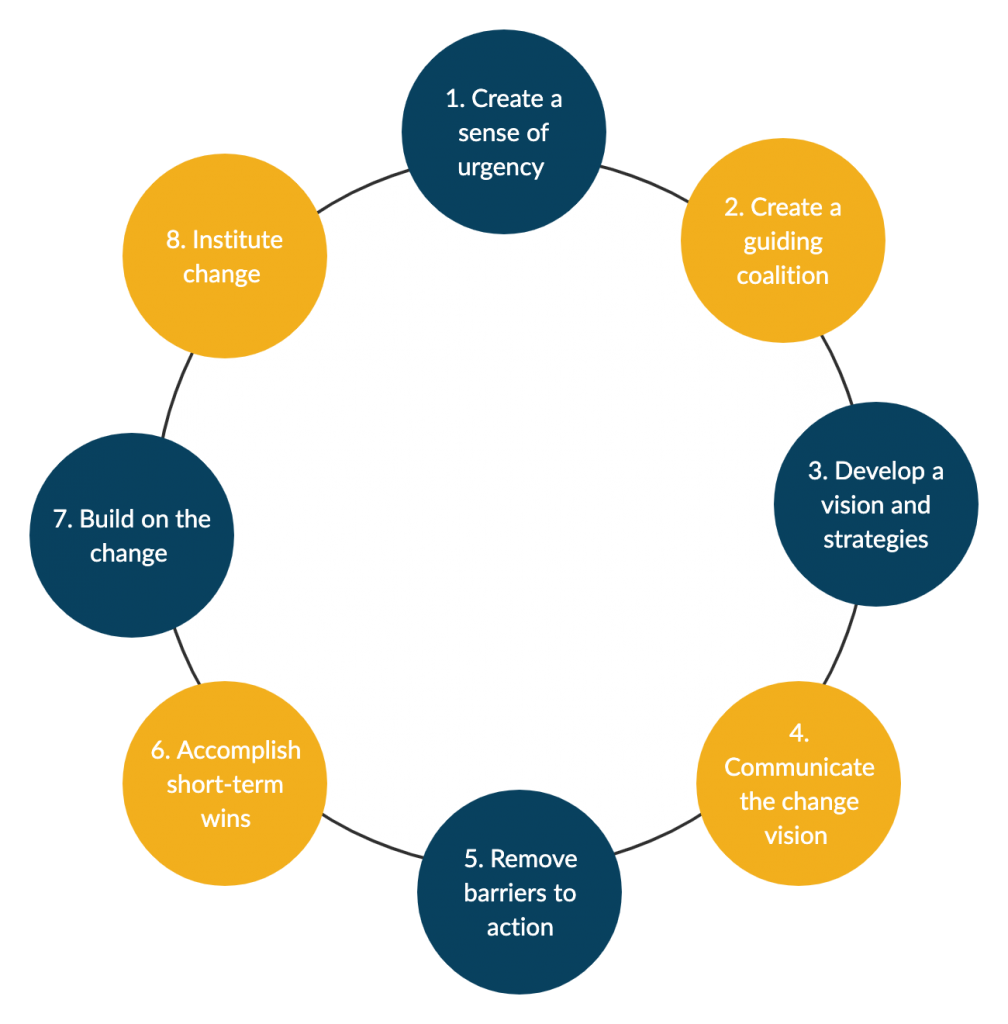
Kotter, in 1995 gives 8 step change model for effective change management. So, Kotter’s eight-step model – showing a road map for change based on common errors made by organizations.
Kotter’s 8-Step Model for Leading change is one of the most important models made for understanding the change management system and then for more straightforward implementation of the change within the company
Whats in it-
What is Kotter’s Model?
It is one of the most important models made for understanding the change management system and then for more straightforward implementation of the change within the company
.
Planning and Leading Organizational Change
Kotter’s eight-step Model- Many prescriptions have been proposed for strategic, organization-level change. But, the best known is the work of John Kotter.
Basically his ideas are based on analysis of many change efforts over 15 years, were set out in a Harvard Business Review seminal article (Kotter, 1995).
The article identified eight common errors that organizations make when trying to undertake significant changes.
Meanwhile, This was followed by his book Leading change (2012a [1996]), in which he specifically elaborated his ‘eight-stage process.’
So, Each stage was an antidote to one of the errors he identified. Also, The whole process offers a roadmap for undertaking significant organizational change, placing a strong focus on the role of effective leadership.
Moreover, in Kotter’s writing, there is an underlying assumption that, given the right process and the right leadership, change can be planned and managed.
He acknowledges at many points the ‘messiness’ of change and offers prescriptions for dealing with this. In his seventh and eighth stages, Kotter does engage with the complexity of organization systems and how one affects another.
However, he appears to see organizations and Change primarily through the machine, architecture, and political systems metaphors described above, and does not engage actively with the less deterministic metaphors.
Kotter’s 8 Step Model for Leading Change
Establishing a sense of urgency
Kotter identifies sources of complacency and ways to raise the sense of urgency. But, it is absolutely clear that this stage is not complete until ‘a majority of employees. Perhaps 75% of managers overall, and virtually all of the top executives… believe that change is absolutely essential’. This is a high bar to achieve, but Kotter sees it as essential.
Creating the Guiding Coalition
The change-leading coalition needs to be characterized by trust and a common goal. It must contain people with strong positional power, appropriate and also varied expertise, credibility across the organization, and effective leadership.
Developing a Vision and Strategy
Kotter sees vision as ‘a picture of the future with some implicit or explicit commentary on why people should strive to create that future.’
So, The vision needs to be something that people can really imagine and should offer positive outcomes for the organization’s key stakeholders. Combining both head and heart, teams create a vision, a time-consuming process.
Communicating the Change Vision
Firstly, The vision needs to communicate in clear, direct language, verbal images, and analogies. We should repeat it frequently through many channels, including opportunities for discussion and take feedback also.
Empowering Employees for Broad-Based Action
Major Change needs the willing effort of a wide range of employees, who really feel that they can make a difference.
Employees can be set free to make that difference by ensuring that the organization’s systems and structures support employee action, providing appropriate training to encourage and remove or side-lining managers who might get in the way.
Generating Short-Term Wins
Short-term wins provide a boost to the change initiative. They help minimize negativity and promote support for the change. They also provide opportunities to recognize individuals who deserve credit for contributing to the transformation thus far. Don’t just ‘hope’ for them to happen; make sure short-term wins are a significant element of the change plan.
Consolidating Gains and Producing More Change
There is always pressure to revert to the old ways. Sustaining and embedding change requires ongoing effort over a long period.
So, Kotter encourages the guiding coalition to ‘press on’ and deliver more change, increasing resources not reassigning them away from the change effort. He also emphasizes the importance of continued clear leadership and direction from the top and excellent project and program management disciplines.
Anchoring New Approaches in the Culture
It has been said that ‘culture eats strategy for breakfast’ – and it sometimes eats change as a second course! It is the nature of culture to be mostly unconscious and deeply embedded over a long period.
Furthermore, Kotter points out that even apparently successful change programs can be ‘eaten’ over the years if the organization’s culture is not aligned with them.
It is vital to identify aspects of ‘old’ culture that threaten the change and to address them through highlighting the positive outcomes of the change, through talking about the old culture, valuing it for its time, and where necessary through using changes of staff (especially visible promotions) to strengthen the new culture that is needed. For more on culture, see Section E.
Steps of Kotter’s Model
Create a Sense of Urgency
Firstly, we should examine the market and the competitive environment to identify critical points, potential crises, and significant opportunities.
After that, it is necessary to discuss the findings with all the team members, motivate employees (team members), assure them that things are moving, and answer their questions.
Build a Powerful Coalition
In the second step, the stakeholders should form groups of people who are willing to support the idea.
It should include experts, leaders, managers of the organization, and a responsible team that should be created. It can make a highly effective precondition for change implementation.
Form Strategic Visions
Firstly, it should explain the values of the change process are, a shared vision should be created, and the people who will be a part of the change management team should be inspired.
So, new strategies should develop to achieve the vision.
Enlist Volunteer Army
It is very important to keep communicating with the vision. So, It should be frequently and powerfully. The same applies to talk about change, new strategies, and visions.
Enable Action by Removing Barriers
Firstly, we remove any obstacles on the path, focus on the places where obstacles are recognizable, prepare the change system and company’s structure for a transformation process, and support non-traditional ideas, activities, and procedures.
Generate Short-Term Wins
Planning and achieving visible performance improvements are the main objectives of the sixth step of this Change Model.
So, the important thing that the company should do is to motivate people to make the change happen, value, and reward them for visible planned achievements.
Sustain Acceleration (Build on the Change)
The seventh step focuses on the acceleration of the change.
So, it includes hiring, promoting, and educating people responsible for the transformation process, point out structures, changes systems, and procedures that are not consistent with the transformation and should be changed. And renew those processes that are related to new projects, ideas, and components.
Institute Change (Anchor the Changes in Corporate Culture)
Last but not least is the eight-step orientation at the embodiment of changes in the corporate culture environment. It helps achieve better customer behaviour and thereby increases the productivity and efficiency of management and leadership.
Advantages of Kotter’s 8 Step Change Model
It is a model that provides a brief description and guidance on the entire process of change management, and it is easy for implementation.
Emphasis is on the involvement and acceptability of the employees for the success in the overall process.
The primary emphasis is on preparing and building acceptability for a change instead of the actual change process.
Conclusion
This article briefly describes Kotter’s 8-Step model for Leading Change in a very easy way so that you can learn about all the eight common errors that organizations make when trying to undertake major changes.
In this article, I elaborated his ‘eight-stage process’. Each stage was an antidote to one of the errors he identified.
FAQs
1. What is the Kotter model?
Kotter 8-Step Model for leading change is an important model for understanding the change management system. And then for more straightforward implementation of the change within the company.
3. How can businesses apply John Kotter’s 8 steps?
Kotter’s 8-Step process for leading change 1. Create urgency 2. Form a powerful coalition 3. Create a vision for change 4. Communicate the vision 5. Remove obstacles 6. Create short-term wins 7. Build on the change 8. Anchor the changes in corporate culture
4. What is the first step in Kotter’s 8 step approach?
The first step is establishing a sense of urgency. Kotter identifies sources of complacency and also the ways to raise the sense of urgency. But it is clear to us that this stage is not complete until ‘a majority of employees. Perhaps 75% of managers overall, and virtually all of the top executives believe that change is absolutely essential’. This is a high bar to achieve, but Kotter sees it as essential.
In the earlier-20th century, social psychologist Kurt Lewin first described the process of individual change as-
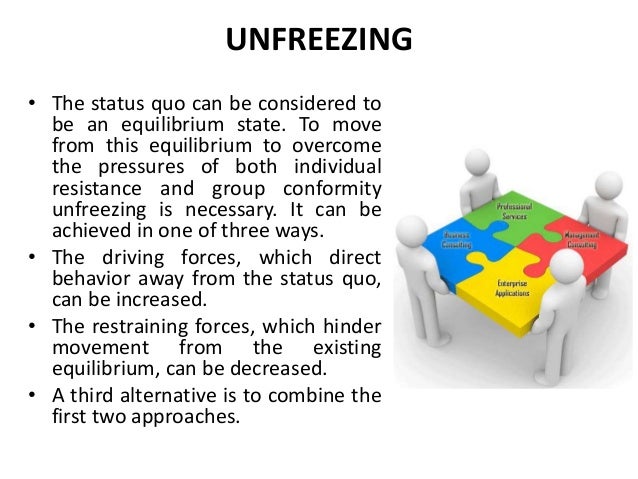
Unfreezing (when you overcome inertia, existing habits and mindsets also break down),
Change (a period of confusion when you challenge the old ways. But, as yet the future way of being is not clear),
and Refreezing (when you form new mindsets and habits in order to establish yourself).
Moreover, you restore a degree of psychological comfort through this process.
What’s in it for me
Lewin’s Change Management Model
The second best-known and also one of the oldest change model is Lewin’s Three-Stage Model of Change.
Mr. Kurt Lewin was an American social psychologist of German origin.
His research focuses on factors that influence people to change, and he determined this change model which contains these three stages:
Unfreezing
Change Stage
Refreezing
The 3 Stages of Change
Unfreezing Stage
The first stage dedicates to the preparation and also getting ready to change.
It is the most important stage. The core thing is to identify the needed change.
And it is getting out of the comfort zone to start the change process and then implement the change itself.
The more they need of change is pushing, the more urgent it is, the more we motivate to make the change happen.
So, Mr. Lewin presents the basis for unfreezing and motivate yourself that is Force Field Analysis.
It is a powerful strategic tool with the help of which we can decide what is essential for change on the personal and corporate levels of decision-making.
It is about decisions that are ‘pros’ and ‘con’s’ and about setting their weight. By listing these factors (forces), we know which factors are for and which are against the change.
So, If the factors for change prevail, we should make the change. If not, there is a low motivation for the change, and we should not start the change process.
Moreover, this Unfreezing stage involves moving individuals, departments, or the whole companies and businesses towards the change.
The Force Field Analysis has seen in Fig. Shows that the change is in equilibrium between forces that drive the change and those that resist the change.
It is ‘quasi-stationary social equilibrium’. For change occurrence, the equilibrium is suspended by increasing driving forces.
The successful change is achieved when the driving forces are strengthened, or restraining forces are weakened.
Furthermore, This analysis is mainly used to differentiate between the factors that drive a person towards (within the organization/situation) or away from the intended state and the factors that resist it.
The Three Main Activities In The Unfreeze Stage
Lewin sees three activities in this ‘unfreeze’ stage:
Clearly define the current situation. The more collaborative this process can be, the more effective it is. This is both because people will be more committed to a picture they have defined and because the involvement of more people will make it a more vibrant, fuller picture.
Create a vision of the desired end state. The richer, fuller, and more attractive this can be, the more people who contribute – the better.
So, Identify the forces that will help drive and resist the change, increasing the driving forces identified and decreasing the resisting forces. Once again, this is best carries out by a group of those leading and affects by the change.
Change Stage
The second stage is Change and is dedicated to the change process – to transition.
The transition is an internal movement that an individual or a company makes in reaction to the change. It occurs when a company or an individual decides on making a change.
An essential part of this stage is the support in the form of coaching, training, and expecting mistakes, which are an inherent part of the process.
The core thing is the development of the company’s solutions, using role models, clearly communicating the design of the desired change.
It also includes benefits for implementing the change and who is responsible for the whole process.
Refreezing Stage
The last stage of Lewin’s Change Model is Freezing (or Refreezing).
This concept is about reinforcing the change and also about maintaining the accepted change into the future. Without this freezing part, people tend to go back and keep doing what they used to do before the change.
That is what Lewin saw as a freezing stage – the support of the desired change to ensure that the change process continues and is not lost. People highly criticize Lewin’s theory for being too simplistic, especially the third stage.
Nowadays, we know that the change process cannot be rigid but has to be exactly the opposite, i.e., flexible. High flexibility is necessary to make the change happen.
This stage is, in fact, the integration of the new values, visions, and processes into the community (of individuals or an organization), but also a new tradition.
So, The main purpose of the refreezing stage is to stabilize and ensure the new equilibrium, which is the result of the change.
You should do it by balancing both the driving and restraining forces (from Force Field Analysis). (Connelly, 2016)
Force Field Analysis
Force field analysis is a very useful tool when considering the case for change.
Kurt Lewin’s ‘force field analysis’ mentions as part of a process of planned change. It is also highly relevant for an organization to engage in a more fluid ‘emergent change’ process.
In this context, it is helpful to involve as wide a range of constituencies as possible, whether or not they are formally defined as stakeholders.
Moreover, the technique encourages those involved to identify all the forces that hold the organization in its current position.
It includes powerful cultural, social, and behavioral forces in such an analysis.
As a result, all can identify how their own actions, behaviours, and interactions with others can be uses by us to weaken opposing forces.
And to strengthen the forces driving in the desired direction.
Lewin Says:
‘An issue is held in balance by the interaction of two opposing sets of forces: those seeking to promote change (driving forces) and those attempting to maintain the status quo (restraining or resisting forces).’
Moreover, in many human situations, Lewin observed an increase in one force (to promote change) creates a reaction in other forces, seeking to maintain the current equilibrium.
He used the term ‘homeostasis’ for this tendency of systems to maintain their current state.
Lewin developed the use of a diagram in which the ‘current state’ (down the middle of the picture) is being maintained by a range of driving and restraining (resisting) forces.
As this diagram is drawn, a desired ‘end state’ of a change process is to the right of the picture, with all the driving forces pushing that way currently balanced by restraining forces.
If an organization desires to make change more quickly. Then either the driving forces need to be augmented, or the restraining troops decreased.
Ideally, both of these must happen. This could, for example. Involve highlighting the benefits of making a particular change (augmenting the driving force). While at the same time addressing staff concerns about the new processes (reducing the resisting force).
Steps of Force Field Analysis
Follow these steps to create a force field diagram in a group setting:
On a flipchart or whiteboard, briefly describe the current situation requiring change.
Briefly state the desired end state (the target for a change).
List the driving and resisting forces at work in your change situation.
Write one per ‘sticky note’.
Place the sticky notes on either side of the ‘current state’ as appropriate.
Discuss the results and share ideas and thoughts about how to augment the driving forces and reduce the resisting forces.
Capture the results and use them to inform the change process and priorities for change.
Important Tip
It is advisable to collaboratively create a force field diagram with key stakeholders to ensure a variety of viewpoints and perspectives.
So, Use different sizes/lengths of arrows or assign a number to each arrow to indicate its strength to drive or restrain the change.
Conclusion
In this article, Kurt Lewin’s ‘force field analysis’ is mentioned as part of a process of planned change.
It is also highly relevant for an organization engaged in a more fluid ‘emergent change’ process.
This technique encourages those involved to identify all the forces that hold the organization in its current position.
FAQs
1. What Is Force Field Analysis?
Kurt Lewin’s ‘force field analysis’ is mention as part of a process of planned change. It is also highly relevant for an organization that is engaging in a more fluid ‘emergent change’ process.
2. What Is The Main Objective Of Force Field Analysis?
The main objective of Lewin’s force-field analysis tool is for analyzing driving and resisting forces. Force field analysis is a very useful tool when considering the case for change. It is used for Change analysis.
3. How To Make Force Field Analysis?
Follow these steps to create a force field diagram in a group setting: 1. On a flipchart or whiteboard, briefly describe the current situation requiring change. 2. Briefly state the desired end state (the target for a change). 3. List the driving and resisting forces at work in your change situation. Write one per ‘sticky note’. 4. Place the sticky notes on either side of the ‘current state’ as appropriate. 5. Discuss the results and share ideas and thoughts about how to augment the driving forces and reduce the resisting forces. 6. Capture the results and use them to inform the change process and priorities for change.
4. Why Choose Lewin Change Model?
Lewin’s force-field analysis tool for analyzing driving and resisting forces. We use this tool for change analysis.
5. What Is Lewin’s Change Model?
The second best-known change model is Lewin’s Three-Stage Model of Change, presented in 1947. Mr. Kurt Lewin was an American social psychologist of German origin. His research focuses on factors that influence people to change, and he determined this change model which contains three stages: 1. Unfreezing 2. Change 3. Refreezing
The change curve is a very helpful way of understanding the process of change. In this blog you learn about the change curve, the impact of the change curve, stages of the change curve and practical observations of the change curve for leading and managing change.
Whats in it
What is the Change Curve?
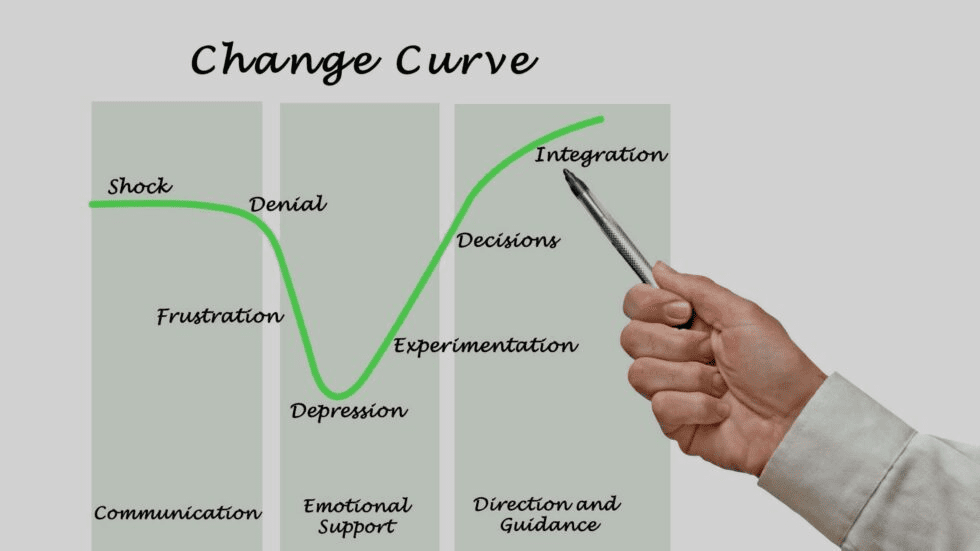
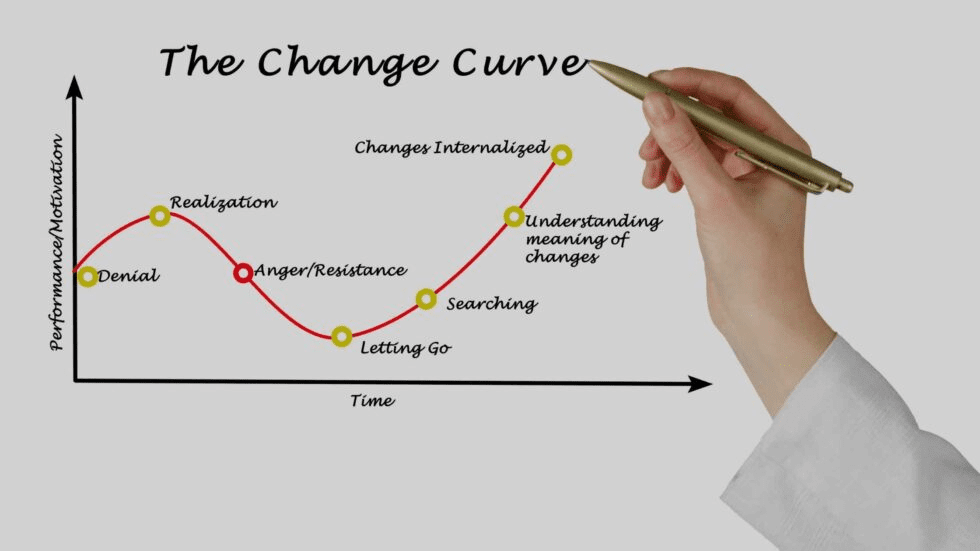
The Change Curve is a powerful model derived from the work of Elisabeth Kübler-Ross (1969) and we can use it to understand all the stages of personal transition as well as organizational change.
It helps you predict that how people will react to the change so that you can help them make their personal transitions, and also make sure that they have the help and support they need.
Impact of the Change Curve
A very helpful way of understanding the process of change for individuals or groups is the ‘change curve’. Also sometimes referred to as the ‘transition curve’, the ‘coping cycle’ or the ‘human response to change’.
It derives from the work of Elisabeth Kübler-Ross (1969) who observed people in the process of coping. All the changes involve the elements of letting go of the past and encourage to engage with a different future. As a result, the patterns she observed, they offer valuable insights into people facing change.
Other authors – notably Adams, Hayes and Hopson (1976), and Parker and Lewis (1981) – have developed Kübler-Ross’s thinking for various life changes.
The discussion here applies her approach in a way relevant to a variety of change situations. Although some challenges the research applying this model to organizational situations. It remains a helpful way of looking at change.
It is communicated and helps to explain many characteristic patterns of response observed in change processes. The figure shows how personal performance, energy, and, characteristically, mood vary through the normal process of human change.
Stages of the Change Curve
Shock and Denial
After the initial ‘shock’ (1) of being confronted with a change, an individual (or group) often resists engaging with the change as if trying to prove that the change is either unreal or unnecessary.
The burst of additional (defensive) energy characterizes this ‘denial’ phase (2) which tends to increase temporarily both performance and mood.
The shock element is minimized by effective and early communication. If at all possible, involve people in the planning process.
Once you get to know the change, be aware of signs that people are not taking it fully seriously, demonstrating both empathy and firmness of resolve.
Anger and Blame
Assuming the change is real and continue, there comes a point where those who experience the change, they can no longer avoid to engage with it.
And at this point, denial often gives way to anger or blame (3). The idea that ‘It’s not fair!’ may take hold. ‘The management’, ‘the market’, ‘the people in suits’ – always ‘they’ – are blamed for the change.
This is a time for empathy, and to help the people to consider realistically the impact that the changes will have on them individually.
Don’t try to minimize the losses that people will experience – they need to know that the cost of the change to them has been well understood.
Bargaining and Self-Blame
As the mood and performance decline further, blame may turn towards self, and elements of bargaining emerge (4).
In fear of bereavement, people try to do deals with God to preserve the life of their loved one.
Faced with imminent redundancy, people may take on additional work to delay or avert the threat. Personal support and empathy remain important.
An effective response will include effective line management, sharing concerns in peer groups and opportunities to contribute to planning how changes are implemented.
Good active listening can be a powerful tool to help people deal with any unwelcome consequences of change.
Depression and Confusion
The process to this point has been characterized by a drive to hold on to – or to revert to – the existing or former condition. Energy, morale and performance also may fluctuate.
But, all these relate to the ‘downswing’ side of the curve, between anger/blaming others and self-blame/bargaining. The realization that all such efforts are failing leaves people at their lowest point of performance, energy and morale.
Similarly, Confusion, sadness, even depression are characteristics of this period (5). Empathy, active listening and good support structures are probably the most effective responses to this phase of change.
Acceptance and Problem Solving
For someone to come through this hard period requires a point of acceptance.
It is the point at which the person accepts at a deep level that change is happening and resolves to address this ‘new future’ (6).
For significant changes, a person may not reach this point quickly – and in some cases may not reach it at all.
But no real future-oriented behaviour will begin until there is true acceptance of what has changed.
This insight is like the first light of dawn, by which individuals see that they have a future beyond the change.
Following this point, people start engaging themselves in problem-solving behaviour (7): how I live without my loved one, how I can find a new job, how I can configure this new work system to make my life easier.
This allows people to always try out new approaches, make new discoveries and eventually to integrate these into their new ‘way of being’.
Practical Observations for Leading and Managing Change Curve
First Observation
People sometimes get stuck in one stage, or oscillate between two – often around ‘blame’. Sometimes people regress through this process.
However, the stages it describes – where people progress through them – are normal human responses to change.
Second Observation
The length, as well as the depth of the personal change curve, can be anything from a brief and minor ‘wobble’ (fluctuation) to a major ‘roller-coaster’ lasting for months.
Some factors that tend to affect this length and depth – and the probability of emerging successfully on the upside – include: –
How deeply an individual is affected by the change. Understanding the change from the perspectives of various stakeholders and stakeholder groups is therefore critical.
The personal confidence and resilience of the individual. The contribution of supervisors and local-line managers is vital. They are best to assess how different people are likely to handle the level of change they expect.
The interaction between a change and another one in the life of an individual. Someone who possesses a stable and strong network of friends and family may cope with redundancy better than another person who is currently undergoing a messy family breakup. Again, if supervisors and line managers know their people well, they can help to assess such impacts.
How much control or influence people feel they have over the change. This is why involving people as early as possible, and as deeply as possible, improves the prospects for successful change.
So, Note that this may go a long way towards explaining the relatively small disturbance that follows ‘positive changes’; in many cases, these are changes that we have initiated ourselves and feel more in control of.
Third Observation
The change curve is a function of time. Some apparent ‘resistance’ simply reflects a difference between the position of those announcing a change and those receiving it.
Those announcing the change have had greater involvement in the process to this point, so their personal change curve is shallower and shorter.
They have also had more time to process the impact of change on themselves. So are typically further through the curve.
So, at the point of the announcement, those receiving the change are right at the start of their curve. Judging their early reactions too harshly as ‘inappropriate resistance’ simply fails to recognize the natural process of human change.
Fourth Observation
When people become angry about the change in general, or about particular aspects of it. And when they blame those announcing the change they are (at least in part) expressing their own process of adjustment to the change.
Of course, all feedback should be listened to and taken seriously. But anger and blame from the recipients of change do not necessarily evidence that change is being managed badly. It is wise not to take such anger and blame too personally!
Fifth Observation
It is important to note that this characteristic pattern of human response to change remains true for the positive changes in life as well as for unwelcome ones. Most people who have accepted a new ‘dream job’ will be able to trace their experience over the first six months through this curve!
Of course, not everyone will experience these things in exactly the same way, but many will recognize – from their own experience – elements of these descriptions.
Observations based on the ‘change curve’ tell us that people who feel involved in planning or implementing a change show a shallower and shorter decline in morale – and performance – than those who feel that change has been ‘done to’ them. Accordingly, the resistance of all kinds is lowered.
Tip to Handle Change Curve
The change curve is a personal journey. Don’t expect all members of a peer group to experience a change in the manner of synchronized swimmers!
Different personalities, different life experiences, different personal circumstances at the time of the change – all these and more will affect the way that different individuals respond – and how quickly.
Benefits of Change Curve
The change curve is a useful framework for describing the cycle of change. Communication and engagement efforts need to be appropriate to where people are along the change curve and help to support them through the change journey.
Leaders and managers are often unaware of this, and so they can’t align their messages appropriately with the thinking of their teams.
In their enthusiasm to progress with their plans, managers often try to ‘sell and push’ the idea of change, causing even more resistance and anxiety.
Instead, they need to support people through the journey that they themselves have been through.
People need to understand the bigger picture, the wider context, so they can understand the ‘why’ behind the change. They need to make sense of this before they can engage in the process of change.
Conclusion
This article briefly describes the change curve because change curve is a useful framework for describing the cycle of change.
Communication and engagement efforts need to be appropriate to where people are along the change curve and help to support them through the change journey.
One very helpful way of understanding the process of change for individuals or groups is the ‘change curve’, also sometimes the ‘transition curve’, the ‘coping cycle’ or the ‘human response to change’. The change curve is a useful framework for describing the cycle of change. Communication and engagement efforts need to be appropriate to where people are along the change curve and help to support them through the change journey.
2. What is the Kubler Ross Change Curve?
One very helpful way of understanding the process of change for individuals or groups is the ‘change curve’. Also sometimes referred to as the ‘transition curve’, the ‘coping cycle’ or the ‘human response to change’. It derives from the work of Elisabeth Kübler-Ross (1969) who observed people in the process of coping. Change Curve tells us that people who feel involved in planning or implementing a change show a shallower and shorter decline in morale and performance than those who feel that change has been ‘done to’ them. Accordingly, the resistance of all kinds is lowered.
3. What are the five stages of change?
Te five stages of change are- 1. Shock and denial 2. Anger and blame 3. Bargaining and self-blame 4. Depression and confusion 5. Acceptance and problem solving
4. Who developed the change curve?
It derives from the work of Elisabeth Kübler-Ross (1969) who observed people in the process of coping with death and bereavement.
5. What are the benefits of Change Curve?
The change curve is a useful framework for describing the cycle of change. Communication and engagement efforts need to be appropriate to where people are along the change curve and help to support them through the change journey.
Have you ever noticed your actions that you are doing in your daily life? If yes then these daily actions might be your habits.
If we came on the exact meaning of people’s habit, then an action pattern earned by a regular repetition or unconsciously repeated itself in your daily activity means these activities are your habit.
Behaviour is also a person’s action, which can be observed. But there is quite different in it a habit is common or can be said that it can happen unconsciously.
That means it remains same in all cases and for all persons until you change your habit.
On the other hand, its behaviour may differ from person to person it varies according to condition, ages, positions, etc.
For instance, if you see a teacher, she can behave differently with students and parents. She treats students like her own child and with parents like other people.
That’s how behaviour changes from person to person and cases to cases. We can observe instant changes in someone’s behaviour but not inhabit.
If one wants to change habits, they need a lot of time, techniques, steps, stages, and much more. But habit influences behaviour in various ways.
Whats in it-
How Habits Influences Our Life
We have already seen what is a habit here and we are going to be aware of how good or bad habits influence our daily lives.
Daily we interact with lots of people, but we remember a few peoples clearly from them. Now the question is why.
Why we can’t remember all of them and the answer you already know the exact answer. We only remember those people who give us a perfect memory or bad memory.
And this memory is created by interacting with peoples. Some of them have a good habit, and some have bad, and ultimately it influences there behaviour, which includes its temper, ability, character, and much more.
And when we met and spent some time with a person who has these qualities and good behaviour, our mind makes a good memory.
But when we met with a person who has terrible behaviour, our brain makes a lousy memory, and We all want to forget bad memories, but we can’t do it quickly. It is a psychological fact.
For instance, we all want a better life, and for this, we need a high payout salary, which we can make from an excellent job or business.
But, in both cases, we need to interact with peoples, and a person with good behaviour plays the game very well.
But that bad memory person losesthe game. And can’t make it live better. So from the above interpretation, we can understand how good behaviour affects your life.
Role of Habits in Your Life
Your habits play a major role in your health. If you want a healthier lifestyle, then you have to choose a more robust pattern.
You can’t even imagine how your habits decrease your life span day by day because you can not remember your daily actions, which done unconsciously in your activity.
Just because of your unhealthy habits, you can lose your potential. You can not reach your maximum potential in any field.
If you are a student and your habits are not good, then you have to face many problems like lack of focus in your study, reminding previous questions.
If you are a player, then you can lose your stamina, accuracy, endurance. etc. So here we listed some everyday bad habits that you have to quit.
Habits that You Should Change
People’s Habits of Biting Nails
Most of us have this habit, but everyone ignores it, but it can harm your teeth and your nails. Also, it can cause infections. Your hands consist germs and bacterias which enters in your mouth and harms you
People’s Habits of Using too Many Digital Products
This generation is full of digital gadgets mainly your smart because it emits blue light which damages retina cells, and it ultimately causes lack of sleep
People’s Habits of Using Headphones
Long term use of headphones may damage your ears because a normal range of hearing is about 75 decibels, but this young generation wants louder and rocks. This also distracts your mind.
Steps to Make Good Habits
There is a big struggle to make changes inhabit. It can’t be possible in one or a few days or not only done by to fix a target.
So, to make changes occupy, we need a full proof, Applied, and tested method. And it should as planned as everyone can be done without any difficulty. So our plan should be clear in which we have various steps.
Steps are necessary because we can not focus on a huge plan properly rather than small plans that allow us to make our target clearer, so we need to break down our policy in small steps.
So there are some following steps that we need to follow to make quick changes in life.
Make your Mindset
Firstly, you need to absolutely clear your mind and think properly about what you want from yourself.
What habits annoy you more. Is it affects your profession? Is it create difficulty during interacting with peoples.
And in any case, where your habit and behaviour make problems in your life, prepare your mind to make some tough decisions.
Focus on your Main Goal
Firstly, you have to make a list in which a set of bad habits are listed that you want to change, then you should focus on one habit at one time now understand the type of habit and what type of changes you want in it.
And if there is a problem to understand it then just focus on what type of trouble you have to face in your daily life bingo that is your bad habit that you have to change.
Find the Root of your Habit
Now you have to find the main reason behind your bad habit and behaviour why you do it. It can be your laziness, talking, sleeping, watching movies, or anything.
Now you have the main root of it. If you have done it than you already half of the game
Clear your Surroundings
Now see what’s wrong with your surrounding. If you live alone, then find some partner if you talk more than push yourself to talk on central topics, if you sleep more then find some task that you have to do so our focus is to clear your surrounding.
Take Challenges
After clear your surroundings, you have to take challenges it depends on what type of habit you want to change for instance, if you sleep late at night, do some intense physical exercise, so take some obstacles that give you more strength
Keep it Regular
You almost reached your final stage now. You have to keep it continue, and you finally complete your task.
If you want to see the final results, you have to do it for 21 days. You can do it longer be because after this. It becomes your habit.
Conclusion
Everyone wants a better life, and now you know how habit plays a role in our better behaviour, and with this, you can make your success more clear because our practices change our lifestyle completely.
And with clear visibility of progress, you can achieve it earlier than others. Not only your success, but you can also see healthy changes in yourself.
FAQs-
How to change people’s habits?
Ans. Here are 3 ways to change people’s behaviour – First of all, it is very important to know that change is a very difficult task. If you work for change, then you see the results of change very well soon. 1. You have to pay attention to your small things, things and other important things. 2. Open up porosity – Do not shame the people when they screw up. Be honest, vulnerably. Ask people for advice. Use some levity. Try to ask someone if he wants to change, and will commit to doing so. Offer choice. People don’t like to be told what to do. 3. To begin with, you should pay good attention to the role model. Not at all people who are against revenge.
Is it possible to change habits?
Ans. With clarifying cue and reward. You must make an effective plan to change your habit. For a change, you have to create a new routine and adapt it to your person. A routine that will achieve your desired reward.
How do you change someone’s bad habits?
Ans. Often in life, you try a lot to help yourself change other people. Then whether you are acting as a mentor, a parent, or a well-to-do spouse. You always expect positive effects on them. Help you reach your goal.
What are Behaviour change strategies?
Ans. Most individuals who start with good intentions and commit to change their behaviour fail to continue. Extension professionals may use behaviour change strategies to motivate participants and follow regular physical activity and a healthy diet rather than on weight changes.
Before we start, why does the change or why change can fail, let’s know what the organizational change is? Here is the descriptive definition of the organizational change: What does the organizational change exactly look like?
The organizational change means the company wants to alter its policies and strategies and adopt new technologies and want to make changes in the infrastructure. Maybe there is a need to change the internal control system, and any other stuff. The company makes changes in a major factor for the growth of the organization.
Now, the question arises that why is there a need to change in an organization? There can be many reasons for it. Maybe there is a change in technology, competition, and all that stuff. So, let’s check out why Change Can Fail.
Our minds are very resistant to change. Whenever there is something you have to change, our brains do not suddenly accept it, especially at the organizations or on a large scale.
Suppose you want to make a change in your organization. You want to implement a new marketing strategy or a sales strategy or make changes in any department or policy. It won’t be accessible at all.
According to research, 70% of change can fail.
Do people start questioning how it will happen? How can we change something when it is going smoothly? There is no need for change. But they do not think about why it is important to change something? They used to focus on how rather than why.
It would also be happed many times with you as well, isn’t it? If you even think so. And want to know why organizational change can fail. Then reading this article will help you a lot.
Here we will get to know what not to do
Change Can Fail by Lack of communication
Excellent communication makes things better. Lack of communication is one of the biggest reasons for organizational change can fail. Management fails to communicate with the employees for the change.
They used to tell me what is the changes are what the changes will look like, but they don’t forget to know about the reason that why the changes are needed and why it is so important to do.
Lack of communication leads to distrust among the workers and employees. Suppose the management is not able to communicate effectively to the employees or the workers. Sometimes they are not able to communicate the goals properly.
Differing agendas
The management’s poor communication leads to disinterest in the change among the staff or the employees. The employees resist change because their ego comes in front of it due to poor communication.
Sometimes there is a problem of interest, which means if any department is not getting the benefit of the change, they resist it.
For example, there is a change in the organization for top-level employees. Therefore, the other employees are not getting any benefit or interest, which will lead to resistance to change.
Lack of leadership
Leaders are the individuals who lead and give direction to their team or a group of members. Leadership plays a very crucial role in an organization. Leadership skills are the most important part of the organizational change, and along with this, it can also be the big reason for organizational failure.
If there is a lack of leadership skills in the organization, then it is a big failure. Sometimes the leaders are not able to give the proper guidance to their team.
Here also a lack of communication arrives. The leaders are sometimes not able to communicate the reason why the change is needed. And hence, they have to face organizational failure.
Lack of commitment
If you want to make changes in the organization for this, you must be 100% committed. All employees are very dedicated and committed to their job and their organization. The commitment of employees to the organization shows satisfaction towards their job.
But whenever you ask for any changes, it is seen that there is a lack of commitment in the employees to their organization, as the management doesn’t communicate that way the change is needed. And therefore employees have no interest in it as they think that they will be affected by this change. Hence they don’t have an interest in it, and lack of commitment arises.
Poor planning
Planning is a process of thinking beforehand, which means before doing any action, there must be proper planning for the same.
Whenever you are changing the direction or doing any change to your organization, it needs full proof planning and aforethought vision. Nothing can happen properly without any planning.
A quick decision for change can be a regretful decision for you. Because without proper planning, you can’t make any change, hence there is no adequate plan. And this poor planning can be a very big failure for the organization.
Poor process
After all the things you need to implement the desired change in the organization. The method of the implementation must be proper and in the right way. When the process of implementation of a change is well designed, then there is nothing that will fail.
The implementation of the change is the most important thing in the process. The right way of the process will ensure that there will not be resistance to change among the organization’s employees.
Lack of resources
Lack of resources is one of the most important reasons for the failure of organizational changes. When you plan to make any change in your organization, you must adequately design everything.
Resources are the most important thing for making a change. Make sure that you want to change in your organization, and there must be enough resources for the new technologies and innovation you want to implement.
Sometimes the organization plans all the things well, and when they need to implement the change, the resources are not enough. And you should now all the new technologies and research before implementing it.
Priority focus on system vs. people
The management and leaders focus on the change of system. Their primary focus and priority are to make changes to the system than people who are going to work on that.
This is the big reason why organizational changes fail. The management’s priority must be the people. They should train people first before bringing any new technology or system.
The priority must be the people, not the system, because if people know how to operate the system, then the change will automatically be successful. There will not be any failure faced by the organization.
Conclusion
As you read the article above, every organization has to make changes due to technologies and innovation purposes, and there may e any other reasons for the same.
But every change is not successful, and 70% of changes get fail, but the difference is also significant for the growth of the organization. You have seen all the reasons why organizational changes fail, and if these reasons are modified accordingly, then there won’t be any failure faced by the organization.
You have read the article, and now you know what to do and what not to do at the time of change.
FAQs
What is organizational change theory?
Ans. There is Kurt Lewin’s change theory which has three stages explained as under: Kurt Lewin’s change theory is developed in the 1940s, and this theory involves three steps, which are unfreezing, change, and refreeze. Stage one: unfreeze In this change theory, the first stage is unfreezing. When you want to make changes, then there is every individual resistance to change. You have to realize why the changes are needed. Every employee and individual must recognize the changes are for them and organizational growth. Stage two: change After every person realizes that the change is necessary and needed, then it’s time to implement it. Stage three: refreeze Now when the changes are done. After implementing all the new policies and technologies, its time to refreeze it and hold on. It is the final stage when you implement all the latest strategies and apply this until the new changes require.
What is organizational change and development?
Ans. The organizational change refers to the necessary changes that have to do in the organization due to innovation, change in technology, and change in the interest of the customers. Organizational development refers to the overall increased productivity and growth of the organization. It affects both the individuals as well as the organization. You should do organizational development only when the necessary changes are done, and it helps the business grow.
Why is organizational change important?
Ans. Change is the most important thing, and it is also necessary because the changes help people improve themselves. In organizations, the employees learn new skills and improve and polish their skills. It is important for the growth of the organization. To bring new technologies and innovation to the business.
How to communicate organizational change?
Ans. Here are some tips for clear communication during change: Make the goal clear and discuss the plan with every person. The communication must be clear and why the change is to be needed must be explained. Discuss the change with every employee of the organization, and make them involved in the process. So, no one will feel excluded, and they will feel good and hence support it. Don’t forget to take feedback to get to know what the employees think about it.
So, The companies are very dynamic nowadays. You might also have seen a list of organizational changes in your company.
also, Change management is a necessary part of any company. hence, In this article, we will discuss The Burke-Litwin Change Model of Change.
What’s in it-
What is the Burke Litwin Model of Change?
This performance and change model is a tool. This model is used to understand the components of the organization.
They also provide information about how they are related to each other in terms of change.
W. Warmer Burke and George H. Two renowned organizational change consultants. Who is known as Burke Litwin?
In the 1992s, both of those famous organizational change consultants invented the model. Which is known as the Burke Litwin Model of Change?
With the help of this model, you can identify three levels of changes in any organization. To know about these three changes, you have to study the important information obtained by the 12 factors or drivers of change.
Three Levels of Changes in the Organization
Transformational Change
It is caused by the environment outside. It has a direct as well as effective impact on leadership and organizational culture, mission, and strategy.
Transformational change is defined as a 2nd order. Frame-breaking changes that completely change your current operating structure.
These changes lead to huge changes in processes, people, and usually on a large scale of technology.
When one acquits you adopt these changes. After this, you are unable to return your mind. Because of which you are not able to go back to the old way.
Transactional Change
Transactional change affects your structure, management practices, system and process, and functionality.
Under the Transaction Transformation Project, you have to facilitate the achievement of strategic objectives by shifting the functions of the organization, overall duties, and specific tasks.
This process provides an opportunity for an objective project or organization of modification.
Organizational Change
Organizational change refers to simple policy related to disorder and progress in growth, decline, and also change within the organization.
You should know a lot about organizational change. With which you will get a different level increase in progress.
However, there is a thinking among you that the organization is making the structures permanent in the changing society.
While this is not the case at all. The truth is that organizations are changing all the time. Organizational change is taking various forms.
Sometimes organizations keep changing radically to maintain their name. The new organization may not have anything special in the name other than the old one.
Burke Litwin Model of Change identifies the relationship between the level of changes and factors of changes.
Elements of Burke-Litwin Model
Burke is about defining and also establishing the relation of all-cause and effect to the organizational change of the Litwin model.
Model implies the folowing organizational elements that determine a change within an organization.
External Environment
An outdoor environment made up of all the factors or influences outside. This external environment affects business operations. Businesses must work continuously or keep reacting to maintain the flow of their work.
Organizations do not work in isolation. Many external factors have an impact on the organization such as economy, culture, social norms, competition, market conditions, etc. Organizations have control over external factors.
These are the strongest factors for change due to all these factors.
The outdoor environment is divided into 2 types of departments.
Microenvironment- Factors that directly impact any company. Such factors are called in the microenvironment.
Macro environment- These are common factors in general terms that do not have any kind of impact on business. The success of any company always depends on its favorable circumstances and presence.
Mission and Strategy
The mission is simple sentences. How will you get your vision? Strategies are an excellent range of ways to use the mission to achieve the vision. This series is very effective.
A lot of implementation, specific action timelines, and techniques are used to achieve the goal. Time plays a very important role.
Mission and Strategy are referencing the purpose and goal of the organization. Which are called Mission and Strategy?
Prepares mission and strategy leadership in organizations. It is also a very powerful factor in change. For this reason, it is among the transformational factors according to this model
Leadership
What is leadership? In simple language, leadership is the art of motivating a group of people to achieve a common goal.
A business can direct workers and associates with a strategy to meet the needs of the company for rapid growth in the right direction.
Leadership is also one of the strongest transformation change factors. They are champions of change and change leaders. They explain the change.
Lead its process. Let’s evaluate its performance. Take corrective action to make changes in the right direction.
It is always ready to be able to define leadership and inspire others.
Organisation Culture
Another transformational factor is organizational culture. It is about norms, the behavior of employees, and also value the system prevails in any organization.
It is less tangible and formal but it has a strong influence on the future and process of organizational change.
Organisation Culture is thus one of the most useful factors. All companies have a distinct personality.
So, The unique personality of any company is known as its culture. In a group of individuals working together, organizational culture is the power that affects the behaviour of members of that group.
So, how do we define organizational culture?
Organizational culture is a collection system of shared beliefs, values, and beliefs also. Organizational culture governs how people treat each other in organizations.
These shared values have a strong impact on the people in the organization. It also tells them what kind of acting they do, how they dress, and do their jobs.
Each organization develops and maintains a unique culture. Provides guidelines as well as boundaries for the behavior of members of the organization.
Let us know which elements make up the culture of the organization.
Structure
The structure is a tangible factor. It is about hierarchies and departments.
It also includes communication channels and decision-making relationships between those hierarchies and departments. According to this model, the structure is a transactional factor.
Systems
The next transaction is the factor system. So, It refers to rules and regulations, procedures, policies. It also helps employees to function in an organization.
These are very basic factors of change. This requires a complete understanding of the existing system before initiating any organizational change.
Transactional systems are the company’s databases. So, Plain information and records of the company’s daily transactions are collected and kept.
There are three major types of databases.
CRM (Customer Relationship Management),
HRM (Human Resource Management),
ERP (Enterprise Resource Planning)
For example, to record a sales transaction it will be stored as a piece of data in the CRM database.
Management Practice
Management practice usually refers to all of that work, ideas, and also those innovations. which managers work systems look towards good impressive success. Meanwhile, Helps in use to improve effectiveness.
Common management practices involve too many skills.
Hence, to train employees, empower employees, introduce various schemes for quality improvement and introduce various forms of new technology.
so, Management behavior refers to the activities and behavior of managers towards implementing the strategy.
All these practices suggest that managers, leadership, and employees play an important role in following rules and regulations.
What is the nature of relationships between different hierarchies and departments and also establishes relationships among them? also, Management practices have an impact on organizational change.
Working Climate
Climate is the perception of the work environment by the employee. What kind of connection do they feel when they work or stay at work. How are they motivated to work so that they can do good things?
The work climate refers to and also influences the organizational environment. What is the attitude of employees towards work?
for instance, Are they comfortable in organizational culture? Are they able to adapt themselves to work climate?
How they feel or understand about leadership. This working climate is also a driver of change and how it affects the change process.
Tasks and Skills
So, You should know very well and be precise about these two words. Let us understand.
Work and skills. Work is an activity carried out within a period. Also, it is a prefabricated work activity and specifies how. A skill is an inferior ability.
The tasks assigned by the employees are required to be completed within the time limit. So, Work and expertise are well accepted by this deadline.
So they complete the work within time. meanwhile, For an organizational change, employees’ skills must be aligned to new roles and task.
Individual Values and Needs
How do you reflect those principles in your life and your specific needs? Which you consider important for your selfishness.
So, Personal values reflect all these things. also, Personal values include creativity, enthusiasm, humility, and personal fulfillment.
Also, Most of the employees come from different backgrounds and The organization has different expectations regarding work climate, growth, wage opportunities, etc.
This affects the efficiency as well as productivity of employees. Hence it Exerts a strong influence on success or failure. organizational change.
Motivational LevelMotivation has usually been defined as a force. It plays a special role in stimulation, direction, selection, and also in continuity of behavior.
Inspiration means a strong desire to do something.
Hence, It reinforces the level of dedication, determination, and commitment of employees towards achieving organizational goals.
The motivation level of employees depends on many other factors such as what is the organizational culture, values, remuneration, management practices, etc.
This is a very soft factor but it is an important prerequisite for implementing change initiatives in an organization.
Individual and Organizational Performance
The performance of individuals refers to the completion of tasks effectively and efficiently.
And the total of individual performance is the organizational performance. The organizational performance is assessed by the achievement of organizational goals in a given period.
Conclusion
So, According to me, very deep information has been given in Burke Litwin Model. Burke Litwin Model of Change explains three levels of changes- transformational, transactional changes, and changes in performance.
Also, You should understand these three changes. You should deeply understand all these factors as well as changes for your business.
so, Among these drivers, some are hard factors and some are soft; some are tangible and some are intangible.
FAQs
How many stages of change?
Ans. The TTM believes that every person goes through 6 stages of change. Those 6 stages are as follows – pre-contemplation, contemplation, preparation, action, maintenance, and completion. Termination was not part of the original model and is less often used in the application of stages of change to health-related behaviors.
What is Burke-Litwin organizational assessment survey?
Ans. There are many examples of chaotic, uncertain, frustrated, and stressed. Many Surrey leaders use the burke-Litwin model to describe the current state of their ‘organizational health’. Change agents are usually the first most stung ones. Those who try to reach ‘health’ issues to a good level and often rely on very good organizational assessments as diagnostic tools. This article presents the reliability and validity findings from the best survey of Burke-Litwin organizational evaluation and helps Burke-Litwin spy on organizational performance and change models.
What are the best critiques of the Burke-Litwin organizational change model?
Ans. I have found the Burke-Litwin model very useful as a framework for thinking about organizational change at a deeper level, But some of its recent critics must keep in mind that with the help of the latest thinking, one can grow well and fast. The reliance on transformational and transactional leadership concepts, and their application to organizational change rather than leader-follower relationships, seem problematic, and are ripe for refreshment. I look forward to learning about recent academic literature that will contribute towards this direction.
Which change management model is best?
Ans. Best 5 Model Changes for your Business- Kübler-Ross Five Stage Change Management Model. … ADKAR Change Management Model. … Kotter’s Change Management Model. … McKinsey 7-S Change Management Model. … Lewin’s Change Management Model.